
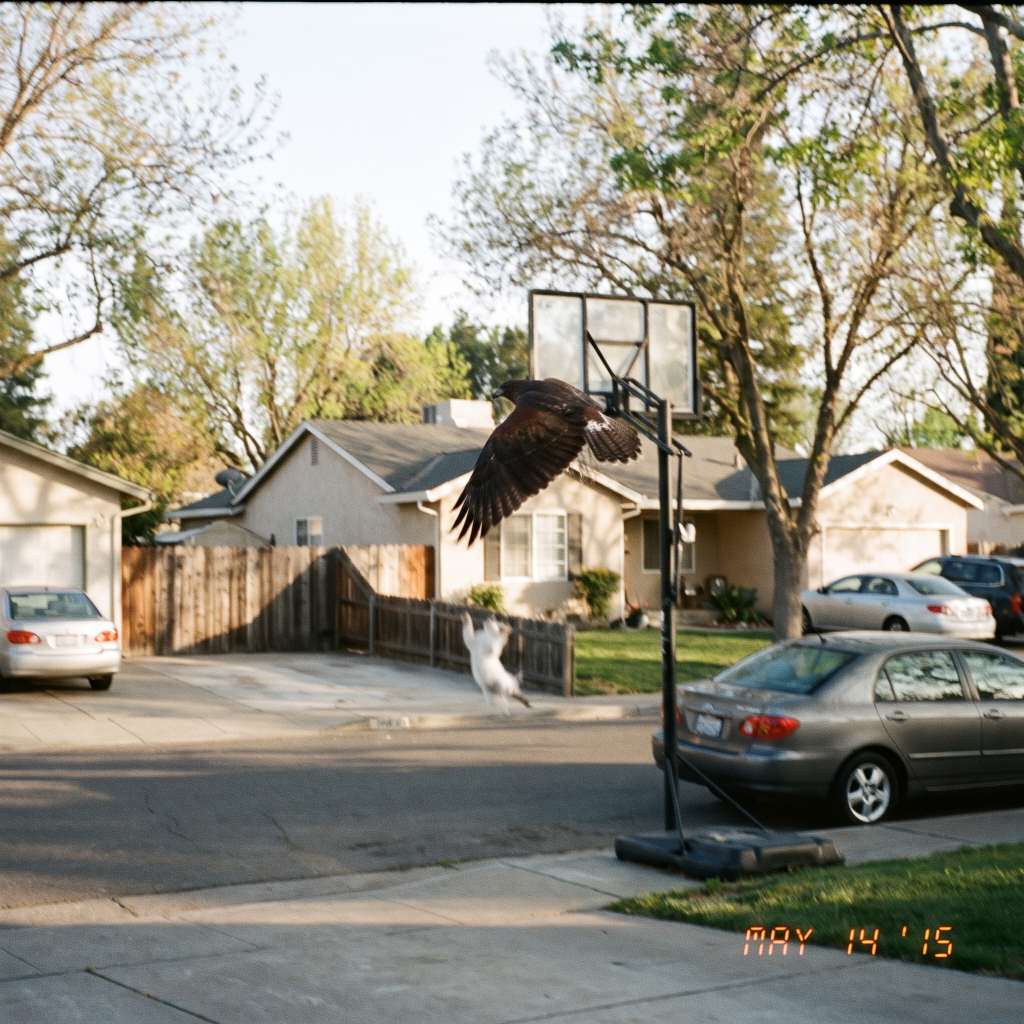
In May 2015, a California mother and her six-year-old daughter were getting into their car for a grocery run when they watched a large hawk take off from a neighbor's basketball hoop clutching a tiny white kitten.
Seconds later, as the hawk flew down the Jurupa Valley street, it lost its grip. The five-week-old kitten tumbled roughly fifteen feet through the air and landed on the ground below.
Lindsey Gage, who witnessed the flight from Mountain Shadow Drive, turned her car around and rushed to the spot where a neighbor working outside pointed her. She found the kitten frightened and meowing but miraculously alive, and immediately transported her to the Western Riverside County/City Animal Shelter.
The kitten, later nicknamed "Kittyhawk," was treated for a puncture wound to her chest. After being transferred to a local rescue group for foster care, she was eventually adopted.
While the midair drop made headlines, the incident highlights a very real, year-round hazard for small pets. Hawks, owls, and eagles are opportunistic hunters, and to a large raptor, a five-week-old kitten or a toy-breed dog looks no different than a rabbit, squirrel, or wild rodent.
In suburban areas, conflicts often occur because human landscapes offer easy vantage points. Basketball hoops, utility poles, and fences make excellent hunting perches for birds of prey, placing them directly above backyard spaces where small pets roam.
While raptors are occasionally blamed for snatching larger animals, most species are physically limited in what they can carry. The red-tailed hawk, the most common large hawk in North America, weighs only about two to three pounds and rarely attempts to fly off with anything heavier than its own body weight. Anything over that limit, like a larger cat or a small dog, is difficult for the bird to lift, which often leads to the predator dropping its catch mid-flight, just as the Jurupa Valley hawk did with the five-week-old, half-pound kitten.
Wildlife biologists and animal behaviorists emphasize that visual supervision is the only reliable way to protect small pets from aerial predators. Large birds of prey are highly wary of humans and will almost never attempt a strike if an adult is standing nearby.
Image is for illustration purposes only
Source: Riverside County Department of Animal Services (2015 stories) / Los Angeles Times (May 2015) / Associated Press (May 2015)