
In March 2009, marathon swimmer Mike Spalding became the first live human ever documented with a cookiecutter shark bite.
On March 16, 2009, Spalding was attempting a nighttime crossing of the Alenuihaha Channel between Hawaiʻi Island and Maui, swimming over open ocean more than 2,000 feet deep. Out in the dark water, he was bitten on the chest and then again on the left calf, leaving a clean, circular wound where a plug of flesh had been removed.
For a full decade, Spalding's injury stood as a medical oddity. Then, between March and July 2019, trauma doctors at The Queen's Medical Center in Honolulu documented three more nighttime long-distance swimmers arriving with identical cookiecutter shark bites.
All three had been attempting to cross the Kaʻiwi Channel between Oʻahu and Molokaʻi over water deeper than 2,000 feet. Their circular wounds measured between three and five inches across, penetrating deep into the tissue, and two of the three swimmers required surgical repair.
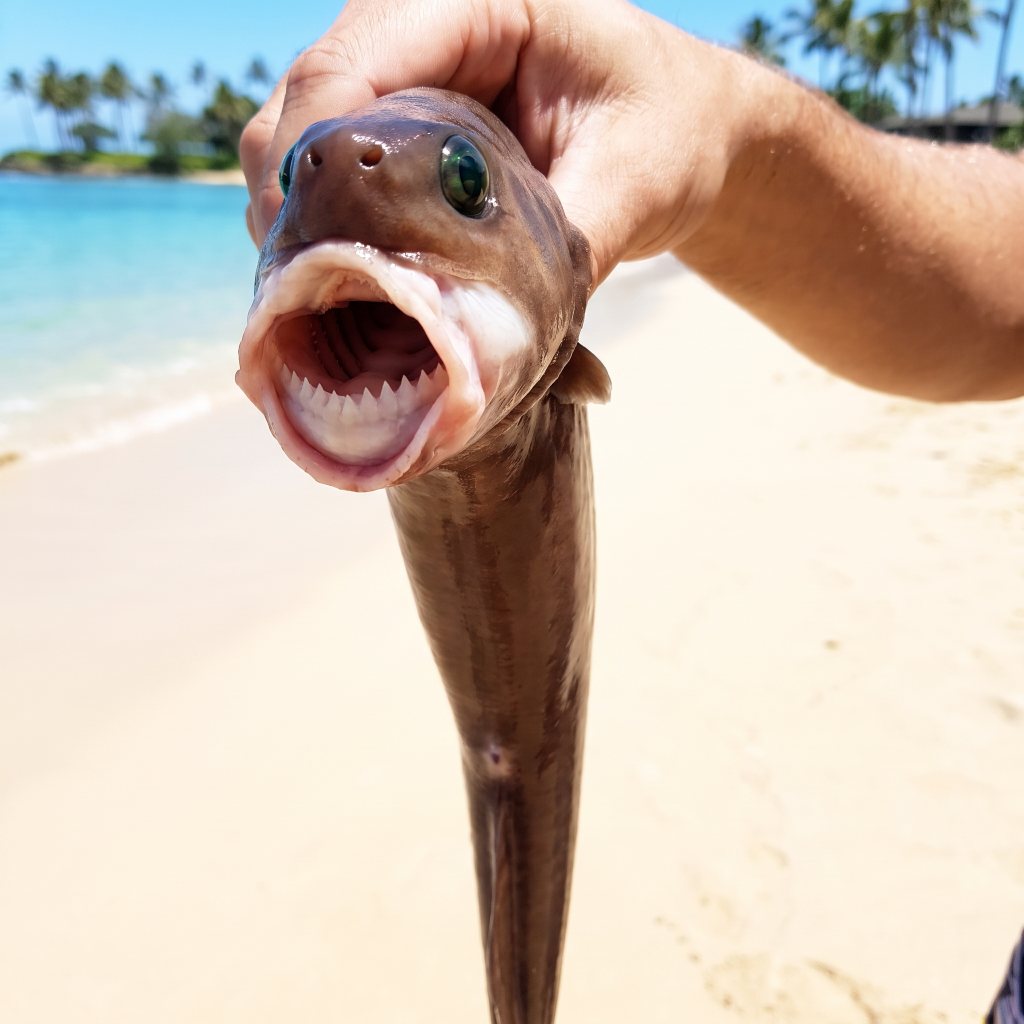
The animal responsible rarely grows longer than 20 inches. The cookiecutter shark (Isistius brasiliensis) is a small, cigar-shaped deepwater shark found in warm oceans around the globe. Rather than killing its prey outright, it feeds like a parasite, carving neat plugs of meat out of whales, dolphins, seals, tuna, and even much larger sharks.
Its mouth is specialized for that exact cut. Thick, fleshy lips create a suction seal against the skin of a passing target. Narrow upper teeth anchor the jaw in place while a single band of wide, razor-sharp lower teeth slices through the flesh as the shark twists its body in a tight circle, popping out a round core of tissue before swimming off.
Most beachgoers never encounter one because of where and when the shark hunts. During daylight hours, cookiecutter sharks remain far down in the dark depths, often thousands of feet below the surface.
After sunset, they make a vertical migration toward the surface to feed alongside deepwater squid and fish. That schedule normally keeps them miles offshore and completely out of reach of ordinary swimmers.
Hawaiian channel crossings change that equation. Marathon swimmers routinely launch in the evening and swim straight through the night to avoid blistering sun exposure and strong daytime winds. In doing so, they place themselves directly over deep open-ocean water at the exact hours cookiecutter sharks rise to feed.
Emergency physicians who reviewed the 2019 Kaʻiwi Channel cases noted that the biggest danger is not the size of the shark, which poses little threat of pulling a swimmer under, but bleeding and distance. With wounds occurring miles from shore, transport times to the Honolulu trauma center averaged more than an hour, making immediate hemorrhage control on the escort boat critical.
Even with those documented cases, a cookiecutter shark bite remains one of the rarest wildlife encounters on Earth. You have to leave the coastline behind, swim out over a half-mile of black water after dark, and cross paths with a 20-inch deepwater predator rising from the depths for dinner.
Image is for illustration purposes only
Source: Hawaiʻi Division of Aquatic Resources Shark Incidents List / Honebrink, R., et al. (2011), Pacific Science / Scala, V.A., et al. (2021), Hawaiʻi Journal of Health & Social Welfare