
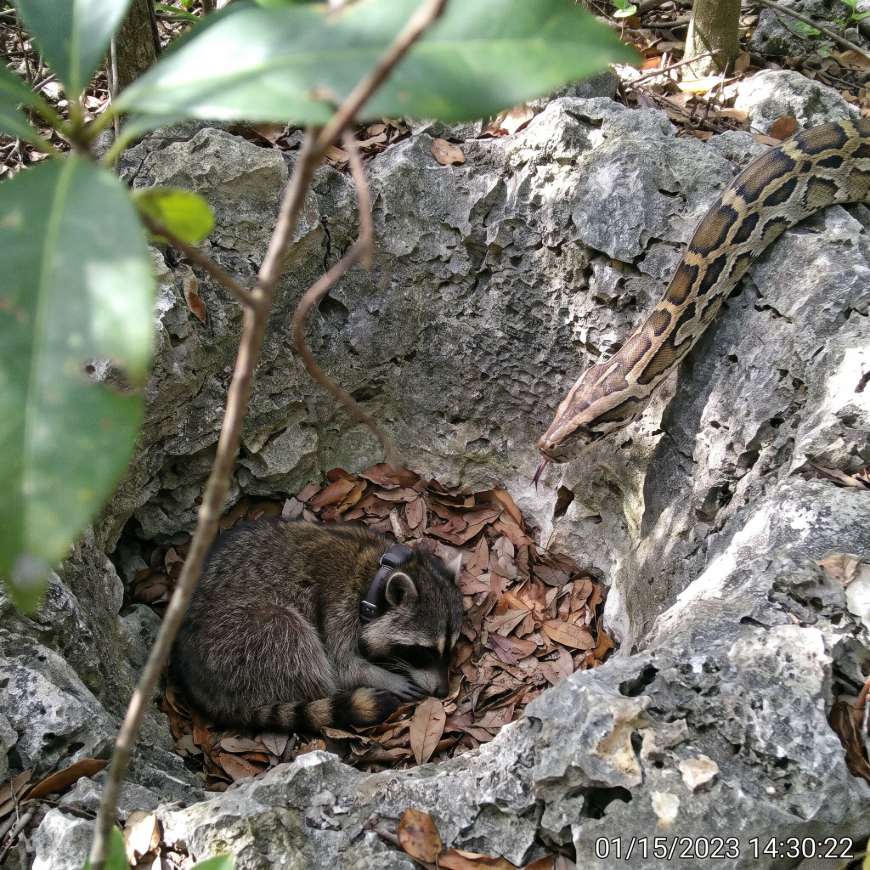
Researchers on Key Largo, Florida, fitted raccoons and opossums with GPS collars to study how they move around people. In January 2023, one raccoon's collar started moving again from inside a python.
The study began in April 2022, funded by the U.S. Fish and Wildlife Service, with partners from Southern Illinois University and the North Carolina Museum of Natural Sciences. The team collared dozens of raccoons and opossums along the edge of Crocodile Lake National Wildlife Refuge, where wild hammock forest meets neighborhoods. The goal was to see how human activity changes where the animals go. Pythons weren't part of the plan.
Burmese pythons, native to Southeast Asia, most likely got loose in the Everglades through the exotic pet trade in the 1990s. They now breed as far south as Key Largo. On the mainland, they have eaten so many mammals that Michael Cove, curator of mammals at the North Carolina Museum of Natural Sciences, said the Everglades no longer have any left to put collars on.
In mid-September, about five months into the study, one opossum's collar sent a mortality signal, the alert it gives when an animal stops moving. A car or a dog seemed the likely cause. Then, hours later, the collar started moving again. Cove called that the signature signal of an animal eaten by a snake. The python had swallowed the opossum whole and lay still while it digested, then crawled off with the collar inside it.
That snake went underground, and for weeks the team couldn't reach it. On November 1, a technician finally spotted it, and four people pulled the 12-foot, 66-pound female out of the ground by her tail. After she was euthanized, an X-ray showed the collar inside her. She was full of egg follicles. Large females like her can lay close to 100 eggs.
The raccoon's collar went quiet in January 2023, then started moving again in the same pattern. This time the team found the snake faster. On January 30, four people fought for hours to get control of a 77-pound female Burmese python. After euthanizing her, they recovered the raccoon's collar from inside her body. She, too, was full of egg follicles.
The method doesn't always work. In February, a third collar sent the same signal. By the time the team reached it, the collar was lying in a pile of python droppings, and the snake was gone. Cove said missing that giant snake was crushing.
Of the 43 collars the team put out, three were confirmed swallowed by pythons. Six more disappeared, possibly carried off inside pythons that moved out of the study area.
Image is for illustration purposes only
Source: The Washington Post (February 2023) / WLRN (February 2023) / Southern Illinois University (January 2023) / Live Science (February 2023)