
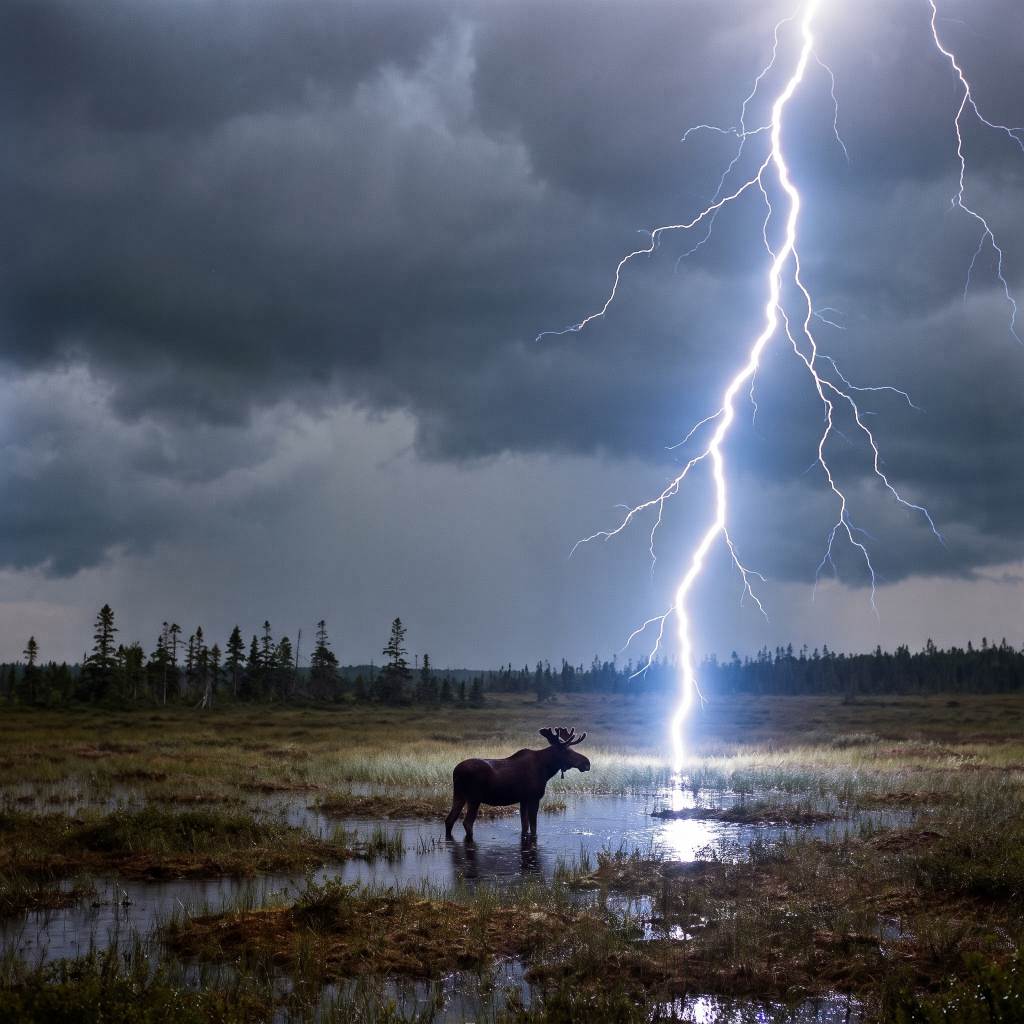
In the summer of 1988, Maine wildlife biologist Ron Joseph scanned West Shirley Bog through binoculars and spotted a dead bull moose lying in the wetland. Up close, the carcass showed badly singed fur and what he identified as entry and exit wounds, leading Joseph to conclude that lightning had killed the animal.
Joseph already knew that bull. About a month earlier, on July 5, 1988, he had paddled his canoe up to two bull moose feeding together in a clear stream at West Shirley Bog. Instead of merely dipping their muzzles beneath the surface, both bulls submerged completely and walked along the streambed.
Watching a thousand-pound ungulate disappear under water surprises most people, yet it is routine summer behavior for moose across the northern woods. Moose can seal their nostrils shut underwater and stay submerged to pull up rooted aquatic plants like pondweed and water lilies. Those plants carry high levels of sodium, a critical mineral that is scarce in the woody twigs and bark moose survive on all winter. Shallow streams and bogs also give them relief from summer heat and clouds of biting flies.
When Joseph returned to the bog roughly a month later, he could locate only one of the bulls alive. He beached his canoe to sweep the open wetland with his binoculars and found the second bull dead. His published field notes in the Morning Sentinel document a firsthand assessment of the carcass rather than a witnessed strike or a formal necropsy, yet the singed hide and wounds pointed directly toward a summer storm.
Open wetlands like West Shirley Bog are prime feeding grounds in midsummer, and they are also one of the worst places a large animal can stand when thunderheads build. Unlike deer that slip quickly into dense timber, a bull moose feeding in a flat, treeless peat bog stands six feet tall at the shoulder with wet hide rising above the surrounding sedge and brush.
A moose does not even have to take a direct bolt to be killed. When lightning hits wet ground or shallow water, electrical current radiates outward across the surface. Because a moose stands with its front and hind hooves spaced several feet apart, that ground current creates a sharp voltage difference between its legs, sending electricity straight across its chest and heart. Biologists and physicists refer to this hazard as step potential, and it accounts for most lightning fatalities documented in large four-legged animals like elk, caribou, and moose.
Because remote bogs rarely have witnesses during a severe thunderstorm, lightning deaths in wild herds usually go unrecorded unless someone happens to find the carcass before scavengers erase the evidence. Joseph's return trip in 1988 offered a rare look at that quiet hazard.
The same open water that gives a Maine moose the minerals it needs to survive the coming winter leaves it completely exposed when the sky turns dark.
Image is for illustration purposes only
Source: Ron Joseph, Morning Sentinel / Maine Department of Environmental Protection (West Shirley Bog record)