
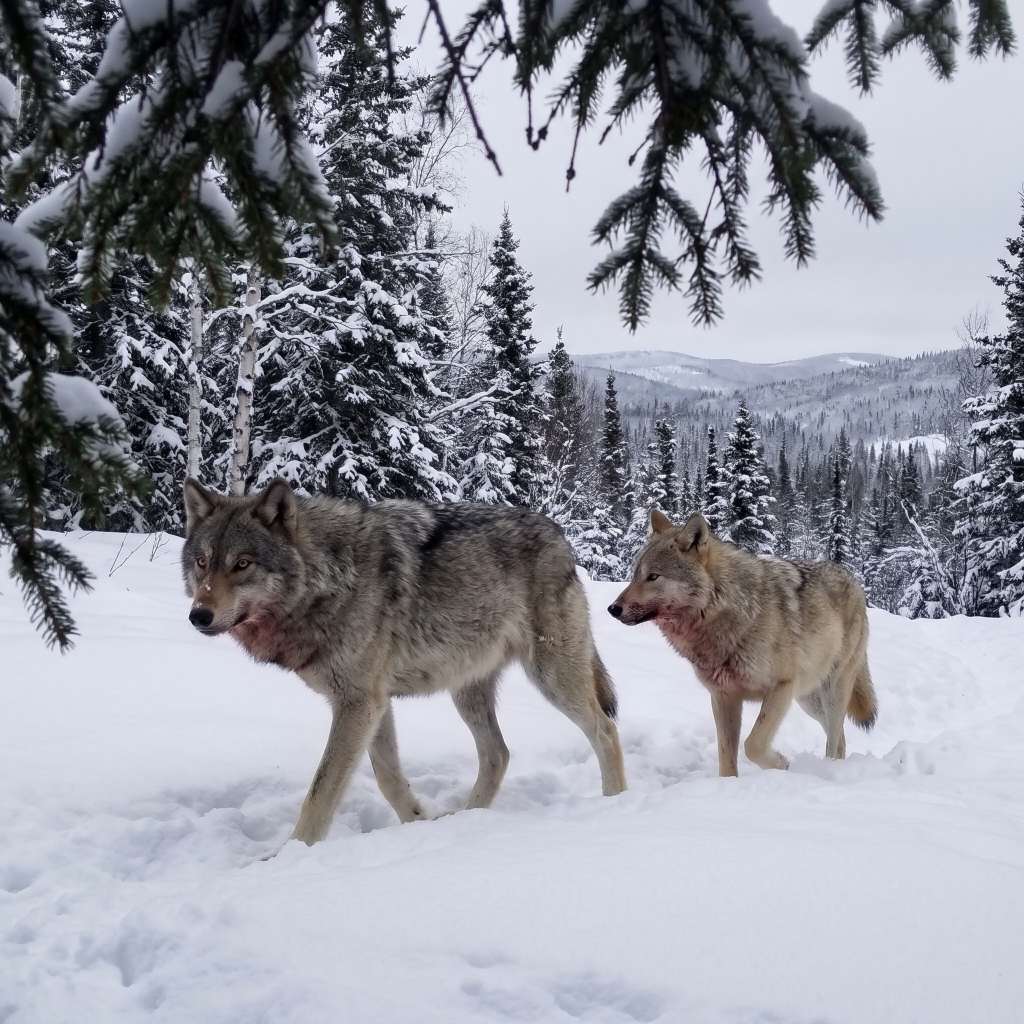
When a wildlife biologist hears someone claim they weighed a 175-pound wolf, the first question is rarely where the animal was caught. It is what the wolf ate right before it hit the scale.
That question sits right behind North America's best-supported historical record. On July 12, 1939, longtime Alaska trapper Frank Glaser collected a 175-pound male along the Seventymile River near Eagle, in the Fortymile country. Federal biologist Stanley Young published the weight in 1944, and wolf researcher L. David Mech later cited it as the probable continental record.
Nearly sixty years later, state wildlife biologist Craig Gardner captured the breeding male of a 16-wolf pack in that exact same Fortymile country. Gardner called the animal enormous. When his crew hoisted the wolf onto the scale, it weighed 140 pounds on an empty stomach.
Put those two numbers side by side and a strange problem shows up. Nobody knows which wolf was actually the larger animal.
Because wild packs live on a feast-or-famine cycle, a hungry gray wolf can pack 15 to 20 percent of its own body weight into its stomach in one sitting. For a big northern male, that means roughly 20 pounds of moose or caribou swallowed at once.
Weigh a wolf straight off a carcass, and you are really weighing two animals at the same time. Alaska Fish and Game notes that Glaser's 1939 male had a belly full of meat, and nobody weighed the stomach contents before recording that 175-pound figure. Canada's most famous historical claim carries the same catch, a 172-pound male reported from the Northwest Territories in 1947 that also had a full stomach.
Modern field captures in Alaska show how routine that difference is. In 2001, National Park Service biologist John Burch captured a 148-pound male near Yukon-Charley Rivers National Preserve, right on the edge of the Fortymile country. A female caught alongside him weighed 110 pounds, and both had just been feeding on a moose kill.
Outside those rare giants, wild wolves weigh far less than most people assume. Across Alaska and Yellowstone, adult males average around 100 to 110 pounds, while adult females average about 90.
For a clean, modern empty-stomach benchmark, the National Park Service points to Yellowstone National Park. The heaviest wolf ever documented there was wolf 760M, a male from the Yellowstone Delta pack. When biologists weighed him, the scale stopped at 148 pounds with no food in his stomach at all.
Add a 20-pound meal to a wolf like 760M, and you are suddenly staring right at the old frontier record books.
Image is for illustration purposes only
Source: Alaska Department of Fish and Game / National Park Service (Yellowstone Wolf Facts) / Stanley P. Young (1944), The Wolves of North America / L. David Mech (1966), The Wolves of Isle Royale