
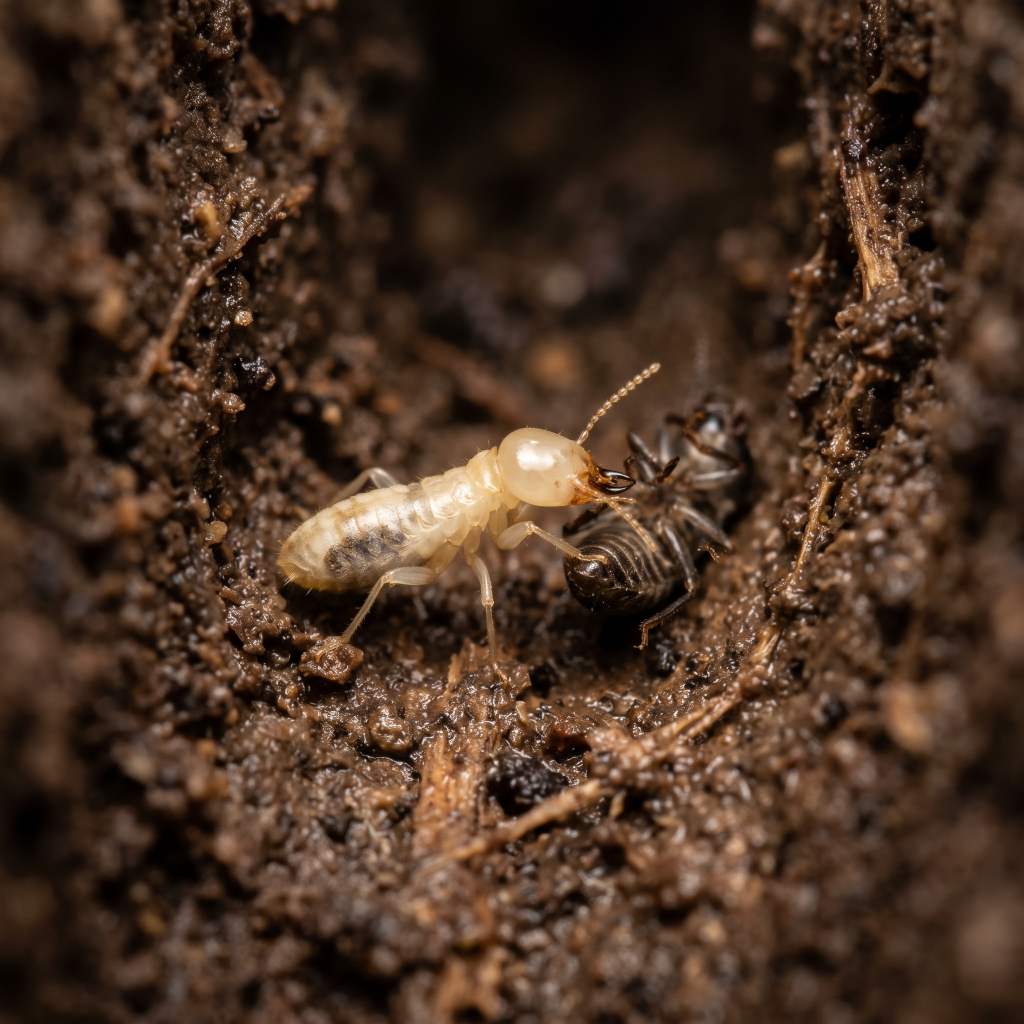
In a 2013 University of Kentucky study, eastern subterranean termite workers carried dead members of their own species straight into the nest, yet buried dead rivals on the spot under armed guard.
Entomologists led by Qian Sun tested colonies of eastern subterranean termites by placing groups of 10 dead termites right outside a nest entrance. They ran trials with dead nestmates and with dead outsiders from a completely separate colony of the same species. In other trials, they set down corpses of a closely related competitor, the dark southern subterranean termite.
When the dead termites were their own species, the response was quiet and routine. A worker walked out and tapped a corpse with its antennae, then gripped it with its mandibles to drag it back inside.
Even dead outsiders from another colony received the same treatment, with almost no soldier aggression. Because a wood-based diet is poor in nitrogen, colonies recycle freshly dead members of their own species through cannibalism before decay sets in.
Everything changed when researchers placed corpses of the competing species outside the entrance. Workers that touched the rival bodies quickly backed into the nest and stayed out of sight until soldiers arrived.
A soldier inspected the pile with its antennae and immediately bit at the dead rivals with open mandibles. Agitated termites then set off alarm signals by vibrating their bodies and rushing back toward the opening, pulling a heavy defensive force into the arena.
In a wild colony, soldiers normally make up only 4 to 5 percent of the population. During the rival-corpse trials, soldiers accounted for roughly 40 percent of the termites outside the nest, and the burial effort drew ten times as many termites as retrieving their own dead.
While a ring of soldiers surrounded the pile and stood guard, workers hauled in soil particles to seal the bodies away. Within 12 hours, all 10 rival corpses were entombed under a compact, moist mound of mud.
Termites tell species apart through waxy chemical signatures on the exoskeleton that linger after death. To an eastern subterranean termite, a dead member of its own kind is recoverable protein, while a dead competitor is a warning of nearby invaders and foreign pathogens that has to be walled off where it lies.
Source: Sun, Q., Haynes, K. F., and Zhou, X. (2013), Scientific Reports / University of Kentucky