
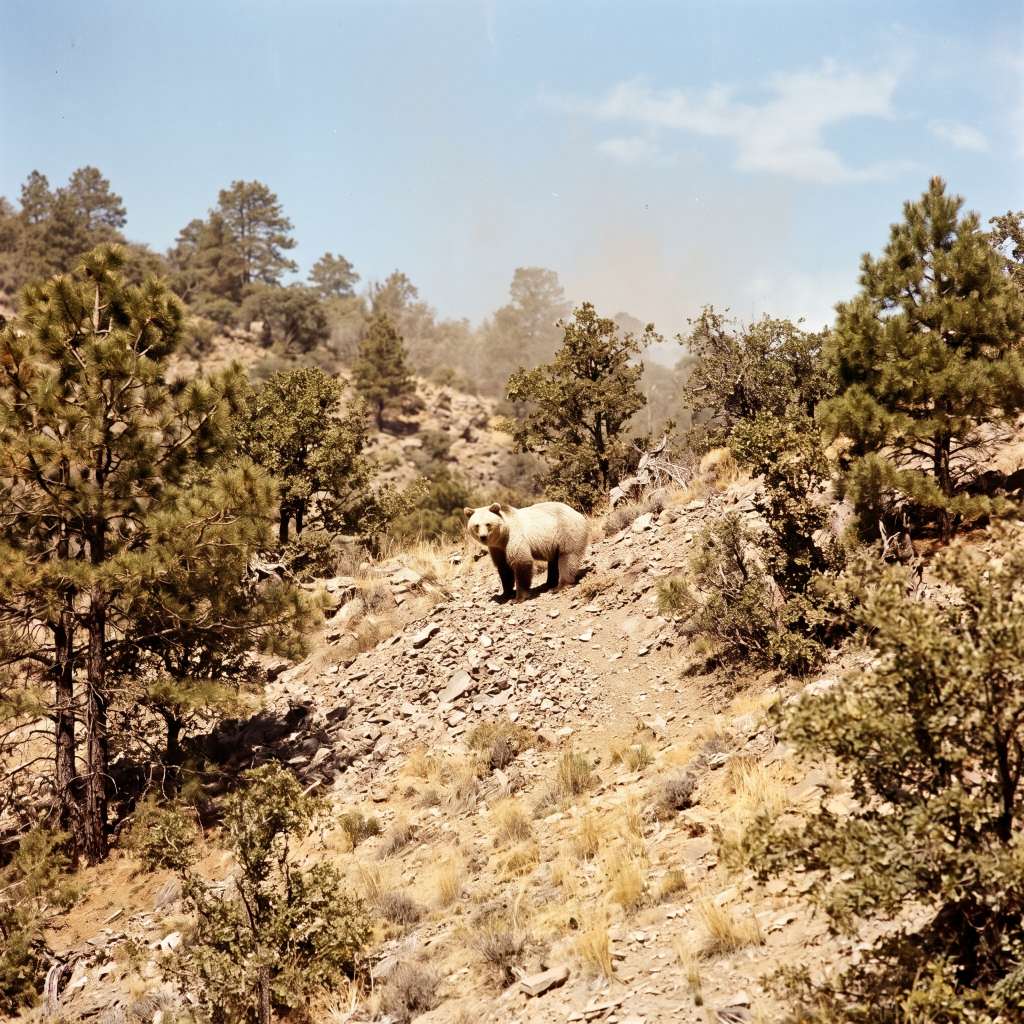
In May 2005, a rancher in Sonora, Mexico, handed biologists a bear skull that had been sitting in storage at Rancho Los Tubos for nearly 30 years. Local ranchers had always assumed it belonged to a black bear, shot in 1976 while feeding on a mountain lion kill in the pine-oak woodlands of the Sierra de La Madera.
When researchers measured the skull and sent photographs to grizzly experts Doug Peacock and Lance Craighead, the identification flipped. The bone belonged to a juvenile grizzly bear. That meant at least one grizzly had survived in northern Mexico more than a decade after the population was widely declared extinct.
For most people today, grizzly bears belong to Alaska and the northern Rockies. Historically, they ranged across the American Southwest and deep into northern Mexico. Locals in Mexico called them el oso plateado, the silver bear, for their pale, yellowish-white coats grizzled over darker underfur.
Naturalist C. Hart Merriam formally classified the southern bears as a distinct subspecies in 1914, basing his description on a specimen shot near Colonia García, Chihuahua, in 1899. Modern genetic work places them within the same maternal lineage as other mainland North American grizzlies, adapted to hotter, drier country where they lived on roots, ants, fruit, small mammals, and carrion.
North of the border, ranching and predator control wiped them out first. The last confirmed grizzly in Texas was killed in the Davis Mountains in October 1890 after preying on a cow near Limpia Creek, and it took four men to hoist the hide onto a horse. According to U.S. Fish and Wildlife Service records, the last reported grizzlies vanished from New Mexico in 1933 and from Arizona in 1935.
South of the border, the bears held out for another generation. By the late 1950s, their range had contracted to a few isolated mountain blocks about 50 miles north of Chihuahua City, centered on the Sierra del Nido. Biologist A. Starker Leopold documented that last stronghold in his 1959 book Wildlife of Mexico, and by 1960 estimates put the remaining population at roughly 30 animals.
Then two pressures hit the Sierra del Nido at once. Severe droughts cut into wild food and water while large properties were broken into smaller cattle ranches, pushing hungry bears into closer contact with livestock.
Around the same time, U.S. Fish and Wildlife Service advisors and Pan American health officials trained Mexican ranchers and veterinarians to use Compound 1080, or sodium fluoroacetate. The poison was officially placed in laced carcasses to wipe out wolves under rabies-control campaigns. Grizzlies scavenge readily, and they took the poisoned bait right alongside the wolves.
Despite nominal legal protection, shooting and poisoning collapsed the Chihuahua holdout within a few years. The last confirmed sighting in the Sierra del Nido was logged in 1962.
In 1968, rumors of surviving bears surfaced near the headwaters of the Yaqui River in Sonora. American biologist Carl B. Koford spent three months searching the area and came back empty-handed, publishing his findings the next year under the blunt title The Last of the Mexican Grizzly Bear.
That report stood as the final word until the 1976 Rancho Los Tubos skull surfaced decades later. Researchers could not extract usable DNA from the dried tissue still clinging to the bone, leaving the finding anchored in skull anatomy alone. Even the authors of the 2008 paper concluded that the odds of a breeding population still hiding in northern Mexico were slim.
Occasional unverified reports still drift out of the Sierra Madre, where black bears are easily mistaken for grizzlies at a distance. Without fresh physical evidence, the silver bear of the borderlands remains a museum specimen.
Image is for illustration purposes only
Source: Gallo-Reynoso et al. (2008), The Southwestern Naturalist / Carl B. Koford (1969), IUCN Bulletin / A. Starker Leopold (1959), Wildlife of Mexico / U.S. Fish and Wildlife Service / C. Hart Merriam (1914)