
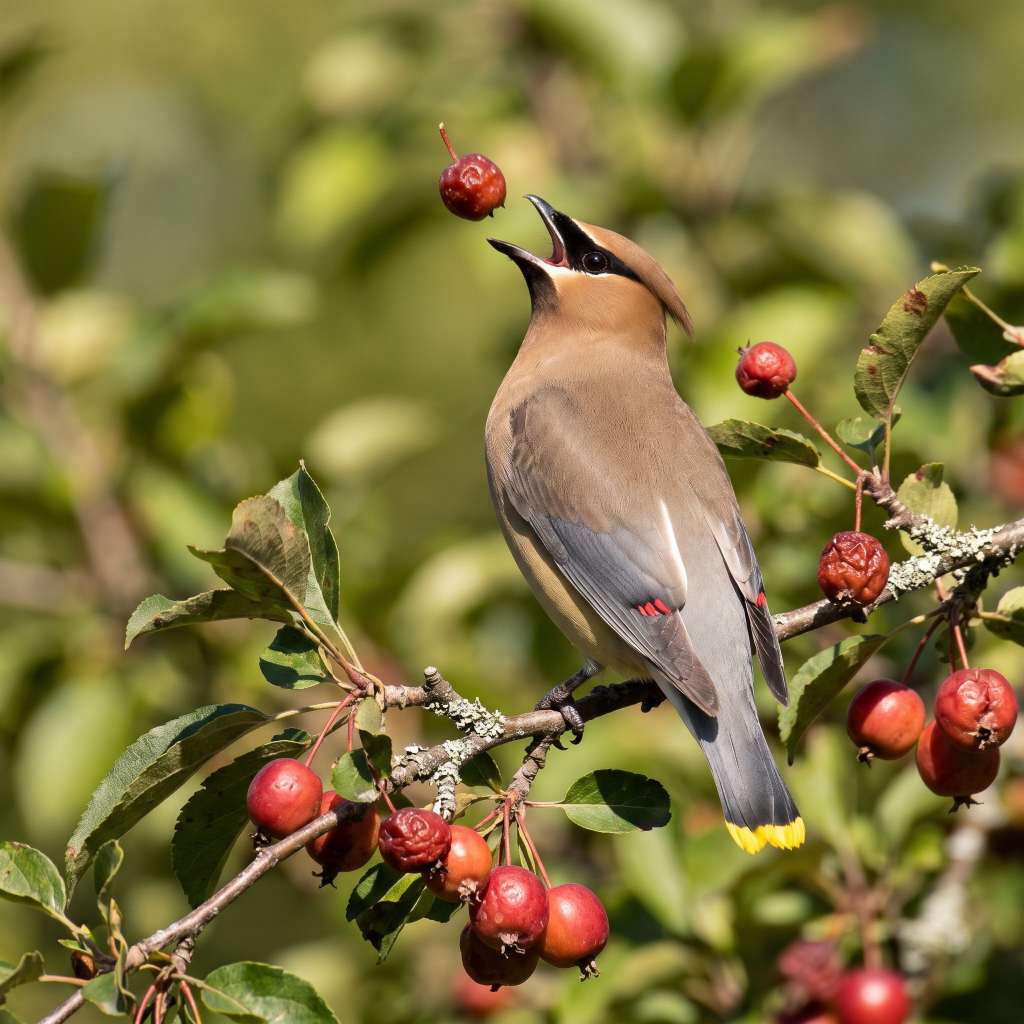
Cedar waxwings are built to handle more alcohol than most North American songbirds. They carry unusually large livers relative to their body size, which allows them to break down ethanol rapidly. Even with that biological buffer, a heavy binge on overripe hawthorn or crabapple berries can push a bird past its limit and leave it disoriented on the ground.
In October 2018, residents in Gilbert, Minnesota, began calling the police department about birds acting strangely across town. Flocks were stumbling on lawns and flying straight into windows and moving cars. Police Chief Ty Techar eventually put out a public notice explaining the cause: an early frost had fermented local berries ahead of schedule, leaving cedar waxwings and robins visibly intoxicated.
Most North American songbirds shift to seeds or insects when cold weather sets in, so they rarely encounter fermented fruit in bulk. Cedar waxwings are an exception. They can survive almost entirely on fruit for months at a time, roaming in tight flocks that drop into a crabapple or hawthorn tree and strip it bare in under an hour.
When berries cling to branches through late autumn and winter, repeated freeze-thaw cycles break down their cell walls. Wild yeast converts the fruit sugars into ethanol. Because waxwings swallow berries whole and feed quickly, a single stop can deliver a heavy dose in minutes.
Biologists have studied how waxwings handle that chemistry for decades. In a 1982 study published in Ornis Fennica, Finnish researchers Kalervo Eriksson and Hannu Nummi tested the cedar waxwing's close cousin, the Bohemian waxwing, alongside European starlings and greenfinches. They found that waxwings carry livers making up roughly four to five percent of their total body weight, allowing them to clear ethanol far faster than other songbirds.
Even with that biological advantage, the system still gets overwhelmed. In 1990, veterinary pathologists Scott Fitzgerald, John Sullivan, and Richard Everson published a report in Avian Diseases after examining wild cedar waxwings that had been gorging on fermented hawthorn fruit. Toxicology tests confirmed ethanol in both their crops and liver tissue.
The necropsies also showed that the alcohol itself rarely killed the birds outright. Instead, they died from internal bleeding and blunt-force trauma after losing coordination in flight and slamming into windows or hard surfaces.
Younger birds often take the worst of it, since their livers process ethanol less efficiently than mature adults. If a disoriented waxwing avoids midair collisions and neighborhood cats, the impairment is usually short-lived.
Wildlife rehabilitators note that stunned birds typically sit fluffed up and quiet on the ground or a low branch while their livers work through the alcohol. In Gilbert, Techar advised residents there was no need to call the police, noting the birds would sober up on their own within a short time.
Once the stupor clears, the flock rarely lingers. The birds lift off together with thin, high-pitched whistles and bank over the treeline, already scanning the next street for another loaded fruit tree.
Source: Avian Diseases (Fitzgerald, Sullivan, and Everson, 1990) / Ornis Fennica (Eriksson and Nummi, 1982) / Gilbert Police Department (2018) / Cornell Lab of Ornithology