
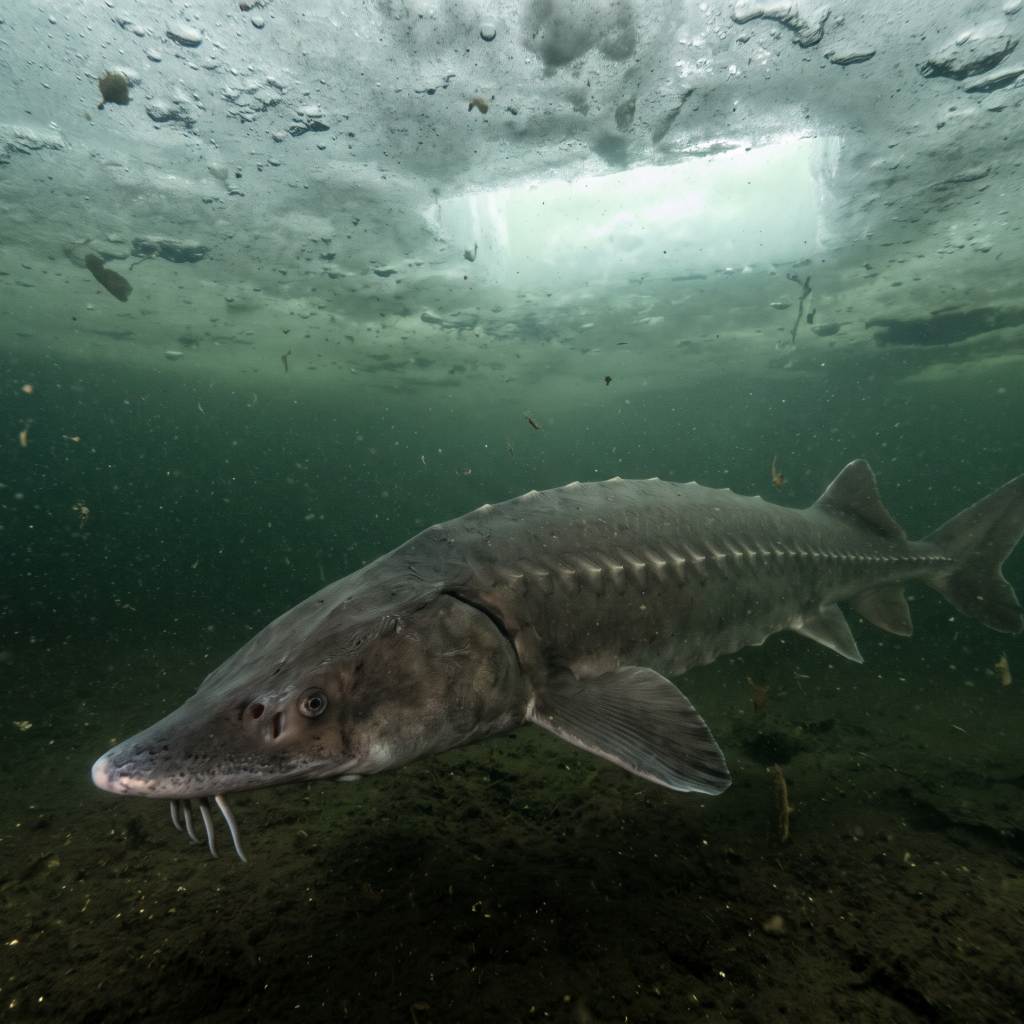
On February 9, 2019, less than two hours into Wisconsin's sturgeon spearing season, a massive shadow slid beneath an ice shanty on Lake Winnebago. Jon Eiden, 34, had speared this lake alongside his father, John, since high school.
When Jon threw the spear and the two men hauled the fish up through the ice hole, her tail stuck out one side of the opening and her head out the other. Getting her out of the cramped shack sent the chairs and the heater flying across the floor. They had no idea yet which fish they had just pulled from the lake.
Biologists had first met her 15 years earlier. In the spring of 2004, a Wisconsin Department of Natural Resources spawning crew netted a huge female below the Shawano Paper Mill Dam on the Wolf River. Built in 1892, the dam blocked the sturgeon's ancestral spawning run farther upriver, so the turbulent water at its base was as far as she could travel.
The crew laid her on the measuring board and she reached the very end at 84 inches. They attached an identification tag and released her back into the current.
Eight years later, in the spring of 2012, the same DNR crew netted her again at the exact same dam. She now measured 87.5 inches, making her the longest lake sturgeon biologists had ever handled in the system's spring surveys.
She was heavy with eggs, and because spring survey crews never put spawning fish on a scale, the famous 240-pound figure that made headlines was an estimate based on length-to-weight data rather than an actual weighing. Retired DNR biologist Ron Bruch estimated she was 125 years old.
After the 2012 recapture, spearers across Lake Winnebago knew she was out there, and some began calling her Stella. The DNR's own report described her as the poster child for the record-sized fish swimming in the system. Every February for seven straight winters, thousands of people sat over dark holes in the ice hoping she would pass beneath their shanty.
When the Eidens brought their catch to the registration station at Wendt's on the Lake in Van Dyne, the tag confirmed her identity. She measured 85.5 inches and weighed 171.0 pounds, making her the longest sturgeon ever registered on the Winnebago System and missing the top-11 heaviest list by just 0.3 pounds.
The 69-pound gap between her actual weight and the 2012 estimate came down to two things: the earlier number was a guess for a fish packed with eggs, and sturgeon condition tracks gizzard shad, their main winter prey. Strong shad years in 2009 and 2010 came before her 2012 capture, while weak ones in 2017 and 2018 came before 2019. DNR biologists noted she could easily have weighed 60 to 70 pounds more after better shad years. Her body was a direct record of the lake's food supply.
Her true age remains unknown. While Bruch estimated 125, the DNR's chief sturgeon biologist, Margaret Stadig, said she was at least 80 to 90 years old, and possibly close to 100. Fisheries scientists normally age sturgeon by reading growth rings on a fin ray, but that method is only reliable up to about age 14 before it begins to undercount. For a fish of her size, no bone can give a certain answer.
DNR biologist Ryan Koenigs admitted it felt "almost a little bit sad," knowing how long spearers had waited for her and how close she had been to a state record. Eiden viewed taking her as bittersweet, though he saw it as part of the lake's conservation system. That winter, Lake Winnebago held an estimated 18,400 adult females protected by strict harvest caps. As Koenigs put it, "I don't think that fish is alone."
Image is for illustration purposes only
Source: Wisconsin Department of Natural Resources (2019 Winnebago System Lake Sturgeon Harvest Assessment) / Fox 11 / Country Today / Patrick Durkin