
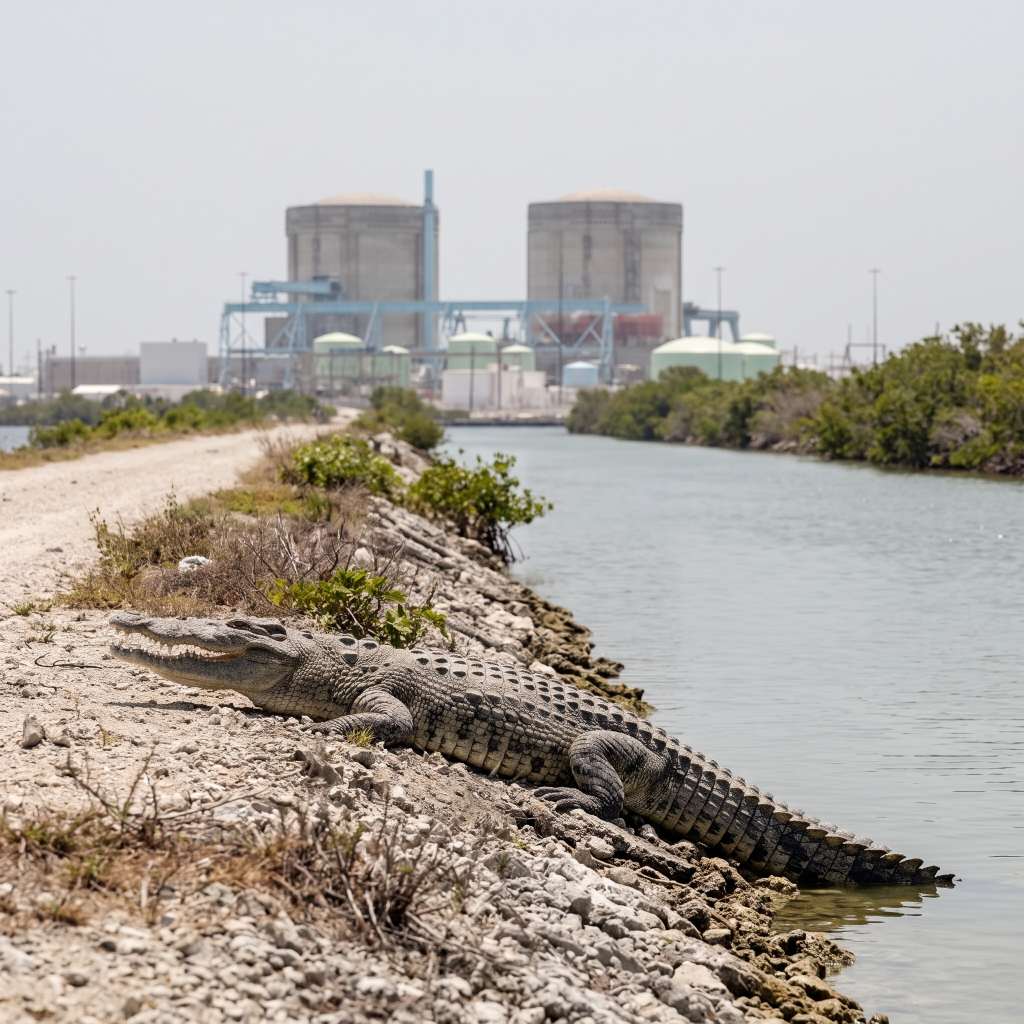
In the summer of 2014, water inside the cooling canals at Florida's Turkey Point nuclear plant approached 104°F. A cyanobacteria bloom had turned the 168-mile grid into green soup, and Florida Power and Light was asking federal regulators for permission to run the reactors hotter just to keep them online.
Out along the limestone berms, the utility's crocodile biologists were counting nests and finding almost none. Between 2013 and 2015, canal temperatures swung from roughly 75°F to 113°F (24 to 45°C) while salinity climbed well past seawater. Nest counts that had held at 20 to 25 a year fell to about six, and the crocodiles still using the site were losing body condition.
The colony had taken hold there by court order four decades earlier. In 1970, the federal government sued FPL for dumping hot water into Biscayne Bay. A 1971 court order forced the utility to build a closed loop of 168 miles of canals instead, operating from 1972 and 1973 to cool the nuclear units alongside the plant's oil and gas Unit 1.
Biologists spotted the first American crocodile on site in 1976 and found the first nest in 1978. The elevated berms stayed dry above storm tides, and a guarded security fence kept the public out. Rather than removing the reptiles, FPL hired biologists to monitor them. The colony grew productive enough to become a major reason the species was downlisted from endangered to threatened in 2007. FPL estimates 300 to 400 crocodiles live in and around the canals.
By 2013, the closed loop was breaking down. Because the canals are unlined, years of low rainfall reduced fresh groundwater inflow while a power uprate pushed extra heat through the system. Heavy evaporation left the salt behind, pushing salinity above ocean levels and fueling the algae bloom. Adult crocodiles can handle salty water for a stretch, though the heat and declining habitat still wore them down. Hatchlings have no working salt glands at all, so hypersaline water dehydrates them quickly and makes survival nearly impossible.
Fixing the plant's radiator meant fixing the crocodile habitat as well. FPL drilled six wells to pump about 14 million gallons a day of cooler, brackish water from the Floridan aquifer into the canals. The goal was to pull salinity back down to about 34 parts per thousand, matching Biscayne Bay and the canals when they were first built. On the berms, the utility also added rain-fed freshwater nursery ponds so newly hatched crocodiles had low-salinity water right after leaving the nest.
Once water conditions stabilized, nesting rebounded quickly. Biologists recorded 14 successful nests in 2018 and 22 in 2019. In 2021, the site hit a record 565 hatchlings from 27 nests. Production held strong in 2024 with 29 nests and 529 hatchlings. In 2025, the crew tagged more than 600 hatchlings in a single season for the first time, a milestone biologist Mike Lloret's team called "the 600 Club."
Hundreds of hatchlings a year still does not translate into thousands of adults. A 36-year tagging study from 1978 to 2014 marked 7,427 hatchlings at Turkey Point and recaptured 380 of them up to 25 years later. Only about one hatchling in six survives its first year, while adults survive at close to 90 percent annually. Even so, the population grew about 4 percent a year. The study's clearest finding was that extra eggs barely change the growth rate. Keeping the young alive is what counts.
Federal licenses for the Turkey Point reactors now run to 2052 and 2053, giving the canals and the crocodiles decades ahead together. On summer nights, biologists still idle along the dark limestone berms, sweeping headlamps over the canal edge in search of pairs of red eyeshine.
Image is for illustration purposes only
Source: U.S. Fish and Wildlife Service / U.S. Nuclear Regulatory Commission / Florida Power and Light / University of Florida (Briggs-Gonzalez, Mazzotti et al.) / Journal of Animal Ecology