A two-year-old wolf left his pack in northeastern Oregon in September 2011 and walked alone across deserts, lava fields, and interstate highways until he crossed into California, becoming the first wild wolf confirmed in the state in nearly ninety years. Then he kept walking until he found a mate.
His GPS collar designation was OR-7. He was born into the Imnaha Pack in the Wallowa Mountains, one of the first established wolf packs in Oregon since the species was exterminated from the state in the early twentieth century. At two years old, his biology gave him two options. Stay in his natal pack as a subordinate who would never breed, or leave everything and walk into country where no wolves had lived for generations, alone, with no idea what was ahead of him and no pack behind him if anything went wrong.
He left in September and headed south.
What biologists call dispersal sounds clinical on paper. In practice it is the most dangerous phase of a wolf's life. A lone wolf has no cooperative hunting advantage. It cannot take down the large ungulates that sustain a pack. It is limited to rabbits, ground squirrels, scavenging, and whatever small opportunistic kills it can manage by itself. At the same time, it is moving through unfamiliar terrain where every established pack treats a lone trespasser as a direct threat to be driven out or killed. Territorial wolves do not issue warnings to strangers. They chase them down and attack. The mortality rate for dispersing wolves across most studied populations is enormous. Most die within a few hundred miles of home. They are killed by other wolves, hit on highways, shot by ranchers, or they simply run out of fuel in country that cannot feed a solitary predator.
OR-7 walked over four thousand miles.
The GPS collar data told the story in real time. Wildlife biologists with the Oregon Department of Fish and Wildlife watched the signal move south out of the Wallowas and into the high desert of central Oregon. He crossed Interstate 84, a four-lane corridor running heavy truck traffic through the Columbia Plateau. He threaded across Highway 20. Either crossing at the wrong moment would have ended him the same way it ends hundreds of deer and elk every year on those roads. He pushed through the volcanic terrain of the Cascades, picking his way across lava fields and dense old-growth timber that he had never seen before, navigating entirely by instinct through a landscape that contained no wolf scent, no pack territories to read, and no indication that any member of his species had been through there in living memory.
By late December his collar pinged from Siskiyou County, California.
The last confirmed wild wolf in California had been killed in 1924. For eighty-seven years the species existed in the state only as a historical footnote, something that had been here once and was gone. OR-7 did not know that. He was not making history. He was following a biological drive that told him to keep moving until he found unoccupied territory and an unrelated female, and he had not found either one yet, so he kept going.
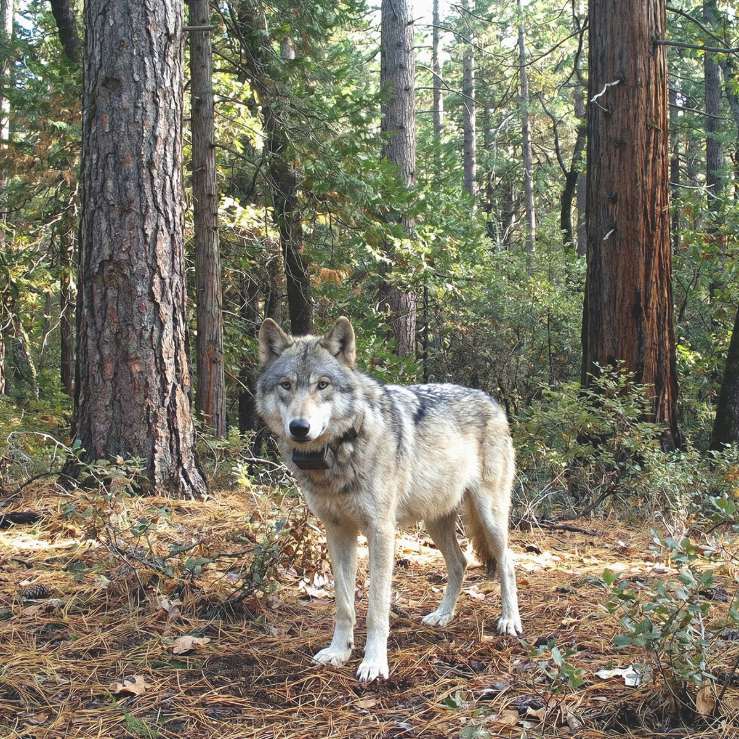
He spent the next two years as a ghost on the Oregon-California border. The GPS data showed an animal in constant motion, looping through the Rogue River drainage, crossing back into Oregon, turning south again into the Siskiyou wilderness, covering staggering distances through human-dominated landscapes without being seen. Ranchers in the region had not dealt with wolves in almost a century. Livestock operations had been built and run for generations under the assumption that the wolf was gone permanently. OR-7 was moving through that landscape like a rumor, occasionally confirmed by a collar ping or a blurry trail camera frame, then disappearing for weeks.
The part that nobody expected was the ending.
In 2014, trail cameras in the Rogue River-Siskiyou National Forest captured images of OR-7 with a black-coated female. Nobody knew where she came from. She wore no collar. She had no designation. But she was there, and she was with him, and within a year the trail cameras confirmed pups. OR-7 had founded the Rogue Pack. The lone disperser who had walked four thousand miles across half of the Pacific Northwest, surviving on his own for over two years in country where his species had been absent for nearly a century, had done the one thing that dispersal is designed to accomplish. He found a mate, established a territory, and bred.
The statistical probability of that outcome was close to zero. A single wolf, dispersing alone through a landscape with no existing wolf population, no potential mates, and active human threats in every direction, finding one unrelated female in thousands of square miles of wilderness and successfully pair-bonding, denning, and raising pups. The biologists who tracked OR-7's collar data from the beginning described it as one of the most improbable successful dispersals ever documented in North American wolf research.
OR-7 did not beat the odds because he was bigger or stronger or faster than other dispersing wolves. He beat them because he did not stop. Every day he woke up alone in unfamiliar country and kept moving south, and then kept moving in circles, and then kept moving in wider circles, and the drive that pushed him out of the Wallowas in September 2011 did not shut off until he had covered enough ground to find the one thing he was looking for.
Source: Oregon Department of Fish and Wildlife / California Department of Fish and Wildlife