
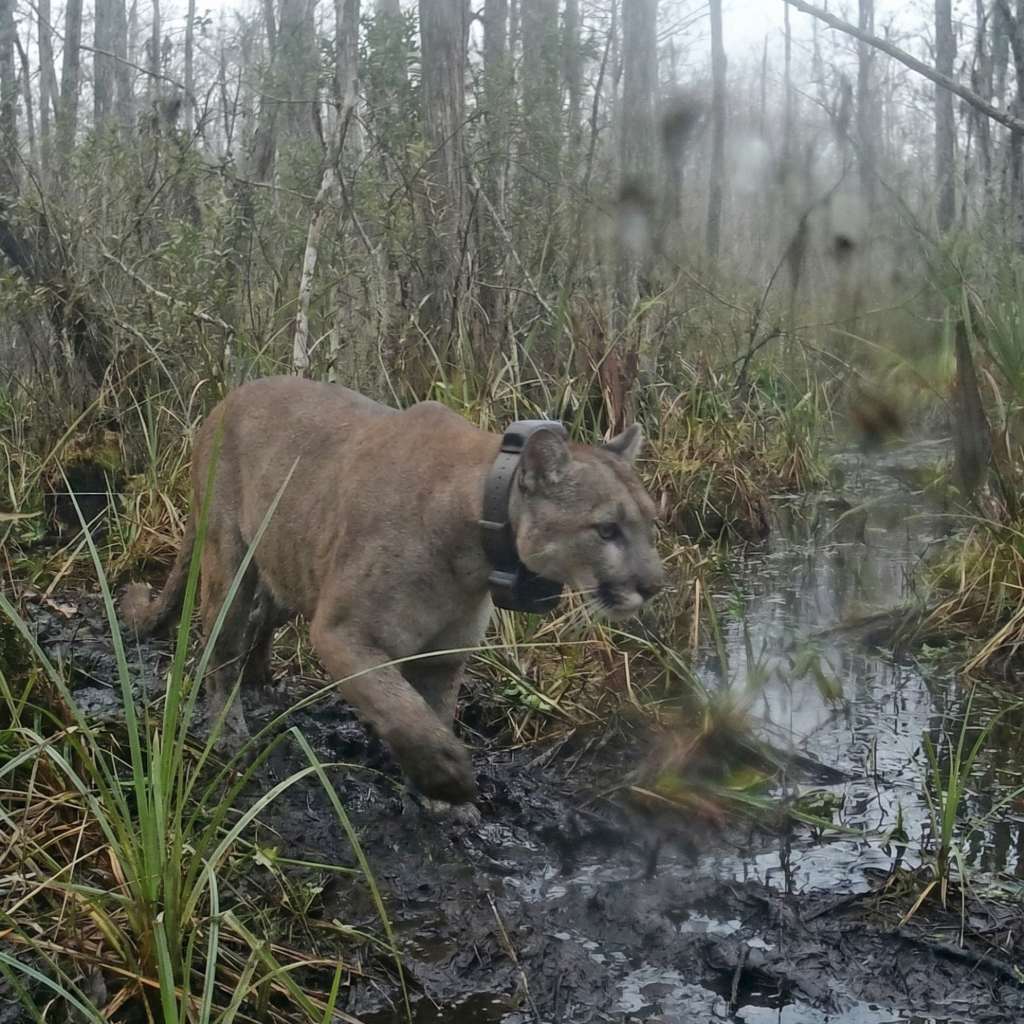
In 1981, the state of Florida sent a houndsman into the worst swamp in the state to find out if the Florida panther still existed. His dogs treed a scarred, tick-covered male deep in the flooded cypress, and that single animal became the reason the species is still alive.
By the late 1970s, nobody with credentials was willing to say with certainty that the Florida panther was still out there. The Fakahatchee Strand in southwest Florida is not a place that lends itself to survey work. It is a flooded corridor of old-growth bald cypress, pond apple, and royal palm running through standing water and knee-deep mud for miles in every direction. The sawgrass will open your skin. The water is shared with alligators and cottonmouths. The ground, where it exists at all, is unstable enough that a man on foot sinks to his thighs with every step. It is one of the last places in the eastern United States where a large predator could disappear completely, and by the early 1980s, that appeared to be exactly what had happened. There had been no verified sighting of a Florida panther in years. The species was sliding toward an official extinction declaration.
Before signing it off, the state made one final attempt. They contacted Roy McBride, a houndsman out of west Texas who had spent decades running cats with dogs across some of the roughest terrain in North America. McBride was not a biologist. He was a tracker. His job was simple. Take his hounds into the Fakahatchee, find a panther or confirm there were none left to find, and come back with an answer.
McBride went into the swamp with his dogs and stayed there.
For days he waded through waist-deep water in country that would break most people inside of a few hours. The dogs worked the flooded timber, casting for scent in conditions where scent disperses quickly across standing water and saturated air. Nothing. Then, deep in the interior of the Strand, the hounds picked up a faint trail in the mud. They locked onto it and pushed forward through the brush, driving whatever was ahead of them into a large cypress tree.
McBride looked up and saw a Florida panther.
The animal that would be designated FP-1 was not what the conservation posters would have shown. He was a mature male, lean and hard, his coat dull and loaded with ticks. He carried scars across his body from fights with other males or close encounters with the feral hogs that made up a significant portion of his diet in the swamp. He was not a healthy specimen from a thriving population. He was a survivor operating at the margins, making a living in a flooded, hostile landscape that demanded enormous caloric output for every kill, burning energy just to walk through the terrain that was supposed to be his habitat. Everything about him looked like the last stage of a species grinding down toward zero.
But he was alive. And that changed everything.
Biologists tranquilized him in the tree, fitted him with a radio collar, and released him back into the Strand. He became the first Florida panther ever tracked with telemetry. His movement data over the following months gave researchers the first real picture of how a panther was actually using the landscape, where it was traveling, what it was eating, how much territory it needed, and how it was navigating the intersection of swamp, development, and highway corridors that defined what was left of its range.
That data became the foundation of the Florida panther recovery program. Every subsequent capture, every corridor preservation effort, every genetic rescue decision that followed over the next four decades traces back to the moment McBride's dogs pushed that one battered male up a cypress tree and proved the species had not given up.
The recovery program that grew out of FP-1's capture eventually led to one of the most controversial genetic interventions in American wildlife management. By the early 1990s, the remaining Florida panther population was so small and so inbred that males were developing kinked tails, heart defects, and catastrophic reproductive failure. In 1995, wildlife managers brought eight female Texas cougars into south Florida and released them into panther range to inject new genetics into the population. It worked. The hybrid offspring were healthier, bred successfully, and the population began climbing from an estimated twenty to thirty adults toward the roughly two hundred that exist today.
Source: Florida Fish and Wildlife Conservation Commission (FWC) / Florida Panther Recovery Program Archives