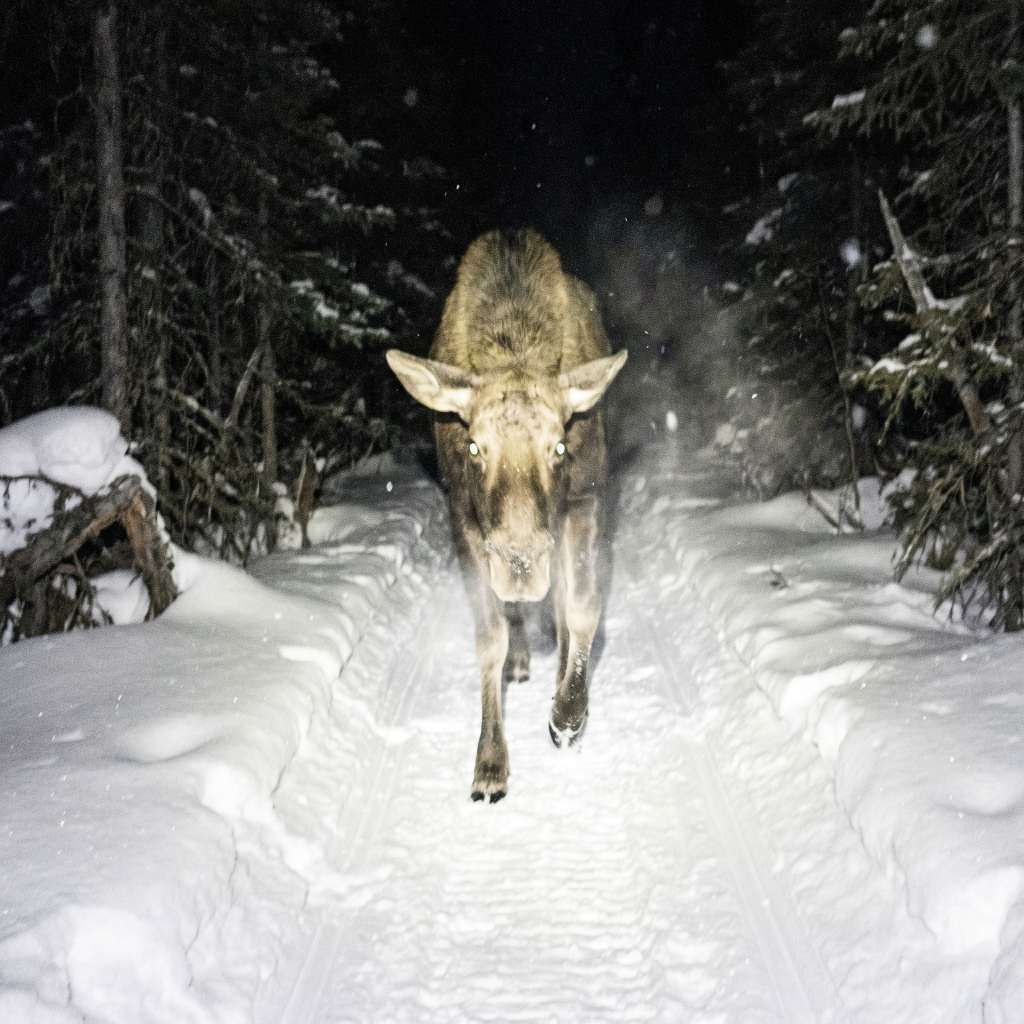
A pregnant cow moose stood on a packed sled trail in the Alaska Range in the middle of the night, and when a sixteen-dog team came around the bend, she did not move. She charged into them and fought for twenty minutes, killing two dogs and injuring thirteen before a second musher arrived with a rifle.
The musher she hit was Susan Butcher, and it was 1985, and she was running in the lead of the Iditarod.
Butcher was not a recreational musher. She was one of the most experienced distance racers in the history of the sport, a woman who would go on to win the Iditarod four times and who had built her entire life around running dogs through the worst conditions interior Alaska could produce. She knew moose. Every musher working trails in the Alaska Range and the Yukon drainage knows moose. In deep snow years, moose use packed snowmachine trails and sled tracks as their primary travel corridors because the alternative is wading through chest-deep powder that burns calories faster than a starving animal can replace them.
When a moose commits to a packed trail in winter, it is not casual about giving it up. Stepping off the hardpack means sinking to its belly in snow that can be four or five feet deep. For a pregnant cow already burning reserves to sustain the calf she is carrying, leaving the trail is not a minor inconvenience. It is a survival calculation, and the math sometimes tells her that fighting is cheaper than running.
Butcher came around a blind corner in the dark and her headlamp lit up an eight-hundred-pound cow standing broadside on the trail directly ahead. The dogs saw her at the same moment. There was no room to pass. No time to stop. The cow did not bolt into the timber the way a healthy, unstressed moose might in October. She was deep into winter, pregnant, and locked onto the only piece of navigable ground available to her. She dropped her head and came forward into the team.
A cow moose does not carry antlers. Her weapons are her front legs. A moose's front hooves are heavy, hard, and edged, and a cow delivers them in a straight downward drive with the full force of her body weight behind the stroke. A single stomp from a mature cow can break a wolf's spine. It can cave in the ribcage of a dog without slowing down. The striking motion is not a kick. It is a hammering, piston-like action, repeated rapidly, targeted at whatever is directly below her chest.
She went through the team methodically. The dogs were harnessed in pairs on a gang line, tethered to each other and to the sled, unable to scatter. They could lunge and dodge within the length of their tug lines, but they could not leave. The moose worked down the line, stomping, and the dogs that tried to fight back were struck again. Butcher was off the sled and in the middle of it, swinging a small trail axe at the cow, hitting her across the shoulders and the neck, trying to drive her off. The axe strikes did not move her. An eight-hundred-pound animal operating on full adrenal response does not register a hand axe as a meaningful threat. The cow absorbed the blows, held her ground on the packed trail, and kept working the dogs.
The attack lasted approximately twenty minutes. Twenty minutes of a musher standing in the dark between a frenzied cow moose and a team of harnessed dogs that could not escape, swinging an axe that was not doing the job, unable to end it and unable to leave.
It ended when Dewey Halverson, another musher, came up the trail behind Butcher's team and shot the moose with a firearm. By that point, two of Butcher's dogs were dead and thirteen were injured badly enough to require veterinary attention. The team was finished. Butcher, the pre-race favorite, scratched from the Iditarod.
The story is usually told as a freak accident, a piece of bad luck that cost a great musher a title. But there was nothing freakish about the moose's behavior. She did exactly what a cornered, starving, pregnant ungulate is supposed to do when a threat appears on the only viable travel corridor she has. She held her ground and she fought until either the threat left or she was killed. The moose did not choose violence because she was aggressive by temperament. She chose it because the snow on either side of the trail was deeper than her chest, and the energy cost of leaving the hardpack in her condition was higher than the energy cost of stomping everything in front of her until it stopped moving.
Every year across interior Alaska and the Yukon, mushers, snowmachiners, and skiers encounter moose standing on packed trails and refusing to yield. Most of those encounters end with the moose eventually walking off at its own pace. Some of them do not. The ones that do not follow the same pattern every time. A stressed animal on a narrow trail, no room to go around, no willingness to leave the hardpack, and a set of front hooves that can kill a wolf or collapse a sled dog's chest with a single downward stroke. The people who travel those trails in winter do not make the mistake of thinking of moose as gentle. They know exactly what they are looking at when they see one standing on the trail facing them in the dark.
Source: Iditarod Trail Committee Archives / Alaskan Wildlife Winter Ecology