
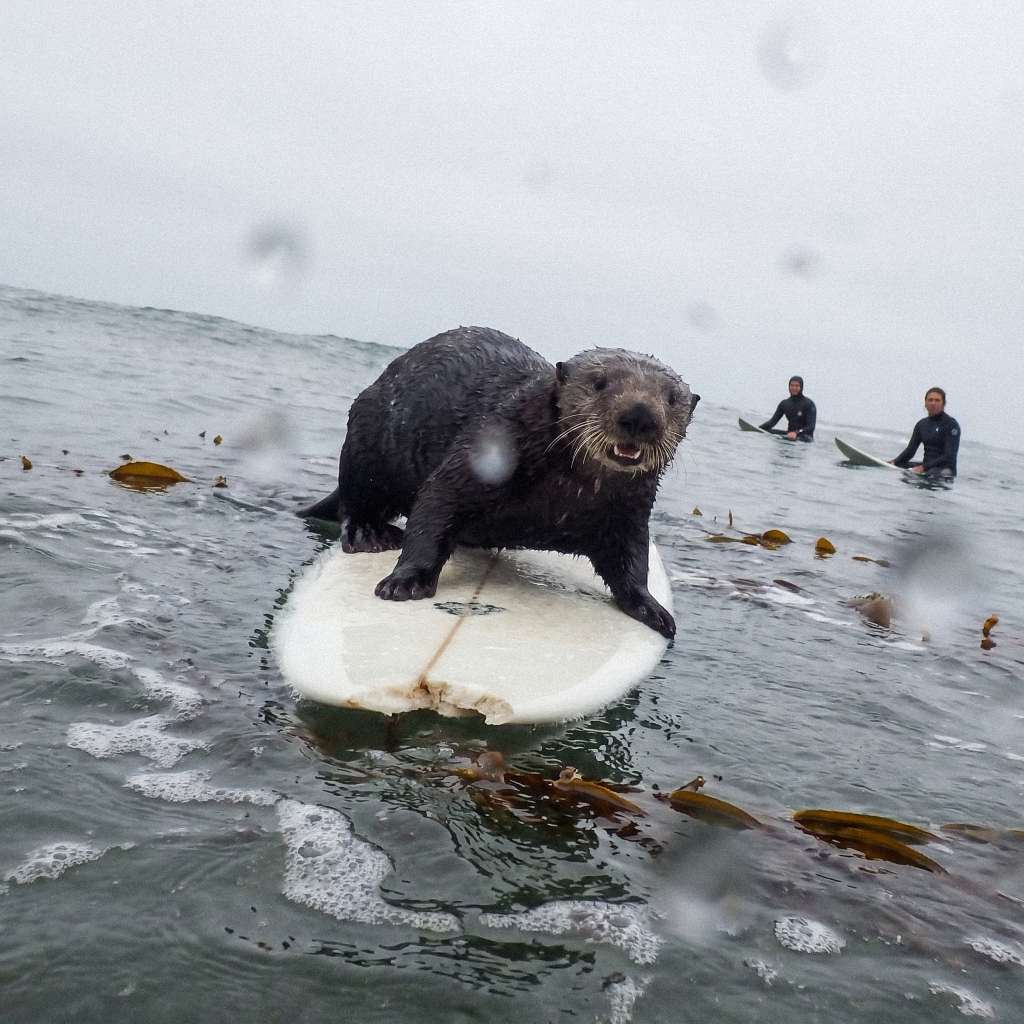
A fifty-pound pregnant sea otter in Santa Cruz spent the summer of 2023 boarding surfboards in a crowded lineup, biting chunks of fiberglass out of the decks, and charging any surfer who tried to take the board back.
Her designation was 841. She was a five-year-old female Southern sea otter tagged and tracked by wildlife researchers working the Monterey Bay coast. For most of her documented life she behaved like a normal otter, foraging in the kelp beds, avoiding humans, doing the things that make sea otters the most marketable animal in the conservation fundraising industry. Then something switched, and the cute, fluffy marine mammal that people buy stuffed versions of at aquarium gift shops started running surfers off their own boards with the aggression of an animal that shares direct evolutionary lineage with the wolverine and the American badger.
Because that is exactly what a sea otter is. The public image is so dominated by the hand-holding, belly-floating, shell-cracking footage that most people have completely lost track of where this animal sits taxonomically. Sea otters are mustelids. They belong to the same family as the wolverine, the honey badger, the American badger, and the river otter. Every member of that family is built on the same behavioral foundation: disproportionate aggression relative to body size, zero willingness to back down from a confrontation, and a jaw structure designed to crush hard targets. A sea otter's bite can shatter clamshells, urchin spines, and crab carapaces. That same bite can go through a wetsuit and into a human hand without any difficulty at all.
841 started showing up in the Santa Cruz surf lineup in the summer of 2023 and immediately violated every behavioral expectation for her species. She did not avoid the surfers. She approached them. She swam directly toward occupied surfboards, hauled her heavy, wet body onto the deck, and claimed the board. If the surfer tried to splash water at her or nudge her off, she did not slide back into the ocean. She lunged. She snapped her jaws. She charged. Surfers who had been sharing the water with otters for years without incident were suddenly abandoning their boards and jumping into the water to avoid getting bitten by an animal they had always considered harmless.
Once she had the board, she went to work on it. Using the same jaw mechanics she applied to crushing shellfish on the daily, she bit into the fiberglass deck and ripped out chunks of resin and foam. Not scratches. Not tooth marks. Fist-sized pieces torn out of boards that cost anywhere from five hundred to over a thousand dollars. The damage was structural. The boards were destroyed.
The situation escalated fast. Viral video of 841 commandeering a surfboard while the owner treaded water nearby made her instantly famous, which made the management problem exponentially harder. The California Department of Fish and Wildlife and the Monterey Bay Aquarium deployed specialized capture teams to remove her from the area. They used boats, kayaks, and trap nets. 841 evaded all of it. For weeks, professional wildlife capture crews with institutional resources and watercraft could not catch a single otter in a defined stretch of coastline. She dove under nets, outmaneuvered the boats, and kept showing up at the same surf breaks to claim more boards.
When they finally captured her, the biological explanation for the behavioral shift became clear. She was pregnant. The aggression, the territorial claim on the surf zone, the complete absence of fear toward humans, all of it tracked with the hormonal and behavioral changes associated with late-stage pregnancy in mustelids. A pregnant female defending what she has decided is her territory does not operate on the same risk calculus as a non-reproductive animal. The threshold for confrontation drops to zero. Everything in the environment is either not a threat or a threat to be driven off, and 841 had classified the entire Santa Cruz surfing community as the latter.
She was relocated to the Monterey Bay Aquarium and later gave birth. The pup survived. The surfers got their lineup back. But the episode left a mark on the local water community that went beyond the property damage. People who had spent years paddling past otters without a second thought were suddenly recalibrating what they were actually sharing the water with. Not a cute marine mammal. A mustelid. A fifty-pound predator from the same genetic house as the most notoriously aggressive small carnivores on earth, temporarily housed in a body that looks soft and harmless until it decides your surfboard belongs to it.
Source: California Department of Fish and Wildlife (CDFW) / Monterey Bay Aquarium Sea Otter Program