
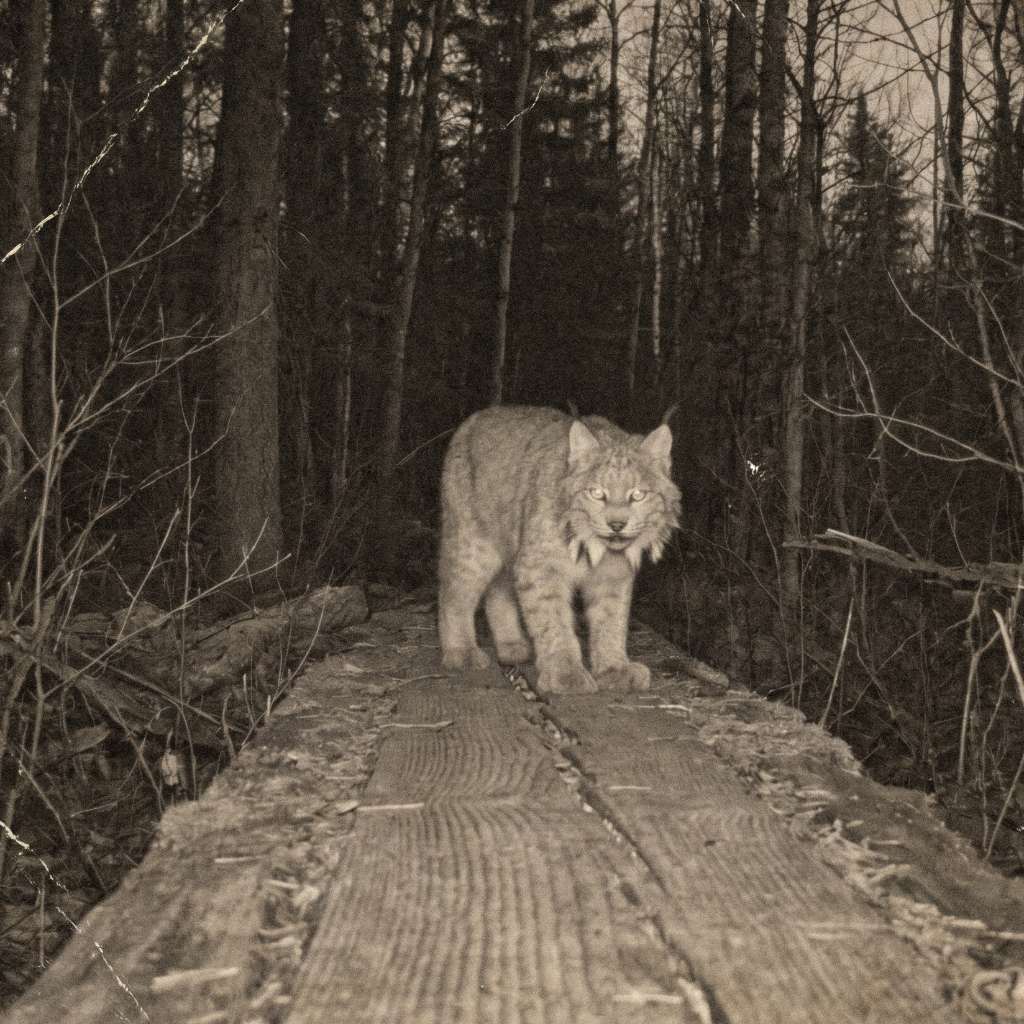
A ten-year-old boy in western Ontario was running barefoot down a corduroy road at dusk when he heard branches crack above him and something heavy dropped onto the trail behind him.
This account was published in The Calgary Weekly Herald on December 29, 1893. The writer is telling his own story, a childhood encounter with a Canada lynx in the backwoods of Ontario around 1890, and it is one of the most vivid firsthand descriptions of a lynx pursuit in the nineteenth-century newspaper archive. The language is Victorian but the terror is real. What follows is the sequence as he told it.
The boy had been sent to a neighbor's farm two miles down a logging road and had stayed too late playing with the other children. By the time he started home the sun was down and the forest on both sides of the road was dark. He was barefoot, ten years old, and running.
He was a few yards from his father's clearing when he heard the sound directly above him. Branches breaking, close, and then the heavy thud of something landing on the road just behind him. He looked back and saw it in the first weak moonlight at the edge of the tree line. A large lynx, already in pursuit, bounding after him over the rough logs of the corduroy road.
He did the only thing a ten-year-old could do. He ran harder. As he broke into the open ground of the clearing, he remembered a log barn standing in the plowed field to his right. It had a root cellar underneath with a trapdoor in the floor. He cut off the road, cleared the rail fence, and sprinted down a furrow toward the barn. The lynx cleared the fence in a single bound and came after him across the plowed ground, but the soft tilled soil slowed it down. The boy was running in the packed furrow. He gained a few strides.
He made it to the barn, found the trapdoor, pulled it open, dropped into the cellar, and hauled the door shut behind him just as the lynx came through the barn door. He could hear it above him, sniffing across the floor, tracing his scent directly to the trapdoor. It growled and began clawing at the boards. The boy held the door shut from below with a short rope fastened to the underside, bracing with everything he had while the animal tore at the loose planks above his head.
Then the lynx went quiet. Minutes passed. The boy convinced himself it had left. He decided to lift the trapdoor a few inches and check. He raised it slowly, saw nothing, raised it a little higher. A paw shot through the gap and hooked into the shoulder of his homespun coat, claws buried deep in the fabric.
He slammed the door down on the lynx's leg and held it there.
Now they were both trapped. The boy could not release the door without freeing the lynx directly above him. The lynx could not pull its paw free because its claws were snagged in the heavy cloth of the coat. The animal howled and thrashed. The boy hung on the rope with both arms, squeezing the trapdoor on the pinned leg, his muscles burning, alone in a root cellar in the dark with a lynx screaming through the floorboards.
He held that position until he heard his father's whistle coming across the field. The man was walking to the neighbor's farm to check on the boy, carrying a lantern and a gun. He heard the noise from the barn, came inside, read the situation in a glance, laid flat on the floor so the shot would angle safely, and killed the lynx through the gap in the trapdoor.
The writer notes at the beginning of the piece that by the 1890s the Canada lynx was already becoming scarce in settled Ontario. The forests were being cleared. The corduroy roads were being replaced. The animal that had once been, in his words, the most dreaded predator in the Canadian backwoods was disappearing along with the timber it lived in. The story he wrote down was already a relic from a closing era when he put it on paper.
Source: The Calgary Weekly Herald on December 29, 1893. (archive)