
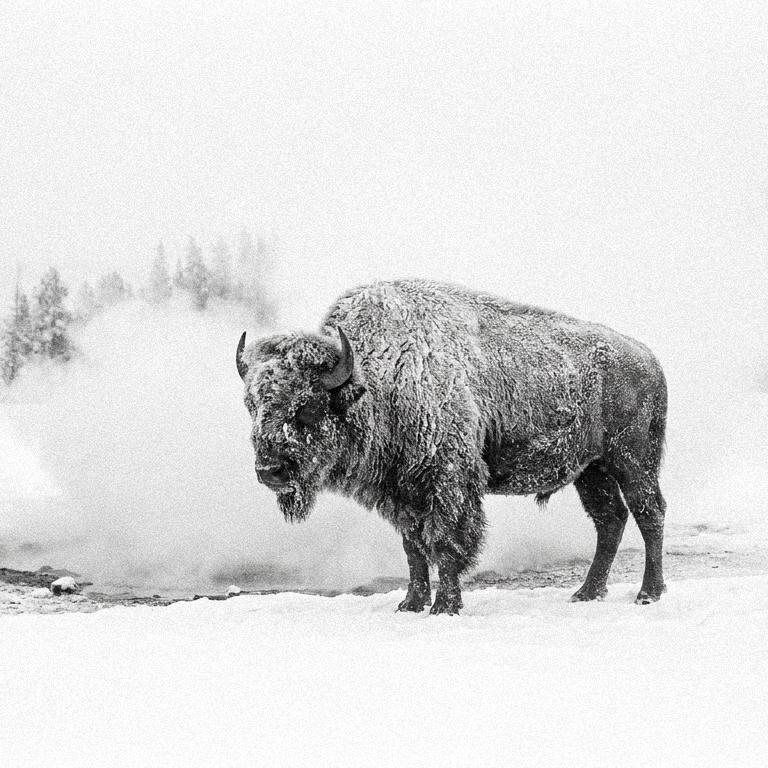
You find the real survivors of the Yellowstone winter standing where the ground literally breathes steam. While the elk and deer move down to the lower valleys to find a break from the snow, the heavy bulls of the bison herds often do the exact opposite. They push straight into the thermal basins.
It is a landscape that would kill almost anything else. The air is thick with sulfur, the ground is a thin crust over boiling water, and the thermal vents pump out a constant, wet mist.
Wildlife biologists monitoring the herds in the Hayden Valley have documented specific bulls that have turned this hellscape into a survival sanctuary. During a brutal cold snap where temperatures dropped to forty below zero, researchers followed a lone, massive bull that had anchored himself near a geyser vent.
The conditions were punishing. Because of the constant steam, the moisture froze directly onto the bull's thick winter coat. He was covered in a layer of white rime ice several inches thick, turning him into what locals call a ghost bison. He stood perfectly still for days, his head lowered to catch the heat rising from the vents.
The success of this strategy comes with a massive cost. To stay warm, the bison has to inhale the toxic gases and sulfur fumes for weeks at a time. The heat from the vents often melts the snow around their hooves, exposing a few patches of dead, brown grass that have been cooked by the underground heat. It is a foul-smelling, low-calorie diet, but it is enough to keep the internal fire burning.
The data from these winter surveys shows that while the physical toll is extreme, the survival rate for these thermal basin bulls is remarkably high. They avoid the deep snow drifts of the high passes and stay well away from the frozen river crossings that claim the younger calves.
It is a raw display of grit. That bull didn't look for a sheltered valley or an easy path. He just planted his hooves on the burning ground, let the ice encase his body, and breathed in the sulfur until the sun finally came back.
Source: National Park Service / Yellowstone Center for Resources