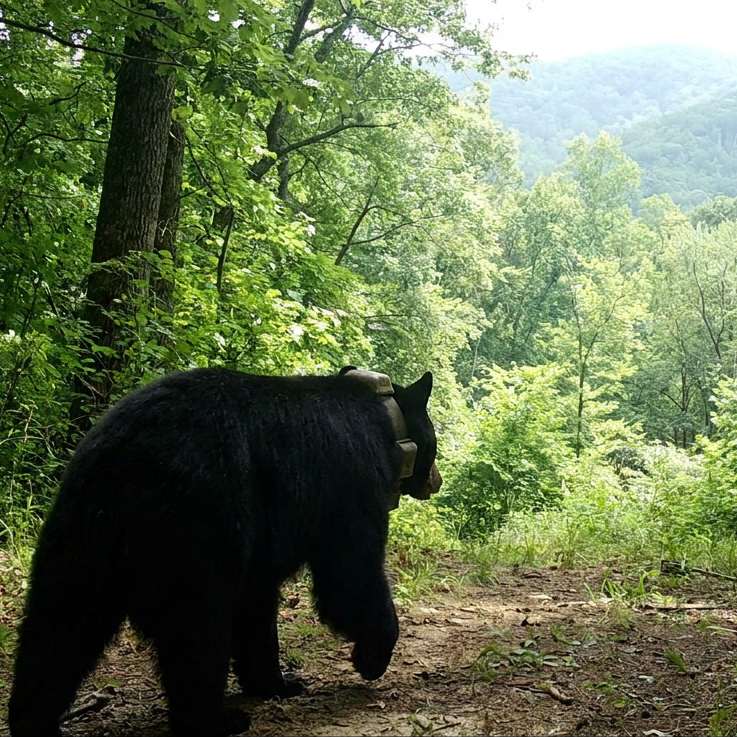
A five-hundred-pound black bear crossed four interstate highways in the dark to get back to the exact ridge where wildlife officers had trapped him a month earlier.
It started the way these things always start in the Great Smoky Mountains. A dominant male figured out how to beat the food storage systems. He was raiding campsites methodically, not randomly, working them like a circuit. The standard protocol for a repeat offender is relocation. You dart the bear, roll him into a culvert trap, chain the door shut, and drive him somewhere he has never been.
Biologists hauled this one deep into the Cherokee National Forest. They released him in an unfamiliar drainage roughly a hundred and fifty miles from his home range. Different watershed, different ridgelines, different everything. By every measure that matters to a bear, he was in a foreign country.
The telemetry collar told the rest of the story.
He did not explore. He did not settle. He turned around and walked a nearly straight line back toward the Smokies. Not a wandering, searching kind of walk. A commute. The bearing he held was so consistent that when biologists plotted the GPS points on a map, it looked less like animal movement and less like navigation and more like someone had drawn a line with a ruler.
He crossed rivers that were running fast and high. He pushed through laurel thickets so dense that a man on foot would need a machete. He went over rocky gaps he had never seen in his life, terrain with no trail and no obvious passage, and he did not slow down. He was burning through his fat reserves at a rate that would normally force a bear to stop and forage. He barely stopped.
Whatever internal map was driving him, it was louder than hunger.
The tracking signal stopped moving after about four weeks.
Biologists hiked in expecting to find a dead bear. Instead they found a living one, sitting in the same drainage where the culvert trap had been set, on the same ridge, in the same home range he had owned before anyone decided to move him.
Nobody fully understands how a bear holds a compass bearing across a hundred and fifty miles of country it has never traveled. The leading theory involves a combination of magnetic field sensitivity, memory of distant landmarks like ridgeline silhouettes, and possibly celestial orientation. But those are theories. What the data actually showed was simpler and harder to explain. The bear knew where home was. He walked there. Nothing between him and that ridge was enough to change his mind.
Source: Great Smoky Mountains National Park / Appalachian Bear Rescue