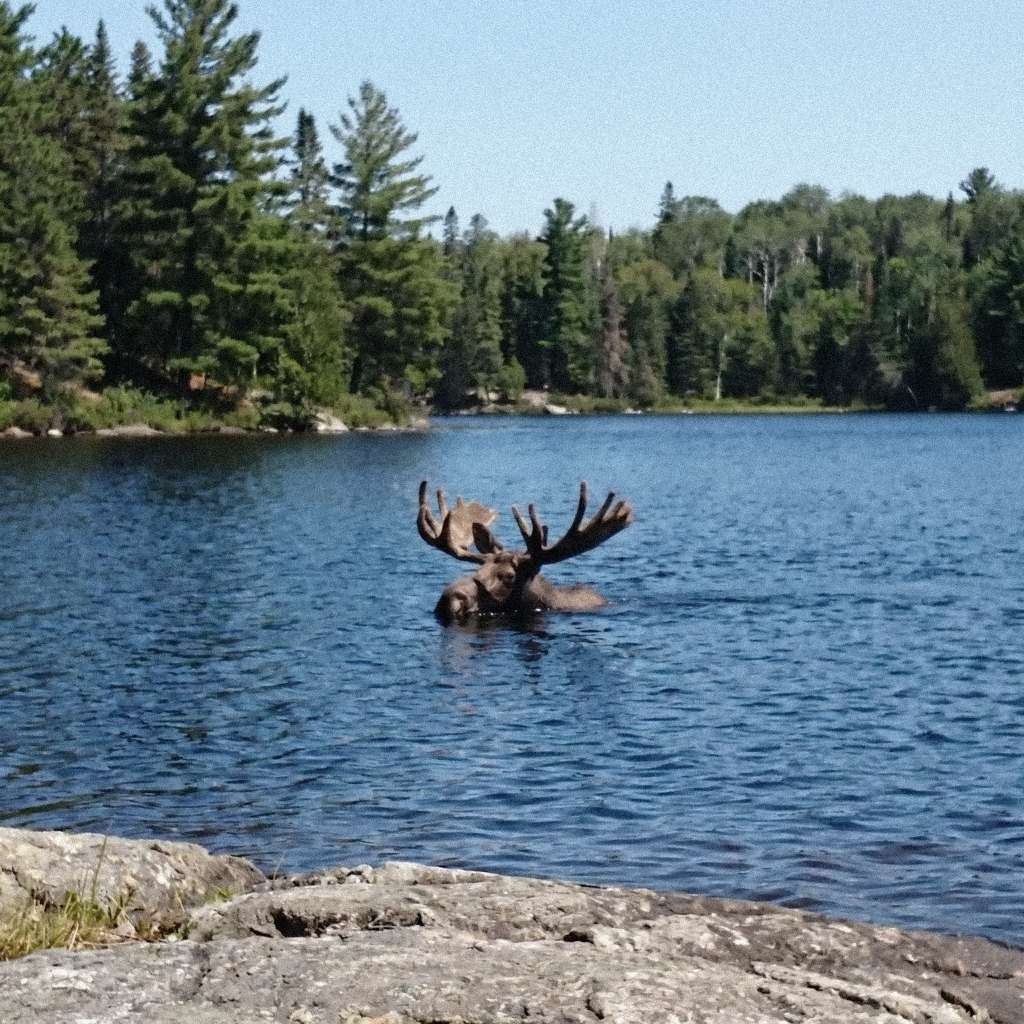
A bull moose will dive twenty feet to the bottom of a freezing lake, hold his breath for over a minute, and rip sodium-rich plant roots out of the mud with his eyes closed.
It does not look like something that should be possible. A mature bull weighs over a thousand pounds. He is built tall and top-heavy, with a chest like a barrel and legs designed for crashing through deep snow and heavy deadfall. Nothing about the animal suggests it belongs underwater. But every summer across the boreal lakes of Canada and the northern Rockies, moose do exactly that, and the reason comes down to a mineral deficiency that drives them into behavior most people would not believe if they did not see the footage.
In late spring and early summer, a bull moose is growing antlers at one of the fastest rates of bone production in the entire animal kingdom. A healthy bull can put on a pound of antler per day during peak growth. That process demands enormous amounts of sodium, and the terrestrial browse that makes up most of a moose's diet is almost completely sodium-deficient. The leaves and bark and woody stems he eats through the winter carry potassium, calcium, phosphorus, everything except the one mineral his body is burning through fastest. The sodium he needs is concentrated in one place. It is locked in the root systems of aquatic plants, specifically pond lilies, pondweed, and other species rooted in the silty lakebed sediment where mineral content is highest.
So the bull goes and gets it.
Wildlife biologists working the lake systems of the Canadian Shield and northern Ontario have documented the full sequence on underwater camera. A bull wades out past the shallows until the water reaches his chest. He stops, takes several deep breaths, and then clamps his nostrils shut. Moose have specialized nasal valves that seal completely, a feature that no other member of the deer family possesses to the same degree. Then he pushes his entire body beneath the surface.
He does not just submerge his head. He swims down. He fights his own buoyancy using those heavy hooves as paddles, driving himself toward the bottom in water that can be fifteen, eighteen, twenty feet deep. The visibility down there is close to zero. The water in boreal lakes is dark, stained brown with tannins, and the silt on the bottom clouds instantly when disturbed. The bull is working blind. He finds the root masses by feel, locks his teeth around a clump of lily roots, and tears them out of the mud with a violent sideways wrench of his neck. He may pull two or three mouthfuls before his oxygen runs out.
When his lungs hit the limit, he kicks off the bottom and comes straight up. A thousand pounds of animal breaking the surface of a still lake is not subtle. The water erupts. His head comes up first, antlers still in velvet streaming water in every direction, nostrils blowing open with a deep gasping exhale that you can hear from the far shore. He stands in the shallows and chews the roots, dark mud dripping off his muzzle, and then he goes back down and does it again.
The biologists who have tracked these feeding sessions say a bull will repeat the cycle dozens of times in a single visit, spending hours at one lake before walking back into the timber. Some bulls return to the same lake every day for weeks during peak antler growth. The sodium intake from these dives is not a supplement. It is the primary source. Without the aquatic feeding, the antler growth stalls, and a bull heading into the fall rut with underdeveloped antlers is a bull that is not breeding.
The whole thing reframes what a moose actually is. The field guides describe them as browsers, animals of the willows and the birch stands and the frozen bogs. And for most of the year that is accurate. But for a critical stretch of the summer, the largest deer species on earth becomes something that functions more like a marine forager, voluntarily descending into dark, freezing water on a breath hold to mine minerals out of lake sediment with its teeth.