
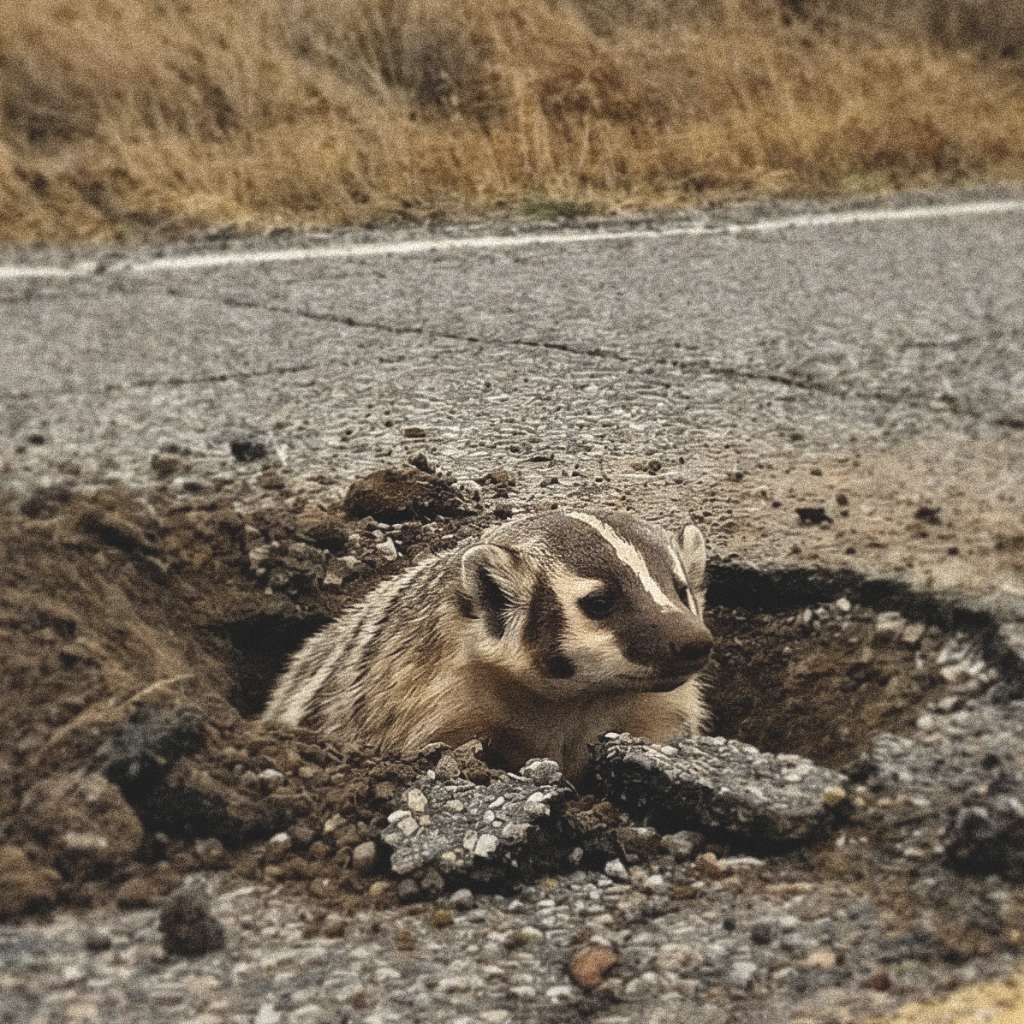
An American badger will tunnel under a paved highway and punch straight up through two inches of asphalt and compacted road base to come out the other side.
County road crews across the rural West have found the evidence. A clean, dinner-plate-sized hole torn through the center of a two-lane blacktop, edges ragged and pushed upward, surrounded by a spray of gravel and shredded pavement. No machine did it. No frost heave. An animal that weighs less than thirty pounds drove its front claws through material that is specifically engineered to resist exactly that kind of force, and it did it from below, working against gravity, because going around was apparently not part of the calculation.
The American badger is built on a completely different predatory blueprint than anything else in North American wildlife. Most predators are designed around speed, or stealth, or cooperative strategy. The badger is designed around destruction. Its entire body is a low-slung excavation platform. The shoulders are massive relative to the frame, sloped forward and packed with the kind of dense muscle you see in animals three times its size. The front claws are thick, curved, and over two inches long, and they are not delicate digging tools. They are built like the teeth on a trenching machine. The neck is short and enormously strong, which gives the head the mechanical leverage to pry and twist through root systems, rock, and compacted earth. Even the eyes are purpose-built for the job. A badger has a nictitating membrane, a clear third eyelid that slides across the cornea to shield it from dirt and debris while the animal works face-first into a hole at full intensity.
What all of this engineering produces is an animal that does not think about the ground the way other predators do. A coyote chases a ground squirrel and watches it vanish into a burrow and the chase is over. The coyote might scratch at the entrance for a minute, but the rodent is underground and underground is safe. When a badger follows a ground squirrel to a burrow entrance, the concept of "underground" stops being relevant. The badger does not try to reach into the hole. It disassembles the hole. It tears the earth apart laterally, throwing dirt behind it in a continuous rooster tail, excavating at a speed that researchers have clocked faster than a ground squirrel can dig to escape. The prey is running for its life through its own tunnel system, and the tunnel system is being demolished behind it in real time by something that digs faster than it does.
That same drive does not shut off when the badger encounters human infrastructure. A badger pursuing a rodent that has burrowed under a road does not surface on one side and walk across. It keeps digging. The compacted gravel road base, the layer of crushed aggregate above it, and the asphalt cap on top are just variations of hard ground, and hard ground is the one problem this animal was specifically built to solve. The claws that can shear through packed clay and root tangles can absolutely shear through the underside of a rural highway. The animal breaches the surface in the middle of the driving lane and keeps moving, leaving behind a hole that will blow out a tire at speed and cost the county a repair crew and a half ton of cold patch.
The whole thing makes more sense when you stop thinking of the badger as a predator and start thinking of it as a process. It does not hunt the way a cat hunts or the way a canine hunts. It identifies where the food is, points itself in that direction, and removes everything between itself and the target. Dirt, rock, root, gravel, asphalt. The material does not matter. The badger does not recognize categories of hardness or structural engineering. It recognizes that something is between it and the thing it wants, and it has the tools and the blind, relentless drive to go straight through it.