
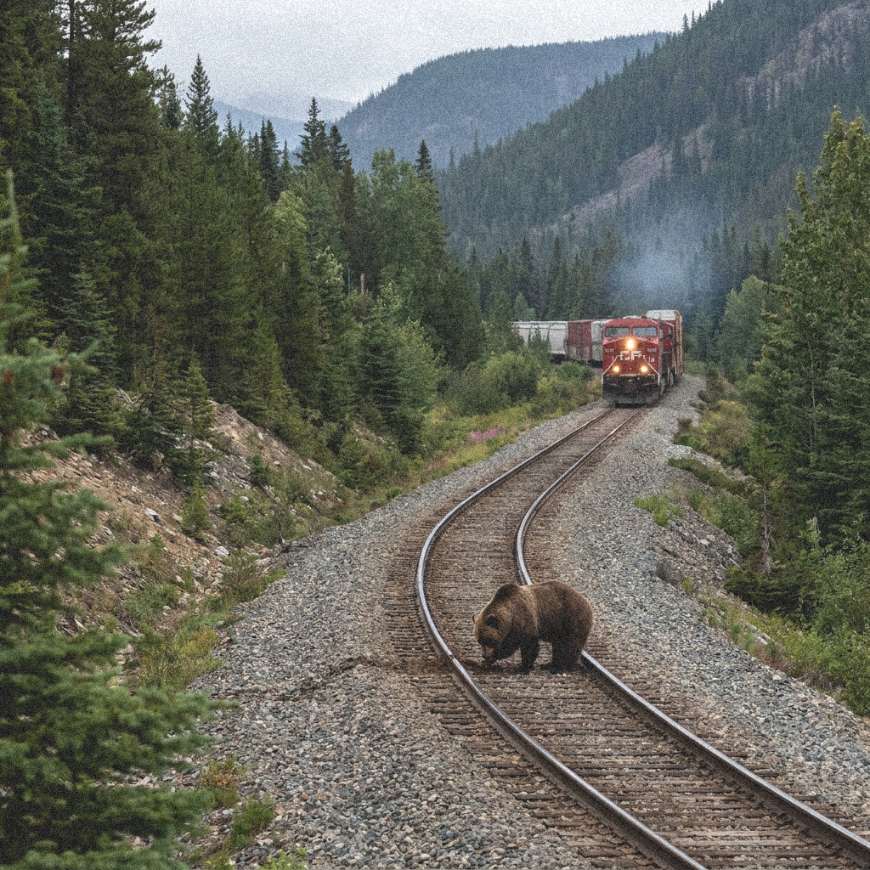
In Banff National Park, wildlife biologists monitor the resident grizzly bear population using GPS collars. The tracking data usually maps standard foraging habits and seasonal movements. But the data logging the life of a massive adult male grizzly designated as Bear 122 provides a strictly factual record of the extreme physical trauma an apex predator can absorb and survive.
Bear 122 weighs an estimated six hundred pounds. He is the dominant male in the Banff ecosystem, maintaining a home range of nearly a thousand square miles. He does not share territory. In August of 2013, researchers following his GPS signal deep into the timber found the partially consumed remains of a black bear. The physical evidence at the site, including disturbed earth and broken vegetation, confirmed that Bear 122 had not scavenged a dead animal. He had actively hunted, overpowered, and killed a smaller competing predator.
But his capability as a predator is secondary to his documented skeletal and muscular durability.
The Canadian Pacific Railway runs directly through Banff National Park. Grain frequently spills from the train cars, creating an artificial food source that draws bears onto the tracks. Vehicle and train strikes are the leading cause of mortality for grizzly bears in the region.
While feeding on the tracks, Bear 122 was struck squarely by a moving commercial freight train.
For almost any terrestrial mammal, the blunt force trauma of a train collision is instantly fatal. The transfer of kinetic energy immediately shatters the skeletal structure and ruptures the internal organs. When wildlife officials learned of the strike, they monitored Bear 122’s GPS collar, fully expecting the signal to stop moving, which would indicate the bear had crawled into the brush and died from internal bleeding.
The signal never stopped. Bear 122 absorbed the direct impact of the train, was knocked off the tracks, and survived the collision entirely on his own.
He did not require capture, surgery, or veterinary intervention. His survival was dictated entirely by his specific anatomy. A mature male grizzly possesses immense skeletal density, supported by an exceptionally thick layer of heavy muscle mass and fat. This physical bulk acted as a natural dampener, absorbing and dissipating the kinetic energy of the train before it could critically damage his vital organs or sever his spine.
The collar data showed that after the strike, he simply recovered in the timber for a short period and then resumed his normal pattern of walking and foraging. He is still alive and active in the park today, remaining the dominant male in the region. It is a literal, documented instance proving that an adult grizzly bear possesses enough sheer anatomical density to take a direct hit from a freight train and walk away.
Source: Parks Canada / Banff National Park Wildlife Management