
In the early 1900s, the heavy timber of northern Minnesota was a working frontier where homesteading directly intersected with high-density predator ranges. During the warmer months, human and wolf encounters were usually brief and unseen.
But deep winter in the north woods creates a brutal caloric deficit. When the snow deepens and standard prey becomes difficult to run down, the biological rules of engagement shift entirely from avoidance to desperate opportunism.
The following is a direct historical account printed in The Pittsburgh Press on February 16, 1903, detailing exactly what happens when a starving pack intersects with a settler and his domestic dog.
"Edward Folkson, a settler near Highland, had a narrow escape from wolves on Monday afternoon, says the Duluth News Tribune.
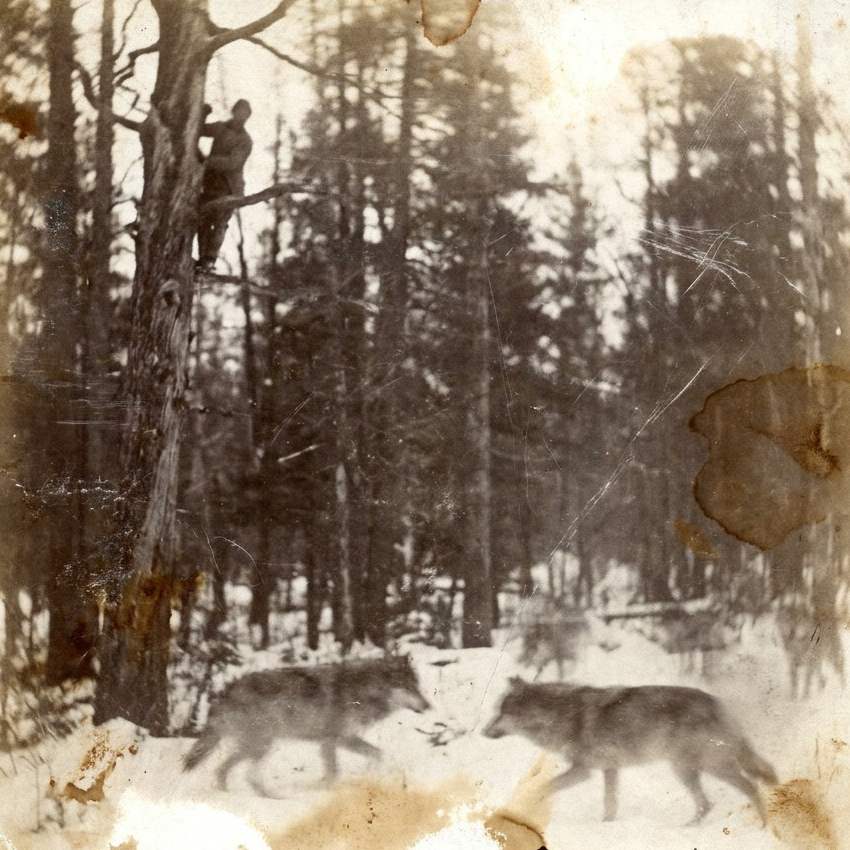
He was driven into a tree by seven of the giant “sharks of the woods,” and compelled to remain there for three hours in a very uncomfortable position. At the end of that time, the brutes evidently tired of waiting and left.
Folkson’s Gordon setter was torn to pieces and devoured by the pack while fighting them to protect his master, who sat in the branches trembling for his own life.
Oscar Folkson, a son of Edward Folkson, was in the city yesterday and told the story of his father’s narrow escape to a News Tribune reporter. He states that wolves are very numerous in the neighborhood of Highland, and that their howling may be heard nightly in every direction.
On Monday his father went out to a piece of timber about a mile and a half from his home to cut cordwood. He was accompanied by the house dog and was unarmed except for an axe, which he used in his work.
About 1:30 in the afternoon, he heard a wolf howling some distance away, but paid little attention to it. The animals are not considered dangerous at this season, as food is fairly plentiful, and they will not attack a man, it is understood, except when pressed by hunger.
Fifteen minutes after the wolf was heard, Folkson’s dog, which had been hunting in the timber on its own account, rushed up to his master, evidently in mortal terror. A minute later, the howling of a pack of wolves only a few hundred yards away broke the silence of the forest.
Folkson did not wait for further developments, but ran to a convenient tree and was soon safe among its branches. He had acted none too soon. The wolves broke from cover within 100 feet and rushed straight for the tree where he was perched. There were seven in the pack, full-grown timber wolves, evidently maddened with hunger. They were on the trail of the dog, which had run into the woods.
The dog, evidently trying to protect his master, remained near the tree, and the wolves fell upon him, tearing him to pieces and devouring his carcass.
After finishing their meal, they turned their attention to Folkson and rushed around the tree, howling and leaping at the lower branches. Tiring of this, they sat around in a semicircle and began a siege.
This lasted about two and a half hours, and then, one by one, they trotted away.
Folkson did not descend from his aerial prison for half an hour, fearing that the animals might still be concealed in the woods waiting to pounce upon him. At the end of that time, satisfied that they had left the immediate neighborhood, he climbed down and returned home unmolested.
This is the first instance known of wolves attacking a human being this winter."
To understand this 1903 account, you have to look at how extreme winter conditions alter standard predator behavior. Wolves naturally view domestic dogs as canine competitors, and territorial skirmishes do happen. But in the dead of a Minnesota winter, the primary biological driver shifts from territorial defense to a sheer caloric deficit.
By February, the snow is deep, standard prey like deer and moose are harder to run down, and the pack is operating on a severe energy drain. While a well-fed pack might just drive a trespassing dog away, a pack facing winter starvation will actively prey on them.
The dogs in these logging camps were generally ignored by wolves when natural prey was abundant. The fact that this pack broke cover during the day, ignored the human initially, and immediately consumed the dog indicates this was not a simple territorial dispute. It was a desperate, hunger-driven predation event.
The wolves besieged the tree afterward not out of malice, but because they had just secured a high-calorie meal and were waiting to see if the second mammal would drop down and provide another.
Source: The Pittsburgh Press, February 16, 1903 (Archive)
Image is for illustration purposes only