
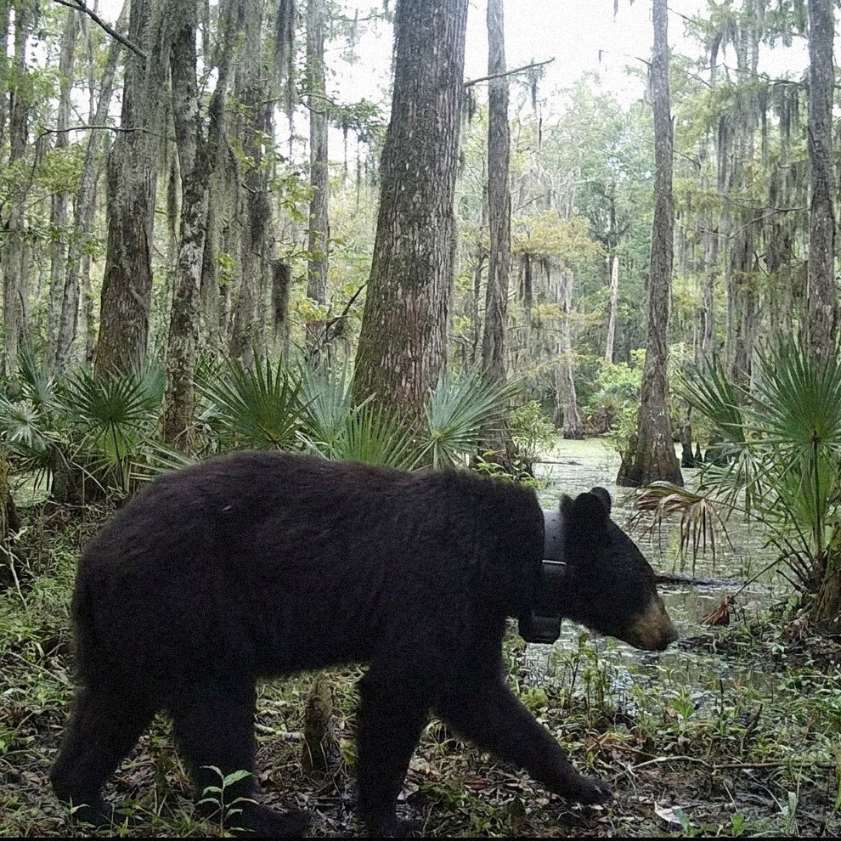
When a young male black bear reaches maturity, his biology dictates a hard rule: he has to leave his mother's home range. This process is called dispersal. The instinct prevents inbreeding and forces the population to expand. A standard male will usually walk fifty to a hundred miles, find a patch of deep, unoccupied timber with a reliable food source, and establish his own territory.
In the summer of 2020, a young male black bear completely shattered that standard radius.
The bear, later dubbed "Bruno" by the public, originated somewhere in Wisconsin. But instead of settling in the northern forests, he turned his nose south and started walking. He stepped entirely out of his species' preferred habitat and walked directly into the vast, fragmented agricultural grid of the American Midwest.
A black bear relies heavily on dense timber. The forest provides a canopy to regulate their body temperature in the summer heat, and it offers immediate physical security. Taking a two-hundred-and-forty-pound solitary predator and marching it through the completely exposed, sun-baked cornfields of Illinois and Iowa is a massive physiological stressor. Yet, the bear simply absorbed the exposure. He navigated the open landscape by clinging to thin drainage ditches and narrow strips of private woodlots.
He did not stop. He walked through Illinois, crossed into Iowa, and eventually hit a massive geographical barrier: the Mississippi River.
A black bear is a highly capable swimmer, but crossing the main channel of the Mississippi River requires immense physical exertion. The bear waded into the current, successfully swam across the heavy water, and made landfall in Missouri.
By the time he reached the suburbs of St. Louis, his presence had attracted massive crowds, forcing state wildlife officials to sedate him and physically relocate him to the rugged terrain of the Ozark Mountains. The biologists assumed the heavy timber of the Ozarks would finally satisfy his biological mandate to find a home.
It didn't. When he woke up, he just kept walking south.
He pushed entirely through Missouri, crossed into Arkansas, and continued down into Louisiana. By the summer of 2021, he had walked over eight hundred miles across six different states. He traveled year-round, ignoring the standard seasonal patterns of his species. He never aggressively raided garbage, and he never attacked a human. He was driven strictly by an extreme, unexplainable neurological urge to keep moving.
But walking eight hundred miles across the modern United States means crossing thousands of high-speed asphalt roads. The natural world operates on brutal probabilities, and human infrastructure always extracts a toll. In June of 2021, the bear attempted to cross a highway in Morehouse Parish, Louisiana. A vehicle struck him at high speed, completely breaking his hind legs and paralyzing his lower spine. When state wildlife biologists found him dragging himself through the dirt a month later, the injuries were entirely beyond repair, and they had to humanely euthanize him.
It is a raw, factual look at the absolute extremes of animal behavior. We expect wildlife to operate on predictable, mapped-out patterns. But occasionally, an individual animal is born with an internal compass that simply refuses to lock in, driving it to walk across half a continent until the modern landscape finally forces it to stop.
Source: Louisiana Department of Wildlife and Fisheries / Illinois Department of Natural Resources