
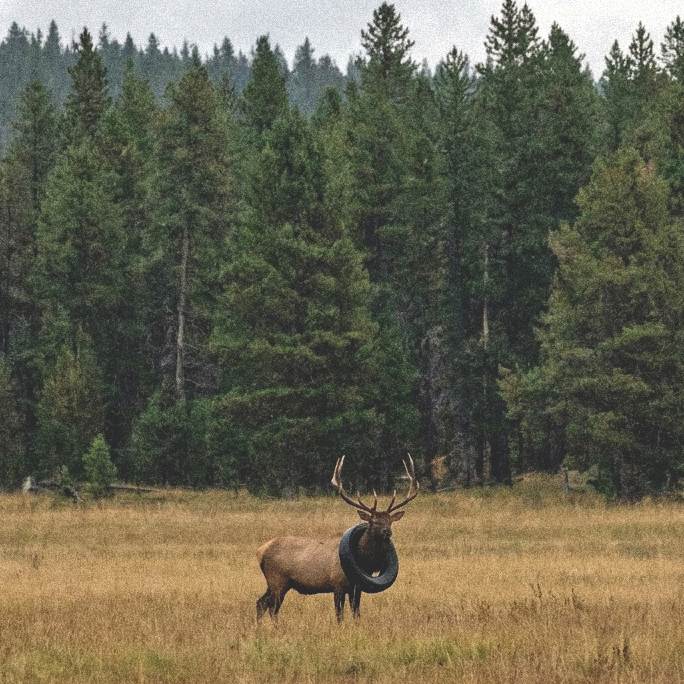
In the summer of 2019, wildlife officers in Colorado started getting strange trail camera pictures from the backcountry near the town of Pine. It was a young bull elk. He was healthy, heavily muscled, and sporting a standard set of antlers. He was also wearing a black rubber automobile tire completely around his neck.
To understand how a wild animal gets collared by a piece of a car, you have to look at the biology of a young bull. They are curious, highly aggressive during the pre-rut, and they will physically spar with anything they can find in the timber. He likely rubbed his head against an illegally dumped tire when he was a yearling, back when he had straight spikes instead of branching tines. He pushed his nose through the center, and the rubber slid down past his ears. Once it cleared his skull, it was permanently locked in place by his own skeletal growth. As his neck thickened with age and his antlers branched wider each year, the tire became a permanent fixture.
A standard tire is an absolute mechanical nightmare for a grazing animal. It is a solid ring of thick, steel-belted rubber. As the elk moved through the heavy timber, the tire acted like a rigid scoop. It constantly caught low branches and scraped against the sage. When he rolled in mud wallows to cool off, the inside hollow of the tire packed completely full of wet dirt, rocks, and pine needles. Wildlife biologists estimated the entire rig added roughly thirty-five pounds of dead weight directly to the animal's neck.
But an adult elk is an incredibly resilient animal. That thirty-five pounds rested on a massive shelf of thick neck and shoulder muscle. He didn't just survive the burden; he actively thrived.
Officers tracked his movements and sighted him intermittently over the next two years. He survived two brutal Colorado winters, digging through the snow crust for forage while dragging the heavy rubber. He navigated steep, rocky terrain while his center of gravity was heavily compromised. Even more impressively, he actively participated in two different rutting seasons, successfully fighting off rival bulls and rounding up cows while wearing a massive piece of trash.
Catching a healthy, wild elk in steep timber is difficult. They are hyper-aware, and this specific bull was constantly on the move, mixed in with a herd of forty other animals. It took wildlife officers two full years of tracking before they finally got close enough to put a tranquilizer dart into his shoulder in October of 2021.
When the officers walked up to the sedated animal in the dirt, they ran into an immediate mechanical problem. They had brought heavy steel shears to slice the rubber off his neck, but they could not punch through the thick steel bead hidden inside the rim of the tire. They could not cut the trash, and they were running out of time on the chemical sedation.
They had to use a bone saw. They quickly cut off the bull's heavy five-point antlers. With the wide bone out of the way, they were able to slide the heavy, dirt-packed tire directly over his head. They reversed the sedation drugs, and the bull stood up. He walked back into the timber a few pounds lighter on bone, but completely unburdened by the rubber for the first time in two years.
It is a strange look at what a wild animal can physically tolerate. You take thirty-five pounds of steel-belted rubber and wet dirt, hang it on the neck of a prey animal in rough country, and logically expect it to die. Instead, the elk just absorbed the weight, bulked up his neck muscles, and carried on with the business of making a living in the mountains.