
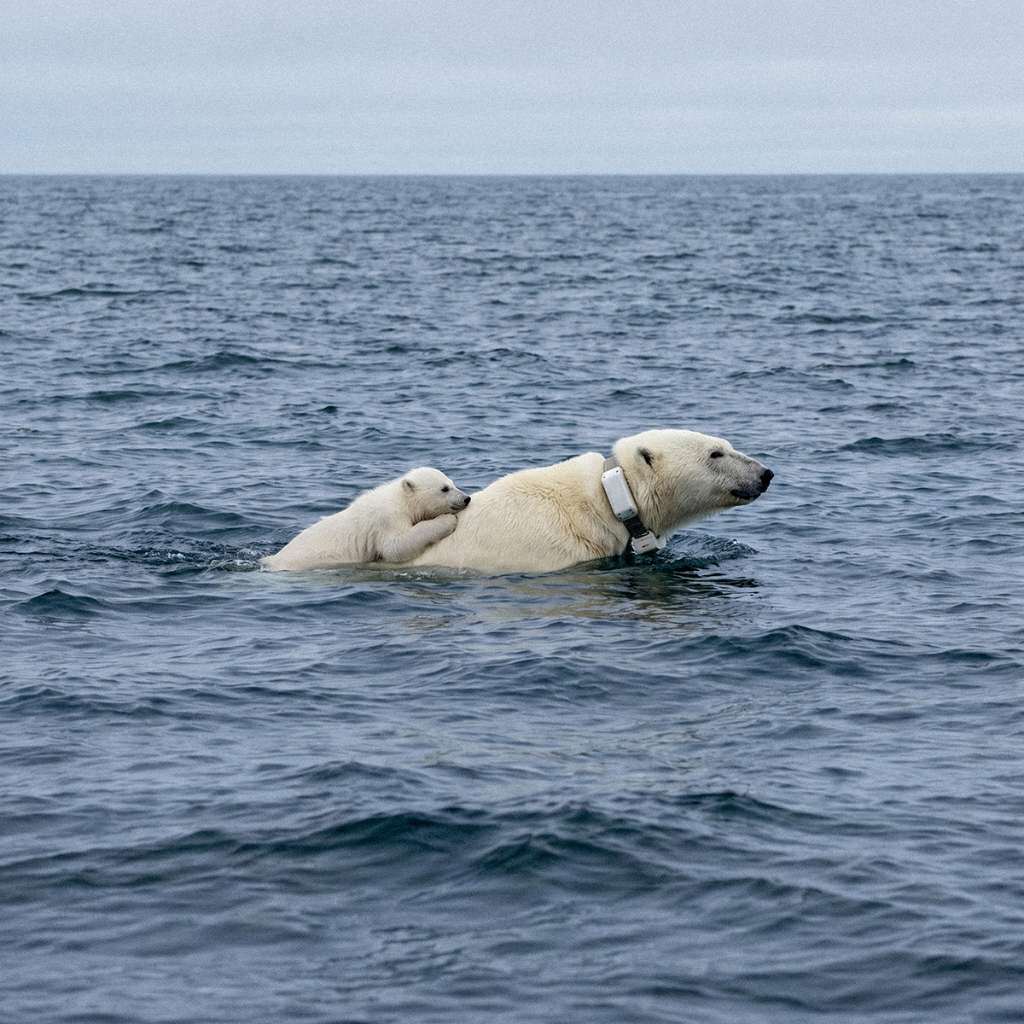
In late August of 2008, a female polar bear wearing a satellite tracking collar stood on the northern coast of Alaska.
In the US Geological Survey databases, she was cataloged simply as Bear 20741. She was a healthy adult female, weighing roughly five hundred pounds, and she was traveling with her yearling cub.
The sea ice that summer had retreated completely off the continental shelf, pushed hundreds of miles to the north. Polar bears are biologically tied to that pack ice; it is the absolute foundation of their predatory lifestyle. It is the only platform they can use to effectively hunt ringed seals. If they stay on the dirt, they are cut off from their primary food source, and they starve. Faced with a massive expanse of open, ice-free ocean, Bear 20741 waded into the Beaufort Sea and started paddling.
A polar bear is officially classified as a marine mammal for a reason. They are physically engineered for the water. They possess massive, partially webbed front paws that measure up to a foot across. They use them like twin oars, pulling their heavy frames through the swells, while their hind legs trail straight behind to act as steering rudders. Their coat is incredibly specialized, made of hollow guard hairs that trap a layer of air against the skin. It acts like a natural drysuit, providing heavy buoyancy and keeping the freezing water from actually touching their flesh.
But those biological adaptations are designed for short, tactical hops between solid ice floes. They are not engineered for open-ocean marathon migrations.
Bear 20741 did not swim for a few hours. According to the telemetry data bouncing off the tracking collar, she swam continuously for two hundred and thirty-two hours. That is nine and a half straight days in open water without a single piece of floating ice to rest on. She covered four hundred and twenty-six miles. To put that physical distance into perspective, that is the equivalent of dropping an animal in the ocean off the coast of Washington D.C. and forcing it to swim to Boston without touching the bottom.
The biological cost of that kind of endurance is absolute. For over two hundred hours, she could not sleep. She could not stop moving her front legs. The freezing saltwater constantly stripped the heat from her body, forcing her metabolism to run completely in the red. She survived by burning through her deep, four-inch layer of blubber, literally cannibalizing her own fat reserves to keep her muscles firing and her heart beating.
But the ocean always extracts a heavy toll. While the adult female possessed the mass and the deep fat stores required to survive the thermal drain, her yearling cub did not. A young bear simply does not have the surface-area-to-mass ratio or the physical horsepower to withstand a week and a half of constant exertion in freezing water. Sometime during that massive crossing, the young bear reached the absolute limit of its physiology. It ran out of calories, succumbed to exhaustion, and drowned in the swells.
Bear 20741 kept swimming. In the brutal, unforgiving economy of the Arctic, there is no capacity for mourning. When your own survival relies entirely on keeping your nose above the water line, you do not stop moving.
When she finally reached the jagged edge of the pack ice in early September, she dragged herself out of the water. When researchers eventually located and recaptured her a few months later to assess her physical condition, the physiological math was staggering. The sheer caloric expenditure of the swim had burned away twenty-two percent of her total body mass. She had lost over a hundred pounds of fat and muscle just to cross the open water.
Yet, as soon as her heavy claws hit the ice pack, she didn't just lay down and rest. The collar data showed that she stood up and immediately began a grueling, eleven-hundred-mile trek across the frozen surface to hunt seals and rebuild her completely depleted calorie stores.
We watch human endurance athletes and marvel at a hundred-mile foot race on solid ground, backed by aid stations, sleep intervals, and support crews. Bear 20741 swam four hundred miles through a freezing ocean, lost a quarter of her body weight, lost her offspring, and met the entire ordeal with the cold, mechanical reality of an apex predator that simply refused to die.
Source: U.S. Geological Survey