
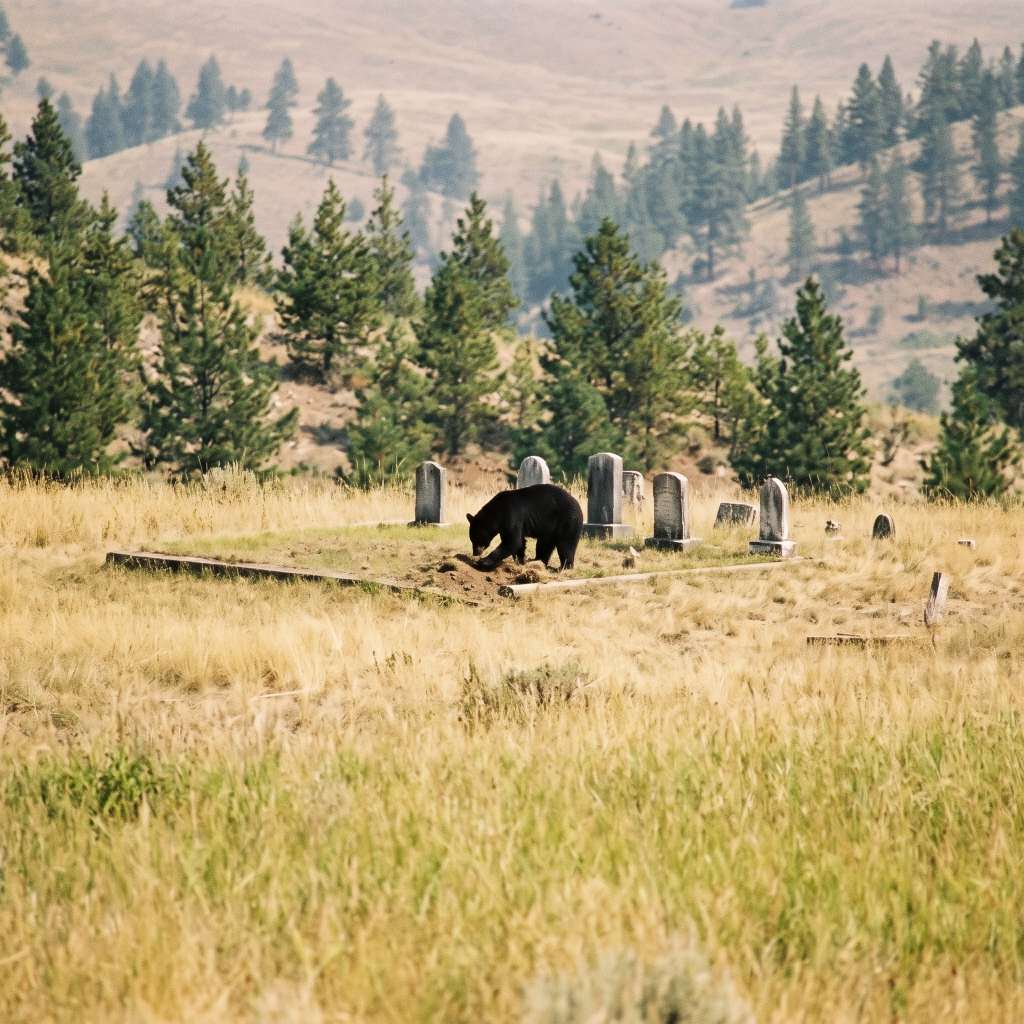
On August 20, 2002, Yellowstone’s Bear Management Office got a call about the old cemetery at Mammoth Hot Springs. A black bear was digging into the graves and pulling something out.
The cemetery sits near the horse corrals at Mammoth, on the park’s northern edge. The caller said the bear appeared to be dragging something from the ground, possibly bones. Bear management staff drove over and found a large black bear working its way across the burial plots, digging into one grave mound after another.
The graves were old. When they were first dug, the extra dirt pushed aside by each coffin had been piled back on top, leaving a low mound over every casket. Over the decades, the coffins underneath had rotted away. As they collapsed, the dirt above them started to cave in, and small hollows opened inside the mounds.
The staff moved in for a closer look at what the bear was pulling out of those hollows. It was eating pine cones.
Red squirrels had found the cavities and turned them into pantries. Squirrels cut cones from pine trees in late summer and fall and pack them into cool hiding spots to eat through the winter. Bears know this, and they raid the squirrels’ stashes for the seeds. The bear at Mammoth was going from mound to mound, digging out each cache the squirrels had hidden over the coffins.
The cones came from limber pine. That year, the crop of whitebark pine, a high-elevation tree whose large seeds are an important fall food for both black bears and grizzlies, was close to a total failure. Limber pine is a close relative with similar large seeds, and in 2002 it produced an abundant crop. Limber pine is uncommon across most of Yellowstone and grows mainly in and around Mammoth, where it has also been planted as an ornamental tree in the developed area and the campground. In good cone years, bears regularly follow it into Mammoth, which leads to run-ins with people and to bears being hazed or moved.
One grave in the cemetery belongs to Frank Welch, a wagon teamster. In 1916 he was killed by a grizzly along the East Entrance Road, the first person in Yellowstone known to have died that way. He was buried at Mammoth, a short distance from the mounds the black bear was tearing open. The squirrels had not stored any cones in his grave, and the bear left it alone.
Image is for illustration purposes only
Source: Gunther, K. A., Wyman, T., and Chin, S. (2015), Grave Digger Bear, Yellowstone Science 23(2); originally published in The Buffalo Chip, October 2002