
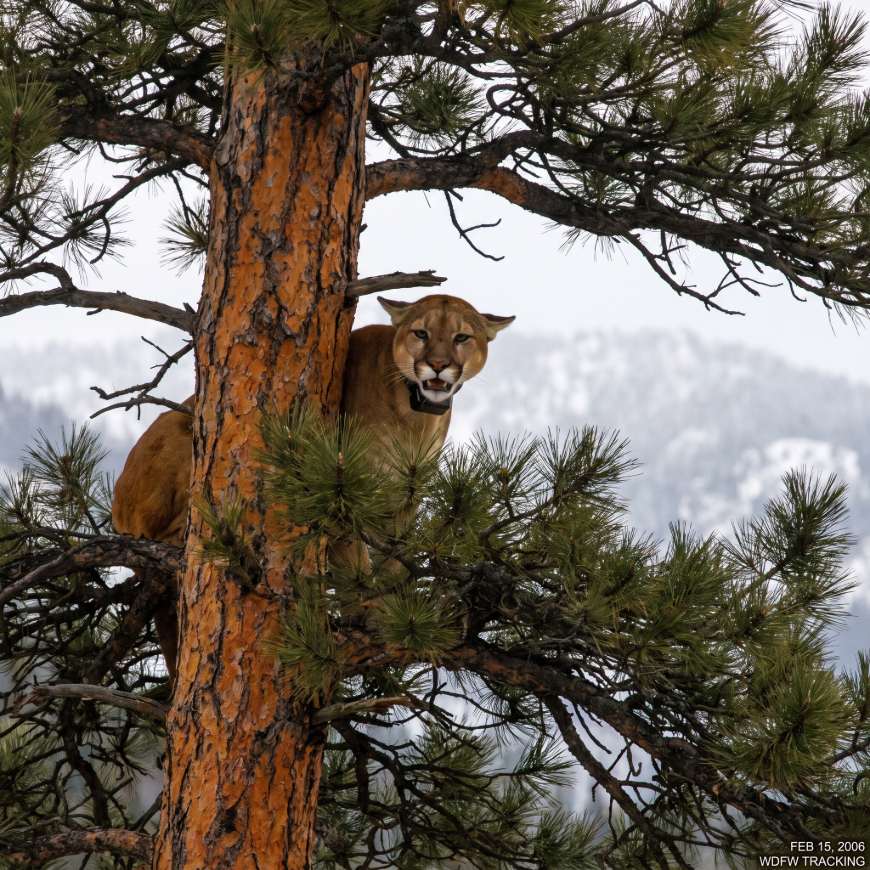
By the fourth time a wild Washington mountain lion heard a podcast playing in the woods and got chased up a tree by hounds, it started fleeing from approaching humans at nearly twice the distance as before.
Across the American West, when a mountain lion begins lingering near trails, homes, or pastures, the standard wildlife management response is usually lethal removal. In 2019 alone, Kalispel Tribe wildlife biologist Bart George helped Washington state officials track and kill 68 cougars following conflicts involving pets and livestock.
During those field operations, a clear behavioral problem stood out: many cats remained bedded down in thick cover even while people talked and dogs barked nearby. That observation sparked an experiment to test whether repeated, deliberately unpleasant pursuits could condition wild cougars to leave an area as soon as they hear human voices.
The method relies on combining an everyday human cue with packs of experienced treeing hounds like Whisper, Tipsy, and Boone, raised and trained for cougar tracking and research captures. During a 2021 field session, the hounds tracked an 85-pound female cougar and held her 50 feet up a tree with continuous barking until handlers called the pack off and allowed her to climb down unharmed.
To turn that pursuit into a repeatable behavioral lesson, the research team paired the dogs with a portable speaker playing a podcast.
Using GPS collar locations to zero in on a resting mountain lion, a researcher walked straight toward the cat while broadcasting recorded human conversation through the trees. Once the cougar stood up, moved away, and stopped again, handlers released the hounds to tree it, adding paintballs during the initial hazing session to reinforce the shock.
Unlike relocation or territory displacement, which a separate California hazing study found rarely holds over time, this protocol was designed to wire a single cause-and-effect link into the predator's mind: the sound of a human voice predicts an immediate, chaotic dog chase.
Across 188 approach trials involving 41 adult cougars, the GPS tracking data showed how quickly the cats adjusted their habits compared to unhazed control cougars that only heard the speaker without ever meeting the dogs.
On their first trial, cougars in the hazing group let a person playing the podcast approach within an average of 246 feet before retreating 304 yards. By their fourth hazing session, those same cats broke cover when the approaching human was still 420 feet away and moved an average of 637 yards out. Meanwhile, the control cougars that heard the podcast without being chased by hounds grew progressively bolder, allowing the approaching person within 113 feet by the fourth trial compared to 223 feet on the first.
In 2023, the protocol was put to work on an active conflict candidate at Riverside State Park near Spokane after a male cougar followed a mountain biker down a trail. Rather than being shot, the male was captured, collared, and entered into the hazing trials. On a subsequent tracking session observed by a field reporter, five hounds struck his scent and drove him up a ponderosa pine, reinforcing the lesson in the exact kind of shared landscape where conflicts start.
While the research did not measure how many livestock attacks or lethal removals the conditioning ultimately prevented, the field trials demonstrated that an ambush predator wired to hide in the brush and let people walk past can be trained to do the opposite: hear a human voice in the timber, and move the other way early.
Image is for illustration purposes only.
Source: George, B., et al. / Kalispel Tribe Natural Resources Department / Washington Department of Fish and Wildlife / The Spokesman-Review / Science News / High Country News.