
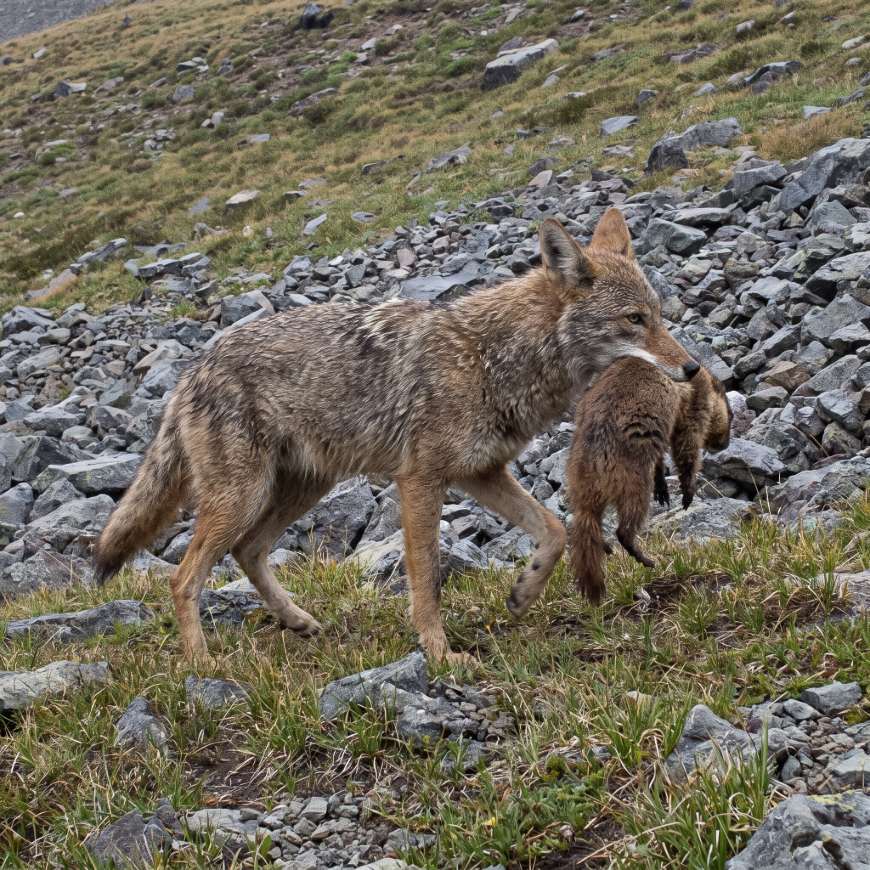
When the high-mountain whistle of the Olympic marmot started vanishing from meadow after meadow in Washington’s Olympic National Park, local rumors often pointed the finger at reintroduced fishers, yet field research showed the die-off was actually being driven by a completely different newcomer that only reached the peaks after the region's wolves were wiped out.
Found nowhere else on Earth outside the alpine meadows and rock slides of the Olympic Peninsula, the house-cat-sized Olympic marmot spent thousands of years isolated from the rest of North America by Puget Sound and dense lowland rainforests. By the early 2000s, however, park biologists noticed that whole colonies were going silent and disappearing from historical meadows without any sign of disease or starvation.
Because wildlife managers began reintroducing fishers to the Olympic Peninsula in 2008 to restore a native forest carnivore, some observers later blamed those mid-sized predators for wiping out the marmots. The timeline alone ruled that out. The steep drop in marmot numbers was already well underway years before the first fisher ever stepped out of a release crate, prompting University of Montana wildlife biologist Sue Griffin to head into the high country in 2005 and 2006 to find out what was actually killing them.
Tracking radio-implanted marmots and collecting predator scat across the subalpine ridges, the University of Montana team uncovered a grim survival rate. Only 69 percent of adult female marmots survived a single active season, and virtually every recorded death during the study came down to predation.
The main killer was not a native alpine predator or a reintroduced fisher, but the coyote. Across the marmots' mountain range, coyote predation proved both widespread and heavy enough to drive local colonies to extinction.
Historically, coyotes were rare or completely absent on the Olympic Peninsula. For centuries, packs of native gray wolves patrolled the valleys and foothills of western Washington, killing or driving off any smaller canids that tried to establish territory. After settlers and government trappers eradicated the last Olympic wolves by the 1930s, the barrier vanished, allowing coyotes to colonize the peninsula and push all the way up into the snowline meadows over the past 60 years.
While related hoary and yellow-bellied marmots in the Rockies and Cascades evolved alongside coyotes for millennia, Olympic marmots grew up in an isolated mountain fortress where their main threats were cougars, bobcats, and golden eagles. Adapted to sunbathe and forage across open turf in tight-knit social colonies, the endemic rodents had little defense when a newcomer built for hunting small mammals in open meadows followed the logging roads and summer snowmelt straight to the top of the mountains.
Since marmots reproduce slowly, with females skipping breeding years and raising small litters that take years to mature, losing nearly a third of the adult females every summer created a demographic trap that small, isolated meadow colonies could not outbreed. Even if a coyote only hunted a high basin for a few weeks in July and August, picking off just three or four reproductive females was enough to push an entire subalpine meadow toward silence.
Image is for illustration purposes only
Source: Witczuk, J., Pagacz, S., & Mills, L. S. (2013) / Griffin, S. C., Valois, T., Taper, M. L., & Mills, L. S. (2007), "Effects of tourists on behavior and demography of Olympic marmots," Conservation Biology / Griffin, S. C., Taper, M. L., Hoffman, R., & Mills, L. S. (2008)