
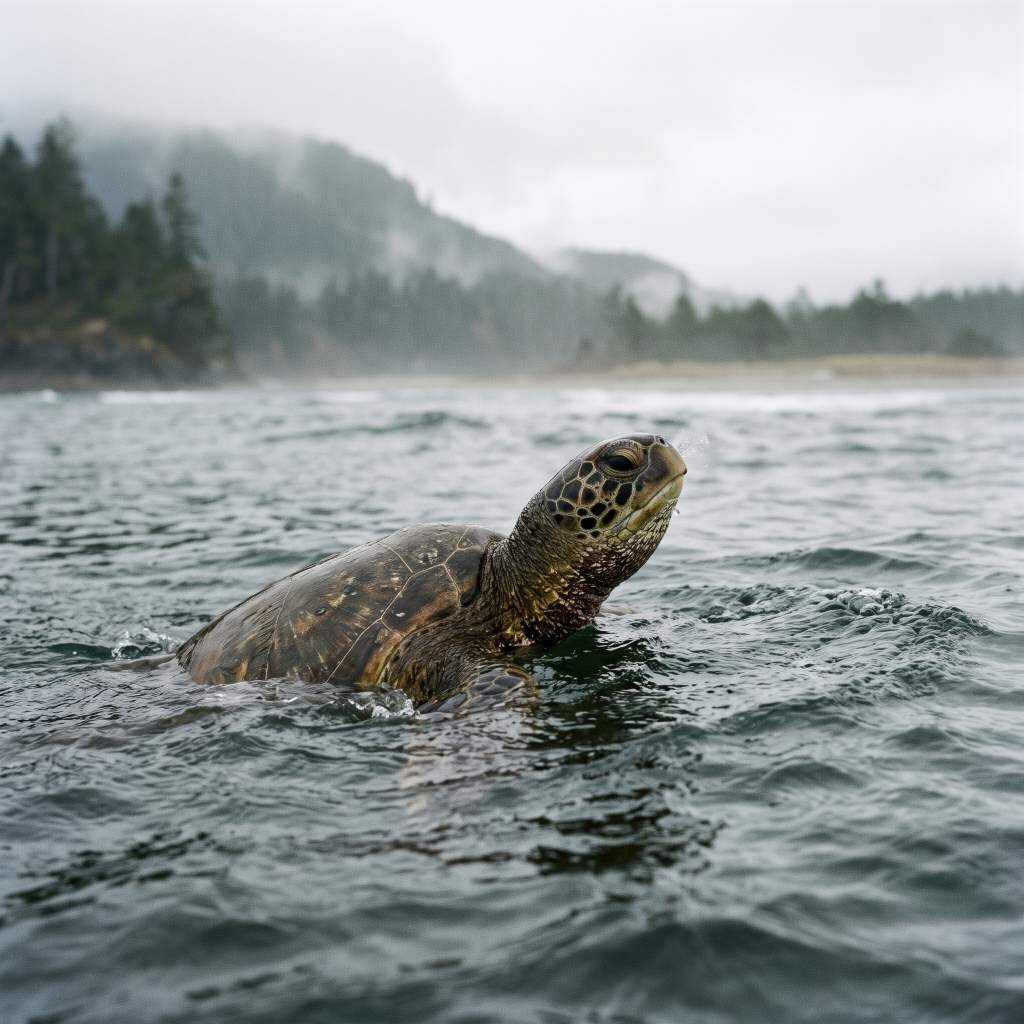
A green sea turtle from the Galapagos Islands drifted more than 4,000 miles north across the Pacific Ocean before washing ashore barely alive on a winter beach on Vancouver Island in January 2016.
Parks Canada staff patrolling Pacific Rim National Park Reserve found the unresponsive male on January 23 at Combers Beach near Tofino, British Columbia. Because green sea turtles are cold-blooded reptiles built for tropical and subtropical seas, the winter waters off the Canadian coast had nearly shut his body down.
When he was admitted to the Vancouver Aquarium's Marine Mammal Rescue Centre, his internal temperature registered just 52 degrees Fahrenheit (11.2 degrees Celsius). The severe cold-stunning had slowed his circulation so drastically that veterinary staff had to use an ultrasound machine to locate his faint heartbeat. Named Comber after the beach where he stranded, the turtle was warmed gradually over several weeks until he stabilized.
During his recovery, genetic testing reviewed by the U.S. Fish and Wildlife Service linked Comber to the Galapagos breeding population along the equator. How or when he originally crossed the open ocean into the northeast Pacific remains unknown, though warm currents occasionally carry hard-shelled turtles far north of their normal foraging grounds.
Because releasing a tropical reptile back into British Columbia's frigid waters risked an immediate second stranding, Canadian and American wildlife agencies organized a cross-border relocation that spring to return him to a warmer latitude.
After an overnight transfer through the Seattle Aquarium, U.S. Fish and Wildlife Service biologist Laura Todd accompanied Comber aboard a U.S. Coast Guard training flight to southern California. At SeaWorld San Diego, rehabilitation specialists spent months monitoring his buoyancy, weight, appetite, and swimming stamina until he was cleared for the wild.
On October 20, 2016, nine months after his rescue in Canada, Comber was released into the Pacific swells off San Diego with a satellite transmitter attached to his upper shell by the Vancouver Aquarium and tracked by Brent Stewart at the Hubbs-SeaWorld Research Institute.
Everyone expected the rehabilitated turtle to stay in the mild waters off southern California or continue south toward Mexico. Instead, Comber turned north into the cooling winter currents.
In an August 2017 follow-up report, Todd revealed that over the winter of 2016 and 2017, Comber swam more than 1,500 miles straight back up the West Coast past Oregon and Washington, crossing right back into Canadian waters off Vancouver Island.
On March 30, 2017, his satellite tag transmitted its final ping from a spot just a few miles north of Combers Beach, almost the exact place where he had washed ashore fourteen months earlier. According to Todd, the telemetry data showed normal diving and surface activity right up until the transmitter failed, leaving both his reason for returning to the cold north and his whereabouts afterward a mystery.
Image is for illustration purposes only.
Source: U.S. Fish and Wildlife Service, Laura Todd (December 2016 & August 2017) / Hubbs-SeaWorld Research Institute, Brent Stewart Satellite Telemetry Track / Vancouver Aquarium Marine Mammal Rescue Centre / Canadian Pacific Sea Turtle Stranding Inventory (Record G31).