
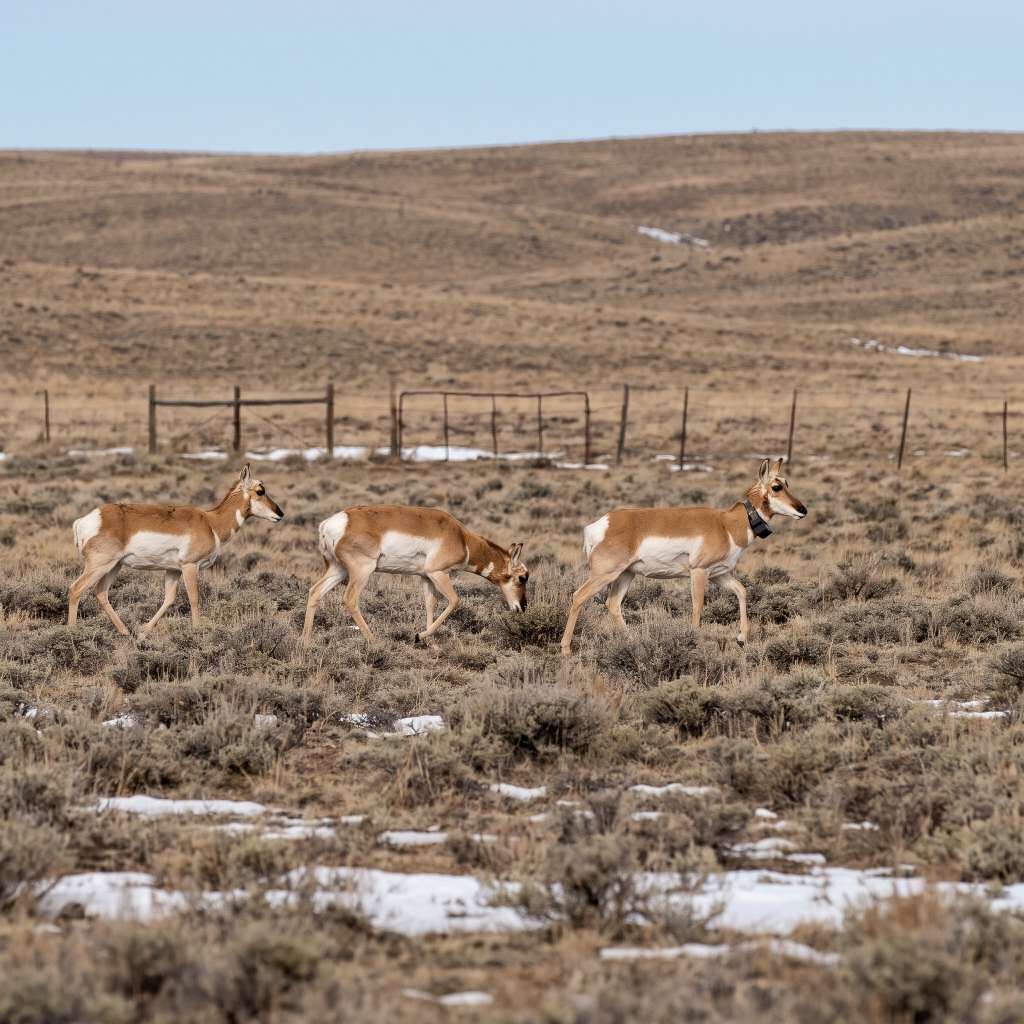
Tracked by GPS collars through the deadly Wyoming winter of 2022–2023, pronghorn that survived a grueling escape across snowed-in fences and highway barriers found much faster, straighter routes back to their Red Desert home ranges once spring arrived.
During a typical winter, the 3,400-square-mile Red Desert in south-central Wyoming serves as a wind-scoured refuge where pronghorn can easily paw down to low sagebrush. Beginning in December 2022, however, relentless blizzards buried 60 percent of the basin under more than a foot of snow for an average of 101 days, more than four times the normal annual snowfall.
Built for sprinting across open plains at up to 60 miles per hour on slender legs and small hooves, pronghorn have high foot loading and sink rapidly in deep drifts. By January 2, 2023, nearly all 33 adult females wearing GPS collars installed by biologist Hall Sawyer had abandoned their traditional winter ranges in a desperate bid to find bare ground.
As the collared pronghorn pushed outward into unfamiliar territory, researchers Ellen Aikens and Jerod Merkle at the University of Wyoming, along with Wenjing Xu and Sawyer, watched the GPS tracks collide with a hidden maze of human infrastructure.
Unlike elk or mule deer that jump over livestock barriers, pronghorn crawl underneath the bottom wire. With hard-packed snow filling the gap beneath woven-wire sheep fences, the fleeing animals hit an average of 18 separate fence lines, delaying their escape by an average of seven days. One massive fenced grazing block locked pronghorn out of more than 104,000 acres of desert.
Highways proved just as unforgiving. Fourteen collared pronghorn that fled south and west ran straight into the northern right-of-way fence of Interstate 80. None managed to cross. Individuals paced up to 47 miles along the highway corridor for nearly three weeks searching for an opening. One collared doe trudged 240 miles in a giant, fence-deflected loop through the snowbound basin only to end up back near where she started, where she died before spring. By winter's end, mortality across the collared group jumped 3.7-fold, claiming roughly half the herd.
Yet for the collared pronghorn that survived the winter bottlenecks and reached lower-snow refuges, a follow-up analysis presented at the University of Wyoming revealed a striking second chapter in their GPS tracks.
When the snowpack finally melted in spring, every single tracked survivor navigated back to its familiar home range. Rather than retracing the long, erratic detours where fences and highways had bounced them across the desert in January, the returning pronghorn took far quicker, more direct routes back to their territories. Most of those spring return paths overlapped less than halfway with their winter escape tracks, showing that even after being pushed dozens of miles into unknown country, the survivors knew their exact bearing home once the snow cleared from the fences.
Image is for illustration purposes only
Source: Aikens, E. O., Merkle, J. A., Xu, W., & Sawyer, H. (2025), "Pronghorn movements and mortality during extreme weather highlight the critical importance of connectivity," Current Biology 35(8) / University of Wyoming & Western EcoSystems Technology Red Desert Pronghorn GPS Telemetry Analysis