
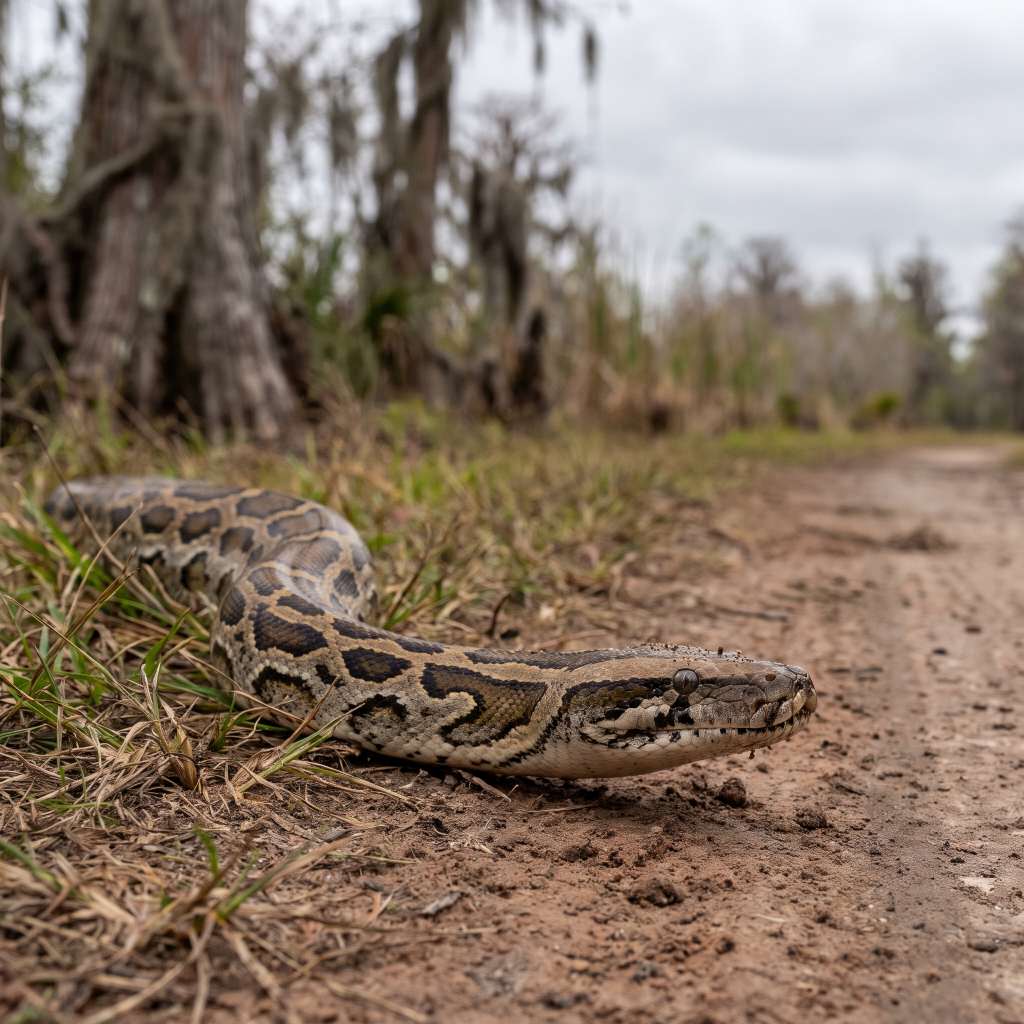
An 11-foot, 50-pound male Burmese python named Elvis spent nearly seven years leading wildlife biologists to 17 hidden snakes across the swamps near Naples, Florida, getting caught, given fresh radio batteries, and sent right back into the brush.
Across the mangrove swamps and cypress strands of southwestern Florida, finding invasive Burmese pythons by eye alone is notoriously difficult. Their dark, blotched scales blend into the mud and dappled shade so well that biologists walking within a few feet of a coiled giant will usually miss it completely.
While hunting along levees and roadsides turns up mostly young, wandering snakes, stopping a population boom requires removing the massive breeding females tucked away deep in the backcountry.
To reach those hidden breeders, wildlife biologist Ian Bartoszek and his team at the Conservancy of Southwest Florida launched a scout snake program in 2013 based on the classic "Judas animal" technique. Because male pythons possess highly sensitive scent receptors that allow them to track down airborne and ground-based chemical trails left by reproductive females during the winter and spring breeding season, the researchers decided to let the snakes do the searching.
Their very first recruit in 2013 was Elvis, an 11-foot, 50-pound adult male captured in Collier County. Rather than euthanizing him, veterinarians surgically implanted two Vhf radio transmitters inside his body cavity and released him back into his home territory near Naples.
Throughout the hot summer and autumn months, Elvis mostly stayed to himself, hunting native mammals and birds while biologists tracked his movements from small airplanes and on foot using handheld directional antennas. Once the cooler breeding season arrived between November and April, Elvis went on the move, following pheromone trails straight to secluded high-ground thickets where large females had gathered.
Whenever the telemetry signal showed Elvis lingering in a remote patch of swamp during winter, the research crew hiked in through the chest-deep water and thickets, zeroing in on the radio beeps until they stood right over him. Time after time, pulling back the vegetation revealed Elvis coiled alongside a giant, egg-laden female, or even inside a multi-snake breeding aggregation where up to half a dozen rival males were competing for a single mate.
The biologists would bag and remove all the untagged pythons on the spot, leaving Elvis behind to go find another female. Whenever the batteries on his internal transmitters began running low after a couple of years, the crew simply tracked him down, hauled him back to the lab to swap in fresh transmitters, and released him again.
By 2019, Elvis alone had led the Conservancy team to 17 other adult Burmese pythons, and in January 2020, researchers reported they were still actively tracking their original scout nearly seven years after his first release. While his final fate and later lifetime tally were not publicly documented after that point, Elvis proved the concept that expanded into a regional network of dozens of scout males, helping biologists remove thousands of pounds of breeding pythons and tens of thousands of developing eggs from the Everglades ecosystem.
Image is for illustration purposes only.
Source: Conservancy of Southwest Florida, Burmese Python Research and Removal Program Records (2013–2020) / Smith, B. J., Cherkiss, M. S., Hart, K. M., Rochford, M. R., Selby, T. H., Snow, R. W., & Mazzotti, F. J. (2016) / Bartoszek, I. A., et al. (2021), Herpetological Conservation and Biology.