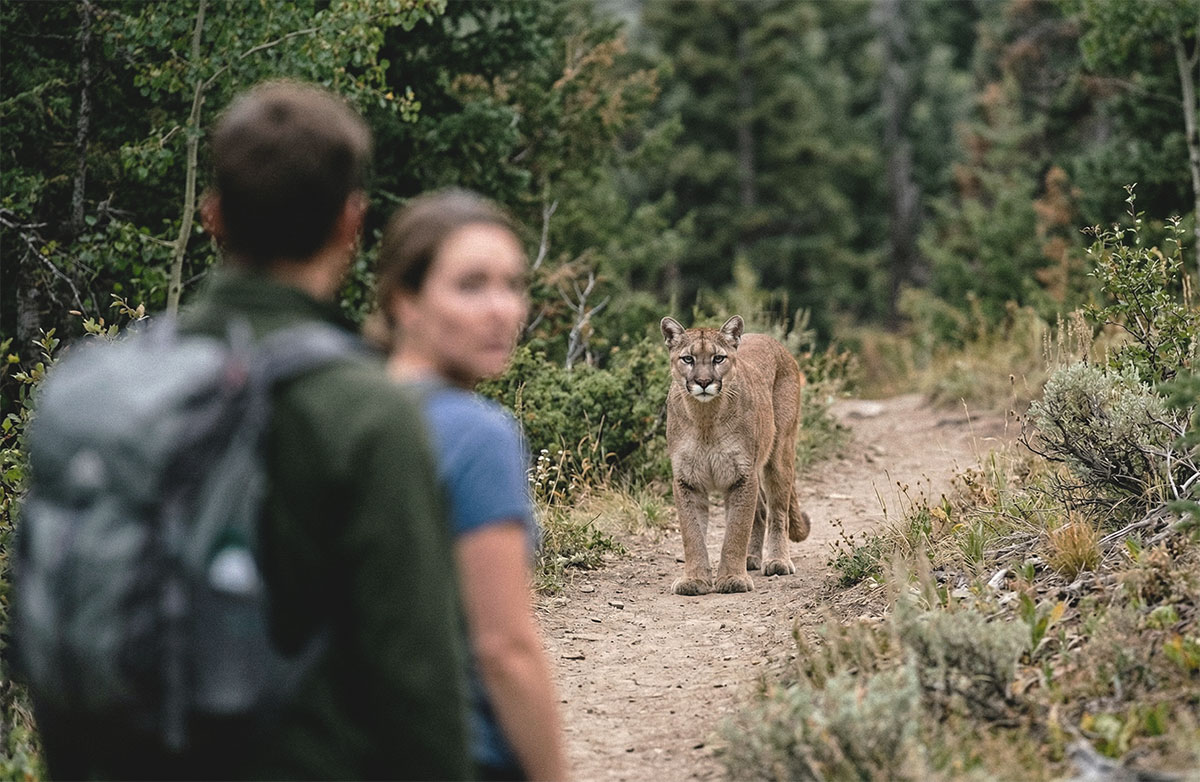
Most people who face a mountain lion make at least one critical mistake. In 2024 alone, those mistakes turned deadly in California and nearly fatal in Washington. Here is what the research, ranger briefings, and documented encounters actually show.
1. Running is the single fastest way to get attacked
The instinct to run is the most common and most dangerous response to a mountain lion encounter. A mountain lion can reach 50 miles per hour in short bursts. No human outruns one. More importantly, running triggers the chase instinct that turns a curious or cautious animal into an active predator.
The mechanism is the same one visible in any domestic cat. Movement away from a predator does not signal safety. It signals prey. When a person runs, they stop looking like an unfamiliar two-legged creature and start behaving like something that can be caught.
In 2018, two mountain bikers in Washington successfully scared off a cougar by standing their ground and making noise. The cat retreated. Then they relaxed, turned away, and began talking about what had just happened. The lion came back, attacked one from behind, and when the other man ran into the woods, the lion left the first victim and chased the runner. He was killed.
Standing ground, backing away slowly, and maintaining eye contact are the correct responses. None of them feel natural under that kind of stress. That is precisely why knowing them in advance matters.
2. Playing dead will get you killed
Playing dead works in certain grizzly bear encounters because grizzlies sometimes attack defensively. They want to neutralize a perceived threat, not necessarily consume it. Going limp can signal that the threat has passed.
Mountain lions operate on entirely different logic. They are predatory hunters. Going limp does not neutralize the situation. Wildlife experts have confirmed that playing dead with a mountain lion can trigger a feeding response rather than stopping an attack.
The Mountain Lion Foundation states this directly: unlike bears, acting timid or playing dead in front of a mountain lion is the wrong call. The correct response is the opposite. Be loud, be aggressive, and make the encounter feel like more trouble than it is worth.
A documented case involving a young boy who had been told to play dead around wild animals illustrates the danger. When a cougar pounced on him near a lake, he went limp. He survived only because other people intervened immediately. Alone, that advice would have been fatal.
3. Crouching down changes how a predator reads you
A human standing upright does not look like anything a mountain lion typically hunts. The silhouette is unfamiliar, the height is unusual, and the shape does not match the profile of deer, elk, or smaller prey.
The moment a person bends down to tie a shoe, pick up a rock, or retrieve something from a bag, that profile changes. The National Park Service warns specifically about this. A person crouching or bent forward resembles a four-legged animal. The posture also exposes the back of the neck and skull, which is exactly where mountain lions aim for a kill bite.
If something must be picked up during an encounter, do it without bending at the waist. Keep the torso upright, maintain eye contact with the animal, and move deliberately. It is awkward. It is also correct.
4. Throwing rocks is a staged response, not a first move
Throwing rocks at a mountain lion is a legitimate defensive tactic, but the sequencing matters. Grabbing the nearest stone and hurling it the moment a lion appears is not the recommended approach.
The U.S. Fish and Wildlife Service recommends a staged response. First, make yourself large: open a jacket wide, raise arms overhead. Speak in a loud, firm voice. If the animal does not retreat, throw objects near it, aiming for the ground immediately in front of the lion rather than at the animal directly. Only throw at the lion if it is actively advancing.
At that point the encounter has moved past deterrence and into self-defense. The targets are the face, eyes, and nose. Mountain lions cannot afford injuries. An animal that cannot hunt will starve. Even a minor strike to a sensitive area can tip the cost-benefit calculation enough to end the encounter.
Image source
5. Bear spray works on mountain lions and most hikers do not carry it
Bear spray is not species-specific. The active ingredient, oleoresin capsicum derived from chili peppers, causes temporary blindness, respiratory difficulty, and intense pain in any mammal. A 2008 study on human-wildlife conflicts confirmed that bear spray is effective against all carnivore species including mountain lions.
In 2015, an Edmonton man successfully stopped two cougars with bear spray alone. Research suggests the spray can be effective in up to 90 percent of close-range confrontations. Some canisters reach 40 feet, which creates a safety buffer that rocks and sticks cannot replicate.
The canister has to be accessible to be useful. A can buried in a pack is worthless in the two seconds an encounter allows. Clipping bear spray to a chest strap or belt, and practicing releasing the safety tab one-handed, converts it from gear to a functional tool.
Wind direction is the one critical variable. Spraying into a headwind exposes the user rather than the animal. A second of awareness about positioning before deployment makes the difference.
6. Turning your back activates predatory instinct
Mountain lions are ambush predators. The kill sequence involves approaching from behind, leaping onto the back, and delivering a bite to the neck or skull. This is not an occasional behavior. It is the primary hunting method refined over millions of years.
Turning away from a mountain lion during an encounter mirrors the behavior of prey in flight. The Mountain Lion Foundation notes that a lion facing a person and not retreating is often a sign that the person already has the advantage. Lions do not turn their backs on animals they perceive as dangerous, for the same reason.
Maintaining eye contact and facing the animal throughout a retreat is the correct approach. Backing away slowly while facing the lion is awkward and increases the chance of tripping. It is still significantly better than the alternative.
In November 2025, two hikers on Colorado’s Crosier Mountain Trail found themselves between two mountain lions, one ahead and one behind them on the trail. They kept facing both animals, yelled, threw rocks, and both lions eventually left. They reported the encounter to Colorado Parks and Wildlife and walked out unharmed.
7. Reading body language before it becomes an attack
Most encounters give warnings before they escalate. Learning to read those signals accurately changes how a person responds in the critical seconds when a response is still possible.
A mountain lion that is simply curious will typically hold its head up, keep ears forward, and maintain a relaxed posture. It may watch closely or shift positions slowly. This is not a safe situation, but it is a manageable one. Back away deliberately and give the animal room to leave.
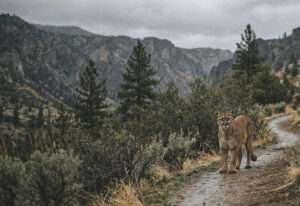
The signals that indicate elevated risk are specific. Ears pinned flat against the skull, an unblinking fixed stare, a low crouched body position, and a slowly lashing tail are the precursors to attack in any large feline. According to Wyoming hunter education materials, a lion more than 50 yards away that is watching closely and changing positions represents an unpredictable risk. At under 50 yards, with ears back, intense staring, and movement toward cover rather than away, an attack may be imminent.
The distinction between a bluff charge and a real attack is one of the most important things to understand. A bluff charge is designed to drive a perceived threat away from kittens or a cached kill. Colorado Parks and Wildlife biologist Jamin Grigg has stated directly: if a lion allows itself to be seen, it is likely not acting predatorially. Protective behavior including bluff charging is the lion trying to move a person out of an area, not to hunt them. The correct response to a bluff charge is the same as to any other approach: stand ground, make noise, appear large, and do not run. Running converts a territorial display into a pursuit.
A predatory approach looks different. The animal moves low to the ground, head held down, body close to the surface, using available cover to reduce the distance. This is stalking behavior. If movement toward a person is slow, quiet, and uses concealment, the situation has moved past curiosity or territorial defense.
8. Dawn and dusk are the highest-risk hours
Mountain lions are crepuscular, meaning their activity peaks at dawn and dusk. These are also the hours when lighting conditions make them hardest to spot and when many hikers are on the trail.
Washington Department of Fish and Wildlife logged 859 cougar incident reports through mid-August 2024 alone, with the majority of sightings occurring during low-light conditions. Wildlife biologist Brian Kertson, who has studied cougars in Washington for over two decades, has noted that people bear responsibility for adjusting their behavior during these windows in lion country.
Trail runners face elevated risk specifically because running posture, bent forward and moving fast, closely resembles the movement pattern of fleeing prey. Attack statistics show joggers appearing with disproportionate frequency relative to their share of trail users.
One practical indicator worth knowing: if deer in the area suddenly bolt without an obvious cause, something spooked them. That something may be a mountain lion. Stop, scan the surrounding terrain, and do not continue moving casually until the area is accounted for.
9. Children are the highest-risk group in any encounter
Small children are the most vulnerable people in mountain lion territory. Their size places them within the size range of natural prey. Their movement patterns, running, darting, making sudden noise, trigger the same chase instincts that make running dangerous for adults.
Compiled data on fatal cougar attacks confirms that the majority of child victims were not with adults at the moment of attack.
In September 2024, a mountain lion attacked a five-year-old boy at Malibu Creek State Park in California during a family picnic. Six adults were present. The children were playing near the table. The lion grabbed the boy by the head. His father fought the animal with his bare hands until it released the child. The boy survived.
Children should remain within arm’s reach in mountain lion territory at all times. If an encounter occurs, picking a child up immediately is the correct move, done without bending at the waist or turning away from the animal.
Talking to children about what to do before entering lion country is preparation, not fear. A documented case in El Dorado County involved a boy who scared a mountain lion away by playing his trumpet loudly when the cat approached. His parents had taught him to make noise, appear large, and never run. That prior knowledge was directly responsible for the outcome.
10. Dogs change the risk profile of any hike
Bringing a dog into mountain lion territory introduces a set of risks that are separate from the risks to the person hiking. Mountain lions see shapes and movement. A dog running loose on a trail reads as prey, regardless of the owner’s proximity. Cougars see in terms of size and movement, not species.
The incidents around Estes Park and Glen Haven, Colorado in late 2025 illustrate how quickly this can escalate. Within a three-month period, multiple dogs were killed by mountain lions in the area. In two separate incidents, dogs were attacked while on leash with their owners present. One dog was taken by a lion that accepted the risk of a human standing nearby. The incidents culminated in a fatal attack on a human in January 2026.
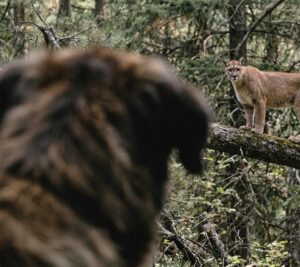
An off-leash dog that runs ahead on a trail, chases wildlife, or disappears around a bend is not just at risk itself. It can provoke a chase response from a lion, lead that lion directly back toward the owner at speed, and dramatically compress the amount of time available to respond. Dogs should be kept on a leash no longer than six feet in known lion territory. Small dogs should be picked up if a lion is present. Most experts advise against physically defending a pet against a lion attack at the cost of personal safety, but the reality is that an attacking lion is already in close range and fighting back is both the correct response for the person and the only option for the dog.
The Mountain Lion Foundation recommends keeping dogs inside overnight and supervising any outdoor access during dawn and dusk hours. Motion-activated lights, light-up collars, and air horns are practical deterrents that reduce risk without restricting normal activity.
11. What to do if you find a kill site
Mountain lions do not finish a meal in one sitting. After making a kill, typically a deer or elk, a lion drags the carcass to a sheltered location and covers it with dirt, leaves, grass, or snow. This behavior is called caching. The lion returns to feed over a period of several days, moving and recovering the cache between visits.
Colorado Parks and Wildlife advises explicitly: if you find a dead animal that appears hidden or covered, treat it as a mountain lion kill and leave the area. A lion that has cached a kill is almost certainly nearby and is likely to return. Human presence near the cache will not be tolerated.
The signs of a mountain lion kill site are recognizable. The carcass will be partially consumed, often starting from the hindquarters. It will be dragged to a location with cover nearby, typically dense brush, a rock outcrop, or a tree line. The carcass will be covered with debris. The area will show drag marks and disturbed ground. A large male cougar in the Cascade Mountains kills a deer or elk every nine to twelve days and may spend several days at a single cache.
Do not investigate, photograph, or move closer to confirm the identification. Do not let children or dogs approach. Back away the way you came, make noise to announce your departure, and report the location to the nearest park or wildlife authority. A cached kill is one of the few situations where a mountain lion is predictably in a specific place and is predictably motivated to defend it.
12. Living in lion territory is different from hiking through it
People who live in homes adjacent to wildland areas in the western United States are not occasional visitors to lion habitat. They are permanent fixtures in it. The management of that proximity requires ongoing attention rather than occasional awareness.
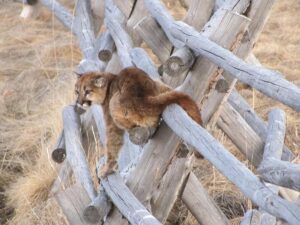
image source
The most effective single action is removing what attracts deer, since deer are the primary prey of mountain lions and wherever deer concentrate, lions follow. Bird feeders, unsecured compost, fallen fruit, and ornamental plantings that deer prefer are indirect attractants. Removing them reduces deer presence and by extension reduces lion presence around structures.
Dense brush and low-hanging vegetation near homes create ambush cover. Trimming brush within a reasonable perimeter of the house removes the concealment that a hunting lion relies on. Motion-activated lighting is effective at disrupting nocturnal approaches. Idaho Fish and Game recommends this specifically for residential properties in lion-active areas.
Livestock and small pets require the most direct protective measures. Goats, chickens, and small dogs should be in fully enclosed structures from dusk to dawn. The enclosure needs a secure top, not just walls. A mountain lion is capable of scaling most standard fencing. Pet food and water should never be left outside overnight, as they attract raccoons and other small mammals that lions hunt.
In early 2019, residents of Idaho’s Wood River Valley reported nearly daily mountain lion sightings including multiple fatal dog attacks over a period of weeks. Wildlife managers convened a community meeting. The core recommendation was not relocation of lions or increased lethal management. It was habitat modification, removal of attractants, and changes to how pets and livestock were secured overnight. Those measures, applied consistently across neighbors, reduced the frequency and severity of incidents.
13. Approaching for photos has become a documented problem
Wildlife officers across the western United States have noted a consistent pattern in recent years: people encountering mountain lions and responding by raising their phones rather than bear spray. The behavior is documented frequently enough that it now appears in official guidance.
Approaching a mountain lion at any distance, for any reason, is dangerous. When lions lose their wariness of humans through repeated close contact without consequence, encounters become more unpredictable and more likely to escalate.
The Mountain Lion Foundation has described close-approach photography as a mistake that puts both the human and the animal at greater risk. A lion that becomes habituated to human proximity is more likely to be classified as a conflict animal and euthanized.
Sightings from a natural distance are rare. Most people who spend careers in wilderness areas never see one in the wild. Maintaining that distance preserves both the encounter and the animal.
14. Not reporting a sighting puts the next person at risk
A completed encounter that goes unreported removes information that wildlife managers use to issue warnings, increase patrols, and protect people who come after.
In November 2025, two separate mountain lion encounters on Colorado’s Crosier Mountain Trail led directly to warning signs being posted and patrol frequency being increased. Those reports may have prevented a worse outcome for subsequent hikers. Without them, the trail would have looked the same as any other.
Reports should go to the nearest park office, wildlife agency, or local authorities. Social media is not a substitute. Overreported or sensationalized accounts frequently result in lions being killed even when their behavior was entirely natural. A factual report to the right agency is more useful and more responsible than a viral post.
15. If it attacks, fight back with everything you have
Let’s hope it will never happen to you, but if it does: A mountain lion attack is not the end of the encounter. It is a new phase of it, and the outcome of that phase depends almost entirely on what the person being attacked does in the next several seconds.
The single most important thing to understand is that mountain lions abandon attacks when prey fights back. They are not programmed to absorb punishment. An animal that hunts deer and elk for survival cannot afford a broken jaw or a damaged eye. Multiple documented cases exist of people driving off attacking lions with rocks, sticks, trekking poles, jacket sleeves, bare fists, and in one case a ballpoint pen. In 2019, a trail runner in Colorado killed an attacking juvenile mountain lion by pinning it to the ground and suffocating it. He sustained serious injuries. He survived.
The priority is the neck and throat. Mountain lions kill by biting through the neck or crushing the skull. Getting hands up to protect that area, and keeping them there, changes the mechanics of the attack in the victim’s favor. Use a backpack as a shield if it is within reach. Keep facing the animal rather than curling away from it.
Fighting back is not just permitted. According to the National Park Service, it is the recommended response. Use rocks, sticks, trekking poles, a water bottle, a camera, anything that can be swung or thrown at close range. Aim for the face, the eyes, and the nose. These are the areas where even modest force produces a significant deterrent effect.
Do not stop. A mountain lion that pauses mid-attack is reassessing the cost. The moment fighting stops, that calculation resets. Keep making noise, keep striking, and keep protecting the neck until the animal disengages and moves away. People who fight through the full duration of an attack survive at a significantly higher rate than those who go passive at any point.
The numbers in context
Mountain lion attacks are rare by any statistical measure. Roughly 32 fatal attacks have been documented across all of North America since 1890. The probability of a fatal encounter in the Bay Area, where mountain lion habitat overlaps with millions of people, has been calculated at less than 1 in 6 million. The odds of a fatal encounter are lower than the odds of being struck by lightning or killed by a falling object.
Rare does not mean impossible. The people who survive encounters share a common factor: they knew what not to do before they needed to know it. They did not run. They did not play dead. They did not crouch, turn away, or hike alone at dawn without awareness of their surroundings.
Preparation in mountain lion country is not about fear. It is about having the right response available before the instinct to do the wrong thing kicks in.