
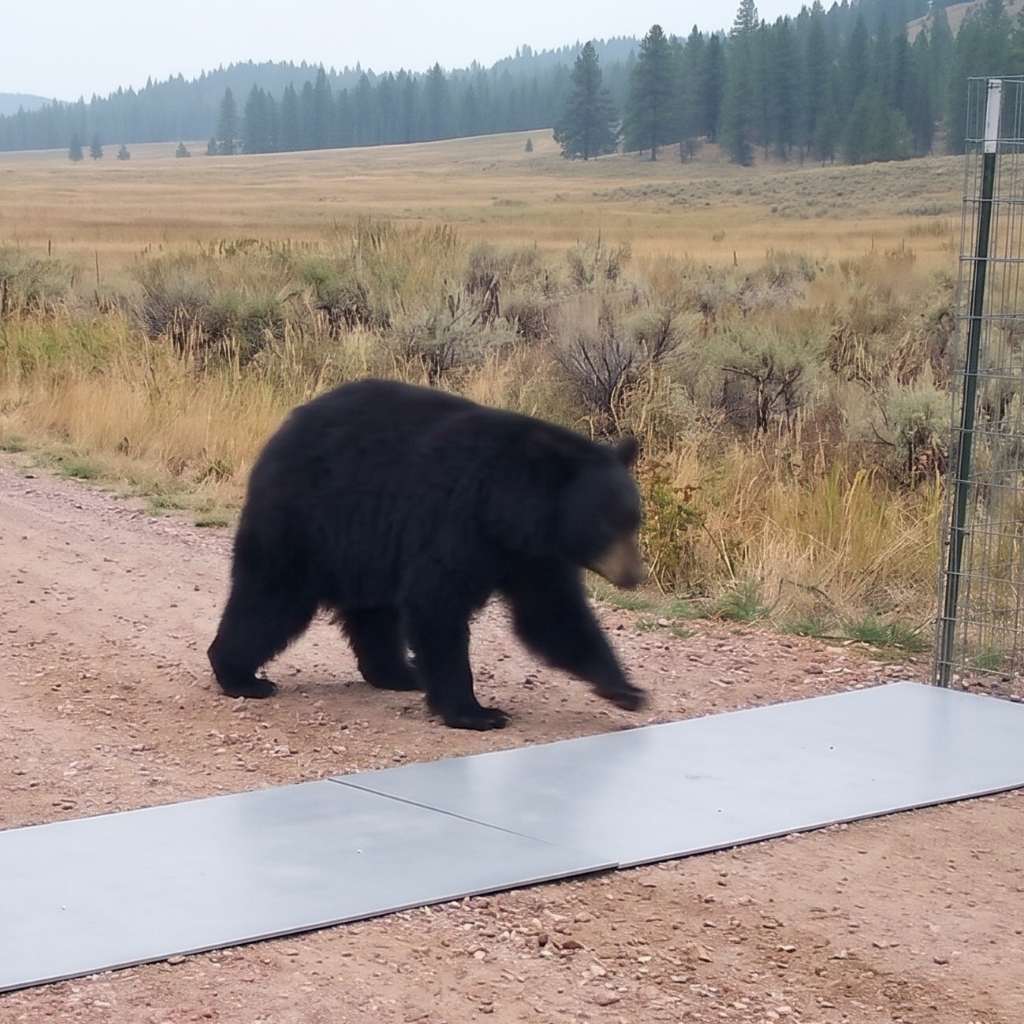
When ordinary steel road grates failed to keep black bears off U.S. Highway 93 in Montana, crews bolted solar-powered, drive-over electrified mats directly on top of the guards and across the concrete pit ledges that wide-pawed animals had been walking like tightropes.
Along this stretch of highway just south of Ravalli on the Flathead Indian Reservation, tall woven-wire fences run parallel to the pavement to funnel deer, elk, and bears toward safe underpasses and overpasses. Whenever a dirt access road or private driveway needs to join the highway, however, road crews have to cut a gap right through that protective fence.
To plug those openings without making drivers stop to open and close heavy gates, transportation agencies typically install metal wildlife guards in the roadbed, scaled-up versions of ranch cattle grates suspended over a shallow pit.
While those open steel grates do a reliable job of turning back hooved animals like deer and elk whose narrow hooves slip between the bars, animals with wide, padded paws treat them very differently.
When road ecologists monitored existing wildlife guards along the highway with motion-triggered cameras, the footage revealed just how easily clawed mammals defeated the standard steel grates. Coyotes, bobcats, mountain lions, and American black bears either walked straight across the flat metal bars with their broad paws or balanced along the narrow concrete retaining walls framing the edges of the pit.
Without an added deterrent, ordinary non-electrified wildlife guards stopped only about 45 percent of observed black bear crossing attempts, allowing more than half of the bears that tested the gap to walk straight onto the fenced highway right-of-way.
Between 2020 and 2023, researchers Marcel Huijser and Samantha Getty at Montana State University’s Western Transportation Institute tested their electrified modification at two access roads south of Ravalli. Rather than tearing out and rebuilding the existing wildlife guards, they Retrofitted the grates in place by anchoring flat, drive-over charged mats directly onto the steel surface and extending the electrified panels over the concrete side ledges.
Designed so cars, trucks, and snowplows could roll over them without damage, the mats delivered a high-voltage, low-amperage DC pulse similar to standard agricultural bear fencing, strong enough to deliver a sharp, memorable jolt without injuring the animal. At the roadside, the team also mounted push-button switches that allowed pedestrians walking dogs or leading horses to shut off the current for about one minute while crossing on foot.
Once the electrified mats were energized, the breach in the highway fence closed for bears.
Across the three-year field trial, the electrified guard assemblies stopped every observed black bear crossing attempt. Most bears that walked up to the access road within two meters of the grate stopped, inspected the setup, and turned back toward the surrounding habitat before even stepping onto the metal.
By reviewing the trail camera sequences recorded at the two Ravalli access points, Huijser and Getty estimated that without the electrified mats installed over the grates, at least three black bears and one grizzly bear (Ursus arctos) likely would have walked across the guards and entered the fenced highway corridor alongside high-speed traffic.
Image is for illustration purposes only
Source: Huijser, M. P., & Getty, S. C. (2023), Electrified Barriers Installed on Top of Wildlife Guards to Help Keep Large Wild Mammals Out of a Fenced Road Corridor, Report 4W8408, Western Transportation Institute, Montana State University / Montana Department of Transportation