
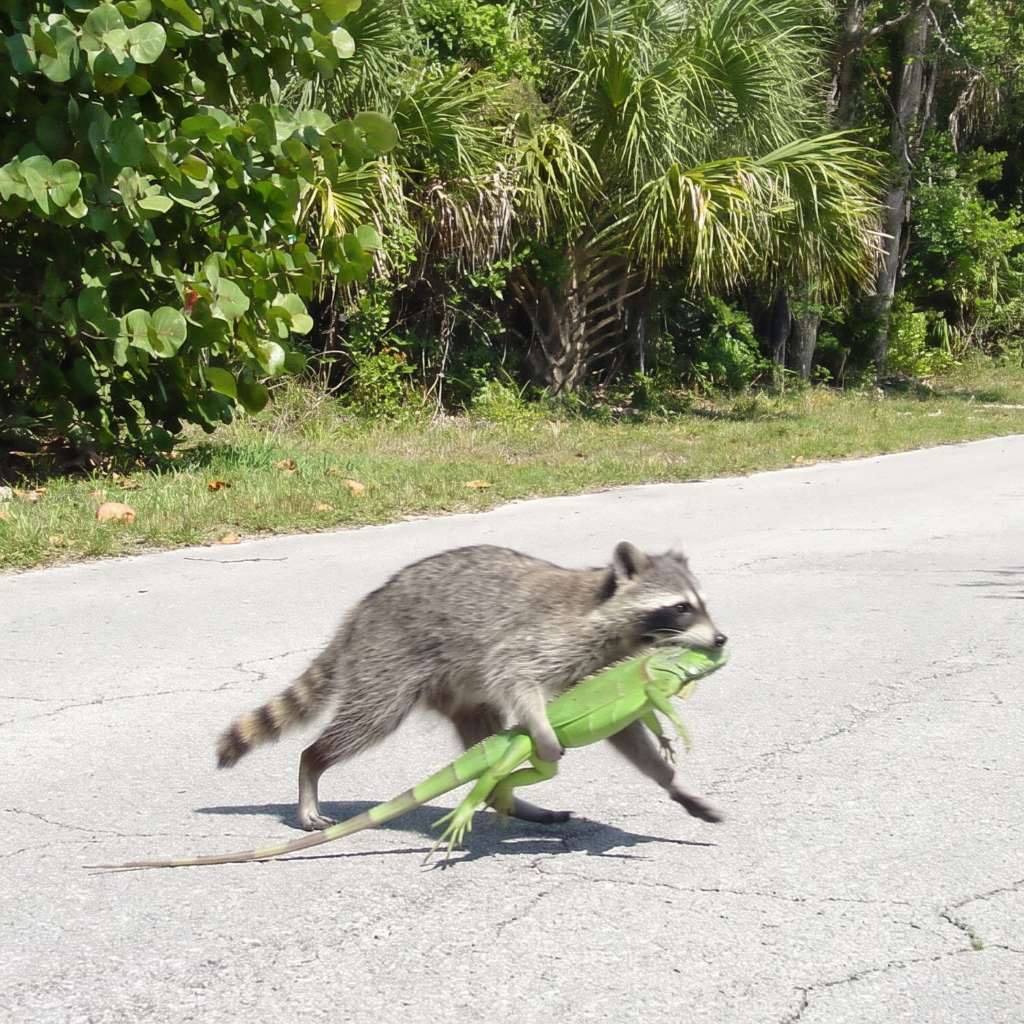
On October 16, 2006, two park rangers at Hugh Taylor Birch State Park in Fort Lauderdale, watched a raccoon bolt out of the coastal woods in bright midday sunlight, chasing a two-foot juvenile green iguana across an asphalt park road.
With temperatures sitting around 85 degrees Fahrenheit, the cold-blooded lizard was warm and running at full speed. When the juvenile iguana cut back across the pavement to reach the tree line, the raccoon closed the distance, clamped the reptile in its jaws, and carried it back into the maritime hammock.
From the moment the two animals burst onto the road until the raccoon disappeared into the brush with its catch, the entire pursuit took less than 15 seconds.
Less than a month later, at 3:35 p.m. on November 9, 2006, observers at the same urban state park watched a second daylight confrontation play out on the ground. This time, a young raccoon walked up to a large, basking adult male green iguana, circled the reptile on the grass, and lunged in to attack.
Unlike the two-foot juvenile caught on the road in October, the heavy adult male stood its ground, puffing up its body and fending off the smaller mammal until the raccoon backed away.
When wildlife biologist Henry T. Smith and his colleagues published both observations in the Journal of Kansas Herpetology in December 2006, the encounters solved a local puzzle that park staff had been tracking for over a decade.
Green iguanas were first spotted inside Hugh Taylor Birch State Park in 1994, trapped inside a 180-acre pocket of coastal hammock bordered by city streets on one side and the Intracoastal Waterway on the other. For the first six years, between 1994 and 2000, biologists surveying the park only ever saw a handful of large adult iguanas high in the trees, with zero sign of hatchlings or surviving juveniles anywhere on the grounds.
Then, in 2000, park managers trapped and removed 160 raccoons from the small urban park to bring down an overcrowded mammal population that had reached a density of roughly 238 raccoons per square kilometer.
Almost immediately after the raccoons were taken out, the green iguana population exploded. Starting in 2001, waves of new iguana hatchlings began showing up every year, and by 2006 the exotic reptiles had saturated every level of the park from the ground to the canopy.
Because raccoons are famous for digging up sea turtle and freshwater turtle eggs across Florida, biologists already suspected they were raiding shallow iguana nest burrows before the eggs could hatch. Watching raccoons actively run down a fast, warmed-up juvenile on open pavement and pick fights with full-grown males in broad daylight proved that the native mammals were also hunting the lizards directly, acting as a natural brake that kept the invasive reptiles in check until the predators were removed.
Image is for illustration purposes only.
Source: Smith, H. T., Meshaka, W. E., Jr., Engeman, R. M., Cross, S. M., & Foley, M. E. (2006), "Raccoon Predation as a Potential Limiting Factor in the Success of the Green Iguana in Southern Florida," Journal of Kansas Herpetology 20: 7-8.