
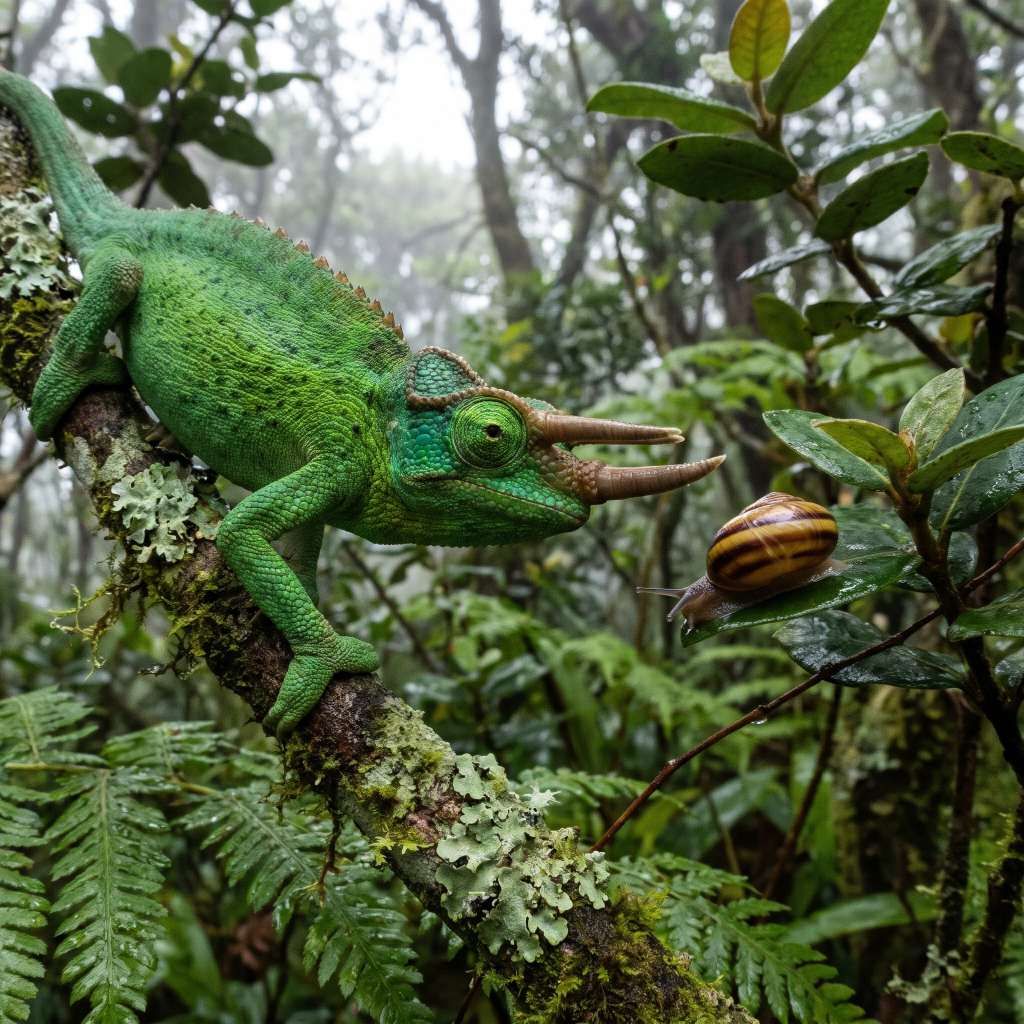
In 1972, a pet store owner in Kaneohe on the island of Oahu ordered three dozen Jackson’s chameleons (Trioceros jacksonii) from East Africa. When the shipment arrived after a long flight through California, the stressed and dehydrated reptiles looked to be in rough shape. Hoping the humid Hawaiian air and local insects would help them recover, the dealer set the chameleons out in his backyard bushes.
They recovered, walked off into the surrounding vegetation, and never came back.
More than five decades later, the descendants of that backyard release have spread across Oahu, Maui, Hawaii Island, Kauai, and Lanai, turning a striking three-horned African lizard into a quiet threat to some of the rarest forest invertebrates on Earth.
Native to the cool, misty highlands of Kenya and Tanzania at elevations between 5,000 and 8,000 feet, the Jackson’s chameleon was pre-adapted for Hawaii’s mid-elevation mountain forests. Unlike egg-laying lizards that require warm, specific soil conditions to incubate a clutch, female Jackson’s chameleons give birth to live young. After a gestation of five to six months, a single female drops between eight and 30 miniature, fully independent offspring straight onto the branches, ready to hunt within hours.
Because these slow-moving, bright green reptiles rely on camouflage and sit-and-wait ambush tactics rather than speed, people rarely notice how densely they pack into the canopy until someone sweeps the trees at night with a flashlight.
For decades, many residents viewed the horned lizards as harmless backyard curiosities that ate garden pests. In the early 2010s, however, wildlife biologists dissecting invasive chameleons pulled from native forest reserves discovered what the lizards were actually eating higher up in the mountains.
Hawaii’s isolated island ecosystems evolved for millions of years without any arboreal, projectile-tongue reptiles. As a result, native Hawaiian insects, spiders, and tree snails never developed defenses against a predator that looks like a leaf and strikes from two body lengths away in a fraction of a second.
When researchers Christinaaki and Brenden Holland at the University of Hawaii examined the stomach contents of wild-caught Jackson’s chameleons on Oahu and Maui, they found that the reptiles were not just snapping up winged flies. They were steadily consuming endemic caterpillars, native beetles, and critically endangered Oahu tree snails from the genus Achatinella.
Known in Hawaiian as kāhuli, these jewel-like tree snails once clung to native ʻōhiʻa and olomea trees by the hundreds of thousands, grazing on microscopic leaf fungi without damaging the plants. Having already lost much of their population to introduced rats, invasive predatory rosy wolfsnails, and nineteenth-century shell collectors, the surviving Achatinella species reproduce agonizingly slowly, often producing only one to four live young per year.
In controlled feeding trials and gut analyses published in Pacific Science in 2010, Holland and his colleagues confirmed that Jackson’s chameleons readily pluck small, hard-shelled snails directly off leaves and crush or digest them whole. Because the chameleons hunt high in the leafy canopy where ground traps cannot reach, they can strip an isolated patch of native forest of its remaining tree snails and endemic bugs before conservationists even realize the predators have moved into the watershed.
Moving the lizards around only accelerates the damage. Although Hawaii passed strict regulations making it illegal to transport chameleons between islands or release captured animals back into the wild, people still pick them up along hiking trails and carry them into new neighborhoods as backyard pets, unknowingly seeding the next forest invasion one bush at a time.
Image is for illustration purposes only
Source: Holland, B. S., Montgomery, S. L., & Costello, V. (2010) / Kraus, F. (2009), Alien Reptiles and Amphibians: A Scientific Compendium and Analysis.