
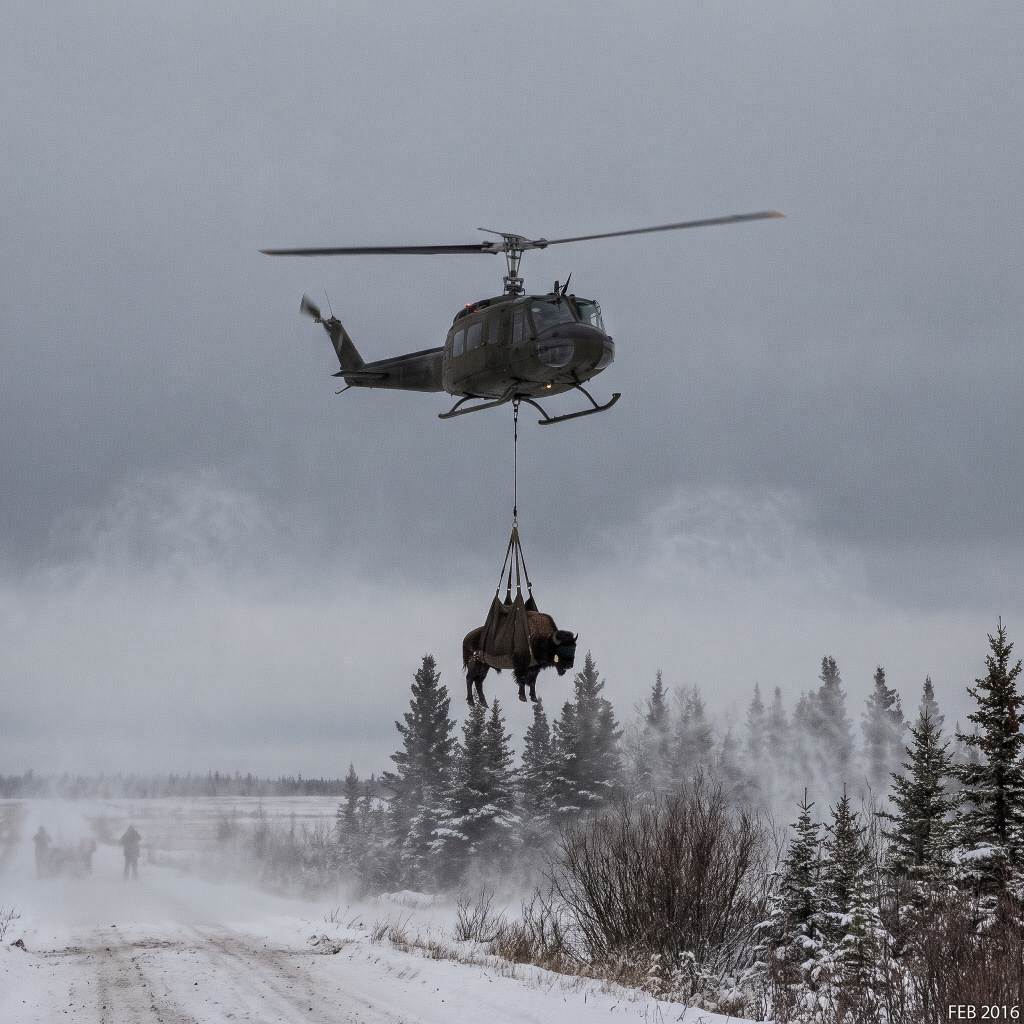
On February 23, 2016, a 1,200-pound wild wood bison hung in a canvas sling beneath a Huey helicopter, flying 22 miles across the frozen backcountry of western Alaska after a small Yukon River village refused to let him be killed.
Eight months earlier, in June 2015, the five-year-old male known as Bull #132 had been released near Shageluk alongside 17 other wood bison (Bison bison athabascae) as part of a historic effort to restore North America’s largest land mammal to its ancient Alaskan range. Instead of staying with the herd in the wetlands, the young bull swam across the Yukon River and wandered into the village of Grayling by July 31.
He showed up again in December and decided to spend the winter in town.
For weeks, Bull #132 walked the snowy roads between houses. He was not aggressive and consistently fled whenever residents approached, and local "bison guards" repeatedly hazed him back out of the settlement. Each time, however, the bull turned around and walked right back into Grayling, likely drawn to the hard-packed snowmachine trails that were much easier to travel than the deep winter drifts in the surrounding bush.
Having a half-ton animal rounding blind corners beside front porches and schoolyards posed an obvious safety hazard. In many wildlife management scenarios, a habituated 1,200-pound bull that refuses to leave a remote village with no road access to the outside world is put down.
When Alaska Department of Fish and Game wood bison biologist Tom Seaton consulted the community, however, Grayling’s elders and local leaders were unanimous. They did not want the bull shot.
To get him off the streets safely, Seaton and residents built a temporary corral in town and laid out a trail of hay. Within an hour, Bull #132 followed the bait straight inside. While state biologists worked out the logistics of extracting a massive ungulate from a bush village in midwinter, students from the Grayling school took over his daily care as a class project, hauling hay and water to keep the bull fed and calm inside the pen.
By late February, the rescue plan was ready. On February 23, Seaton tranquilized #132 inside the corral. Once the sedated bull went down, the team fitted him with a blindfold, supplied supplemental oxygen to keep his breathing steady in the cold, and rolled him onto a heavy sled pulled by a snowmachine to haul him to the village airstrip.
There, crews rigged the 1,200-pound bull into a specialized cargo sling hooked beneath a Bell UH-1 Huey helicopter.
Lifting off from the runway, the Huey carried #132 across 22 miles of snow-covered wilderness to a remote sedge meadow where another young bull had already been winter feeding. After the helicopter set him gently down in the snow, Seaton administered the reversal drug. Within four minutes, Bull #132 climbed to his feet, turned to sniff the empty sling lying in the drift beside him, and walked off into the willow brush to browse. Radio tracking over the next six days showed him staying within a mile of his new meadow.
Image is for illustration purposes only.
Source: Seaton, T., & Taras, M. (2016), "Flying Bison: Moving Wood Bison 132," Alaska Fish & Wildlife News, Alaska Department of Fish and Game.