
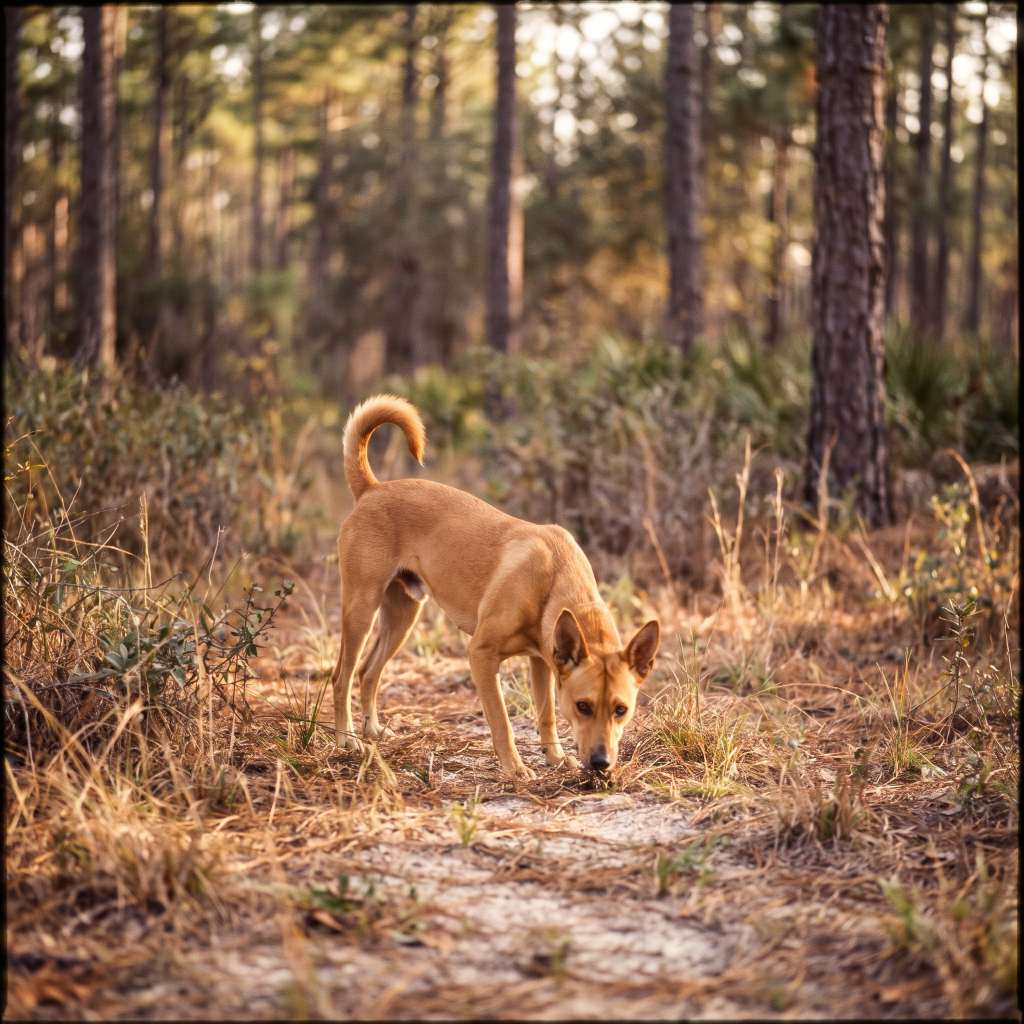
In the 1970s, an ecologist in South Carolina found himself staring at what looked like wild Australian dingoes caught in his research traps. Decades later, scientists are still debating where those swamp dogs actually came from.
The scientist was Dr. I. Lehr Brisbin Jr. of the University of Georgia’s Savannah River Ecology Laboratory. While conducting wildlife surveys inside the restricted 310-square-mile Savannah River nuclear reservation along the Georgia border, Brisbin kept capturing free-ranging dogs in his live traps.
Instead of the patchwork of farm hounds, Labradors, and terriers he expected to see near rural towns, the animals coming out of the longleaf pine savannas and bottomland swamps shared a uniform wild body plan. Weighing roughly 30 to 45 pounds, they had slender frames, deep chests, tucked waists, large upright ears, curved fishhook tails, and short ginger or tan coats that blended into dry broom sedge. Brisbin eventually gave them a name that stuck: the Carolina Dog, or the "Dixie dingo."
The dogs had survived in isolation partly because of where they lived. In the early 1950s, the federal government evacuated local farming communities and closed the vast Savannah River site to the public to build nuclear production facilities. Left alone inside hundreds of square miles of swamp and timber, the free-roaming packs lived off the land like native predators.
When Brisbin brought several of the trapped dogs into captive kennels to study them, their behavior set them even further apart from ordinary stray pets.
Whereas most domestic female dogs come into heat twice a year at any season, Carolina Dog females typically cycled once a year in the autumn, timing their litters for the milder late-winter months. In the kennel yards, pregnant and nursing mothers dug elaborate denning holes directly into the dirt.
Even stranger, both males and females used their snouts to dig small pits in the sand during the fall breeding season, urinating or defecating inside the holes before pushing dirt back over them with their noses. They also hunted small mammals with a high-arching, fox-like pounce and lacked the friendly, attention-seeking demeanor of dumped hunting dogs.
Looking for an explanation, Brisbin compared the Savannah River dogs to skeletal remains recovered from prehistoric Native American burial mounds across the Southeast, as well as early European accounts of the medium-sized, prick-eared dogs that once lived around Indigenous villages.
He proposed a striking hypothesis: rather than being recent runaways from 20th-century farms, the Dixie dingoes might be living remnants of the ancient dogs that accompanied humans across the Bering Land Bridge thousands of years ago, holding out in isolated Southern swamps after European breeds replaced indigenous dogs elsewhere.
In the years since Brisbin’s discovery, geneticists have tested that theory with mixed results.
A 2013 study led by Peter Savolainen at the KTH Royal Institute of Technology in Sweden examined mitochondrial DNA from Carolina Dogs and found that roughly a third of the sampled lineage carried an East Asian maternal haplotype (A184) that did not match modern European breeds, lending support to pre-Columbian roots.
However, a broader 2018 genomic study of ancient archeological dog remains led by Maire Ní Leathlobhair and Laurent Frantz found that indigenous North American dog populations had been nearly completely replaced after European contact, detecting little to no ancient pre-Columbian nuclear DNA in modern test samples of Carolina Dogs.
Because genetic studies have sampled different captive bloodlines and feral populations, how much ancient ancestry these dogs carry remains an open question. Equally uncertain is whether any of their old wild packs still survive.
While breeders and registry clubs now maintain the Carolina Dog in captivity across the country, rural development and crossbreeding with stray domestic dogs have made it difficult for biologists to confirm if any pure, self-sustaining packs still roam the isolated river swamps of South Carolina and Georgia on their own.
Image is for illustration purposes only
Source: Brisbin, I. L., Jr., & Risch, T. S. (1997), "Primitive dogs, their ecology and behavior: Unique opportunities to study the early stages of domestication," Journal of the Washington Academy of Sciences / van Asch, B., et al. (2013), "Pre-Columbian origins of Native American dog breeds," Proceedings of the Royal Society B / Ní Leathlobhair, M., et al. (2018), Science 361(6397): 81-85