
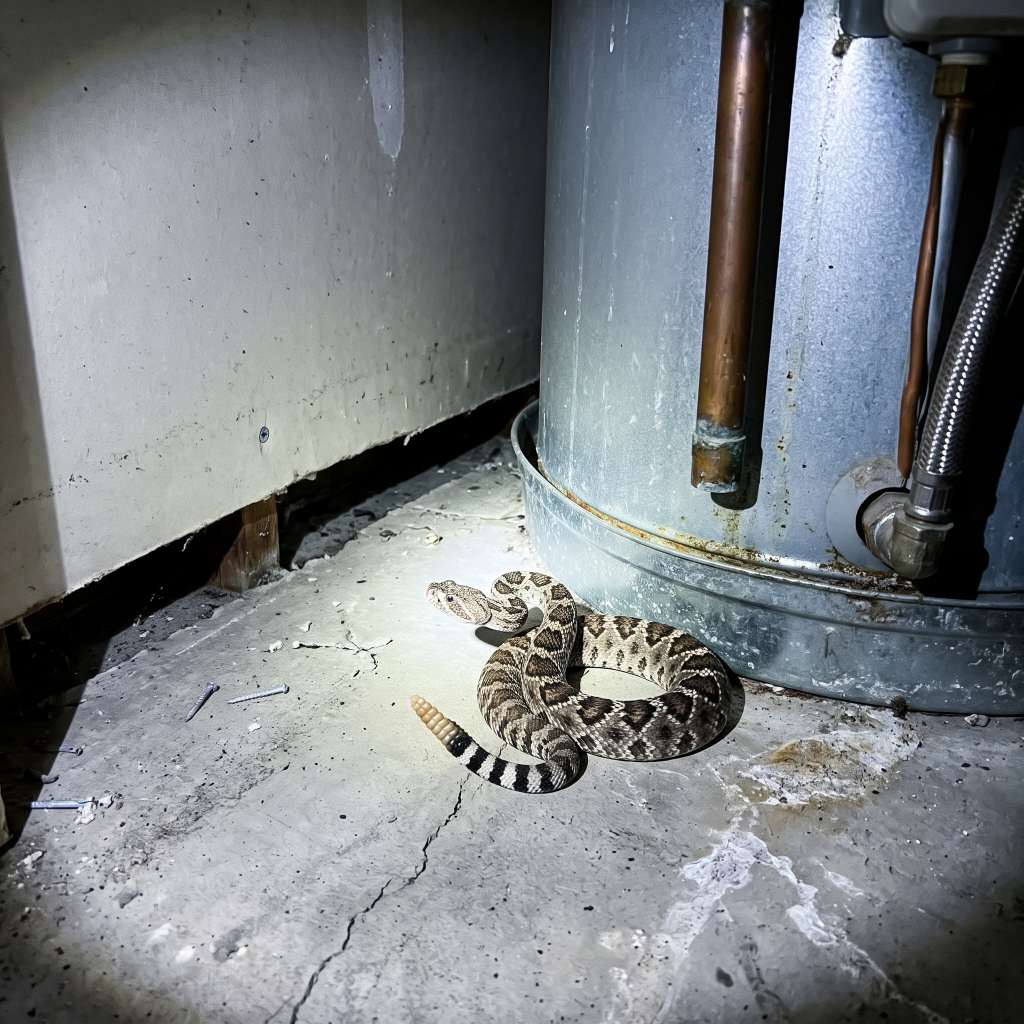
On August 31, 2019, a snake remover arrived at a home in Tucson, Arizona, to find that the homeowner had already scooped three baby western diamondback rattlesnakes into a plastic tub. By the end of the next day, two more rattlesnakes had been pulled from the exact same utility closet.
When the responder inspected the closet on that first afternoon to see how the young snakes were getting inside, a fourth neonate western diamondback turned up in the room. Looking closely at the walls and floor around the utility area, the remover traced the snakes' entry route to an unsealed gap underneath a flimsy section of drywall.
The job did not end with the fourth snake. The following day, September 1, a fifth western diamondback was captured right beside the water heater in the same closet, though the field log did not record whether that fifth snake was another newborn or an older individual.
While nobody crawled beneath the foundation to confirm where the snakes had come from, the homeowner mentioned a key piece of history during the call. Roughly a month earlier, they had watched a large adult rattlesnake slip underneath the house and disappear.
For a professional snake handler working in southern Arizona at the end of August, the timing and the location pointed to a straightforward explanation.
Unlike bullsnakes, kingsnakes, and most other North American reptiles that lay clutches of leathery eggs in the dirt, rattlesnakes are ovoviviparous. Females retain their developing embryos inside thin membranes within their bodies and give birth to live, fully formed young. Across the Sonoran Desert, late July through early September is the peak birthing season for western diamondbacks, coinciding with the late-summer monsoon rains when lizards, pocket mice, and fledgling birds are abundant.
When a heavy gravid female is ready to deliver a litter, which typically averages between 10 and 20 young, she seeks out a dark, sheltered microclimate safe from extreme desert heat and predators. In undisturbed desert scrub, that shelter is usually a deep rodent burrow, a packrat midden, or a rock crevice. In suburban Tucson neighborhoods, an accessible crawlspace or a hollow void beneath a concrete slab offers the exact same dark, temperature-stable protection.
Once born, baby diamondbacks are roughly 10 to 12 inches long, carry a single silent keratin "button" at the tip of their tails instead of a working rattle, and possess fully functional hollow fangs and venom glands from the moment they emerge. For the first week to ten days of their lives, neonates generally stay clustered near their mother and the birth site until they shed their skin for the first time and disperse in search of food.
If a female gives birth underneath a house, dispersing neonates simply follow dark edges, scent trails, and warm air currents until they reach daylight. When an unsealed plumbing penetration or a gap beneath a thin sheet of utility closet drywall opens inward rather than outward, the dispersing litter ends up crawling into the home around the base of the water heater.
Although the field log left it unconfirmed whether the big snake seen in July had delivered her litter beneath the floor, pulling five western diamondbacks out of one utility closet in 48 hours showed how easily a crawlspace gap can turn a utility room into a nursery exit.
Image is for illustration purposes only.
Source: Tucson, Arizona Snake Removal Field Log (Aug. 31 – Sept. 1, 2019) / Brennan, T. C., & Holycross, A. T. (2006), A Field Guide to Amphibians and Reptiles in Arizona.