
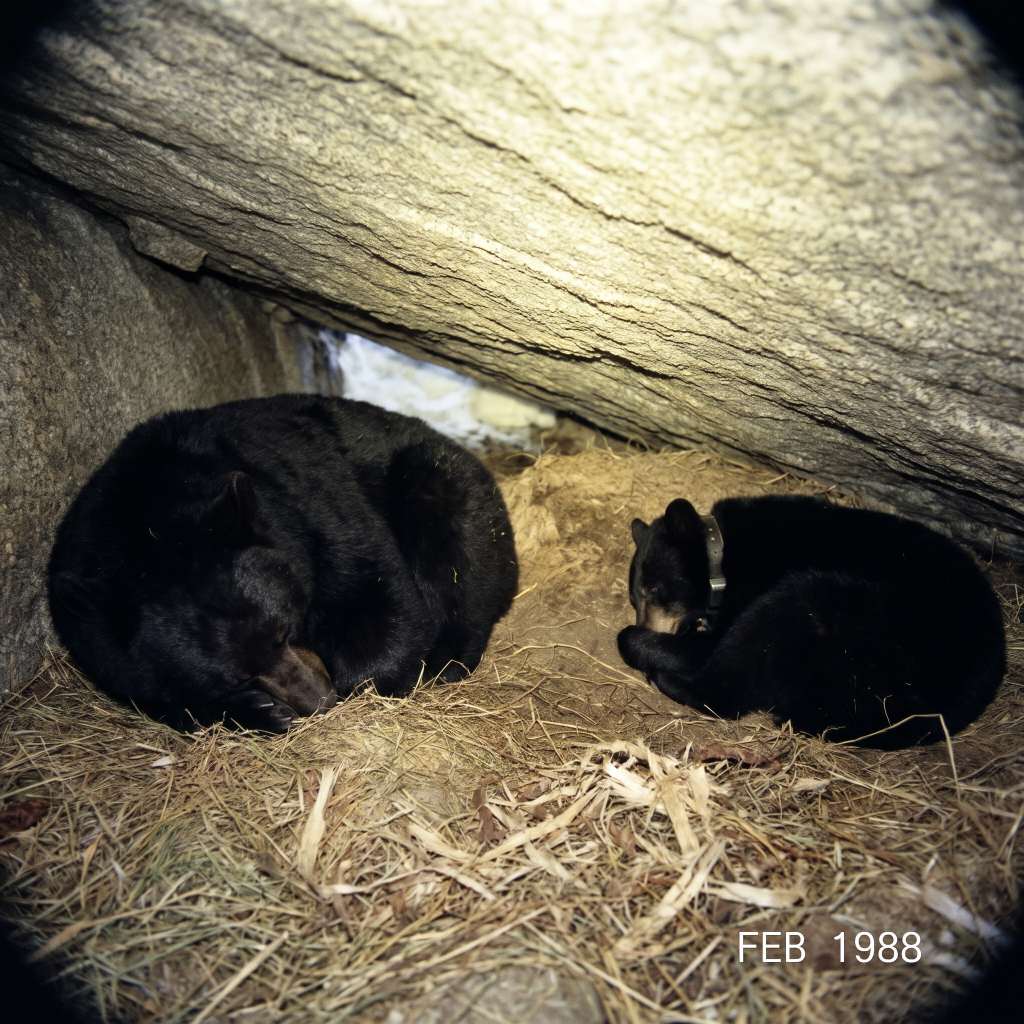
Two adult black bears of opposite sexes rarely, if ever, den together. In 1988, researchers in Nevada found a 90-pound female and a 260-pound male sharing one boulder.
Aside from mothers denning with their cubs or recently independent siblings occasionally sharing a winter shelter for an extra season, American black bears are solitary hibernators. When a large adult male encounters a much smaller bear in tight quarters, the smaller animal usually runs a serious risk of being killed.
Yet on February 21, 1988, when John M. Goodrich of the University of Nevada, Reno, and San J. Stiver of the Nevada Department of Wildlife crawled into a winter den at 8,100 feet in the Carson Range, there were no signs of a fight.
The biologists had hiked in during a field study to check on the 90-pound radio-collared female, an adult that their initial 1989 case report listed as four years old. The partly excavated shelter beneath the boulder had two entrances, one of which was sealed shut by the winter snowpack, and roughly 43 square feet of floor space covered with brush.
Inside that chamber, the bears had hollowed out two separate sleeping depressions spaced 80 centimeters apart, or about 32 inches. Curled up in one bed was the small female. Resting in the second bed less than three feet away was an eight-year-old boar weighing nearly three times her body weight. When Goodrich and Stiver looked in on them, the two bears were not touching.
Radio telemetry locations confirmed that the female had occupied the site all winter. While the researchers could not determine the exact date the 260-pound male had crawled under the boulder, they found no tracks in the snow outside to suggest a recent arrival. With the snowpack around the site estimated at three to six and a half feet deep, moving through the high country to find the den after December would have been difficult.
Once discovered on February 21, the pair remained at the den site together through the end of April.
Writing in the Great Basin Naturalist in July 1989, Goodrich and Stiver presented the observation as the first published record they knew of involving two adult black bears of opposite sexes sharing a winter den. Why the two ended up under the same rock remained an open question. The authors considered whether the bears had denned together to conserve body heat, though they doubted much warmth passed between two animals sleeping in separate beds nearly three feet apart. They also wondered whether the female could have been in heat during the winter visit, though her reproductive status was not checked in February.
Four months after peering into the snowbound chamber, the biologists got a second chapter to the story.
On June 16, 1988, the team recaptured the 90-pound female on the summer range and confirmed she had come into estrus. The very next day, June 17, they spotted her in the woods again, mating with the exact same 260-pound male she had spent the winter sleeping beside under the boulder.
Image is for illustration purposes only.
Source: Goodrich, J. M., & Stiver, S. J. (1989), "Co-occupancy of a Den by a Pair of Great Basin Black Bears," Great Basin Naturalist 49(3): 390-391.