
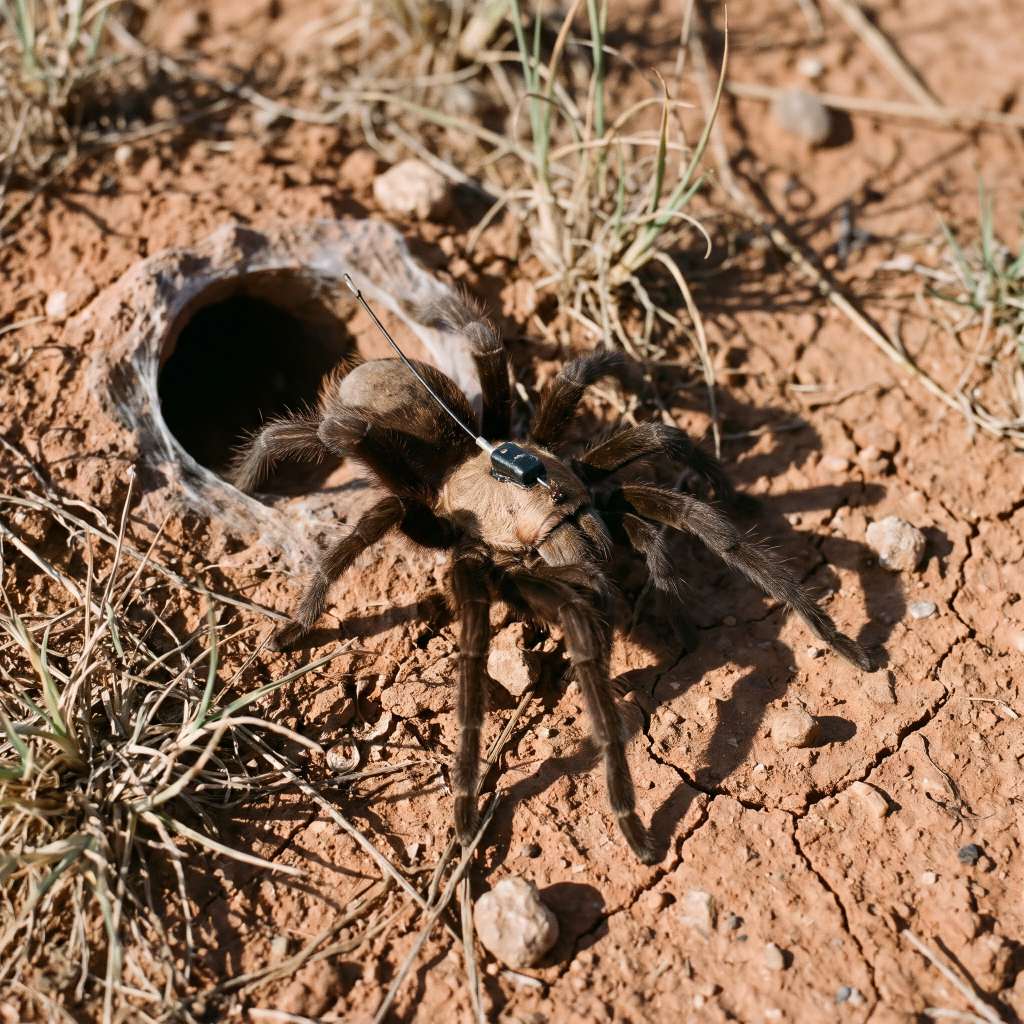
In 1994, biologists tracked a male Texas brown tarantula across a ranch near Electra for 24 days as he walked nearly a mile through the scrub. When his signal finally stopped moving, the researchers walked up to a burrow entrance and found his tiny radio transmitter sitting on the dirt, scratched up and wrapped completely in spider silk.
Inside the hole sat another large tarantula.
The tracking project took place on the massive W.T. Waggoner Estate in Wilbarger County, northern Texas, where biologists Fred Punzo and Linda Henderson were studying the mating marches of the Texas brown tarantula (Aphonopelma hentzi). Female tarantulas can live for decades inside the same silk-lined subterranean burrow, rarely straying more than a few feet from their front door. Once a male reaches sexual maturity, however, his life becomes a one-way search for mates before he dies.
Wait out the summer heat in a burrow, and a mature male misses his window to reproduce. Leave the burrow to roam the open pasture, and he exposes himself to roadrunners, lizards, skunks, and giant tarantula hawk wasps, along with the very real threat of being eaten by the heavier, territorial females he is trying to court.
Because wandering spiders are nearly impossible to follow through mesquite and shortgrass prairie at night without disturbing them, the researchers glued miniature radio transmitters weighing less than half a gram onto the carapaces of adult males and tracked their movements by antenna.
One of those spiders was cataloged as male #5-94.
Over the next 24 days, researchers mapped his nightly progress across the ranch as he searched for female burrows. By the time his trek ended, his mapped path totaled 0.82 miles, or roughly 1,440 yards, a massive distance for an arachnid picking its way over rough ground on a two-inch legspan. Another tracked male in the same study, cataloged as #12-94, pushed even farther across the pasture, covering 1.09 miles in just over 18 days.
Then the signal from #5-94 stopped changing position.
When the researchers followed the receiver pulses to the exact spot on the ground, they found themselves looking down at the entrance of an active tarantula burrow. Sitting right at the mouth of the tunnel was the radio transmitter they had glued to #5-94 more than three weeks earlier.
The tiny device had been completely wrapped in tarantula silk, and its protective outer coating was scored with fresh scratches and breaks, marks consistent with the crushing fangs of a large spider. When the biologists peered into the burrow beneath the silk-wrapped radio, they saw a large tarantula occupying the chamber inside.
Published in the Journal of Arachnology, the paper documented the crime scene at the burrow mouth without declaring a final verdict on what happened to #5-94. Whether a resident female killed and ate the wandering suitor at her doorstep and bundled his unpalatable plastic backpack in webbing, or whether the transmitter was torn loose during a violent confrontation that he somehow escaped, the spider himself was gone, leaving only his chewed-up radio wrapped in silk at the edge of the hole.
Image is for illustration purposes only.
Source: Janowski-Bell, M. E., & Horner, N. V. (1999), "Movement of the male brown tarantula, Aphonopelma hentzi (Araneae, Theraphosidae), using radio telemetry," Journal of Arachnology 27(2): 503-512