
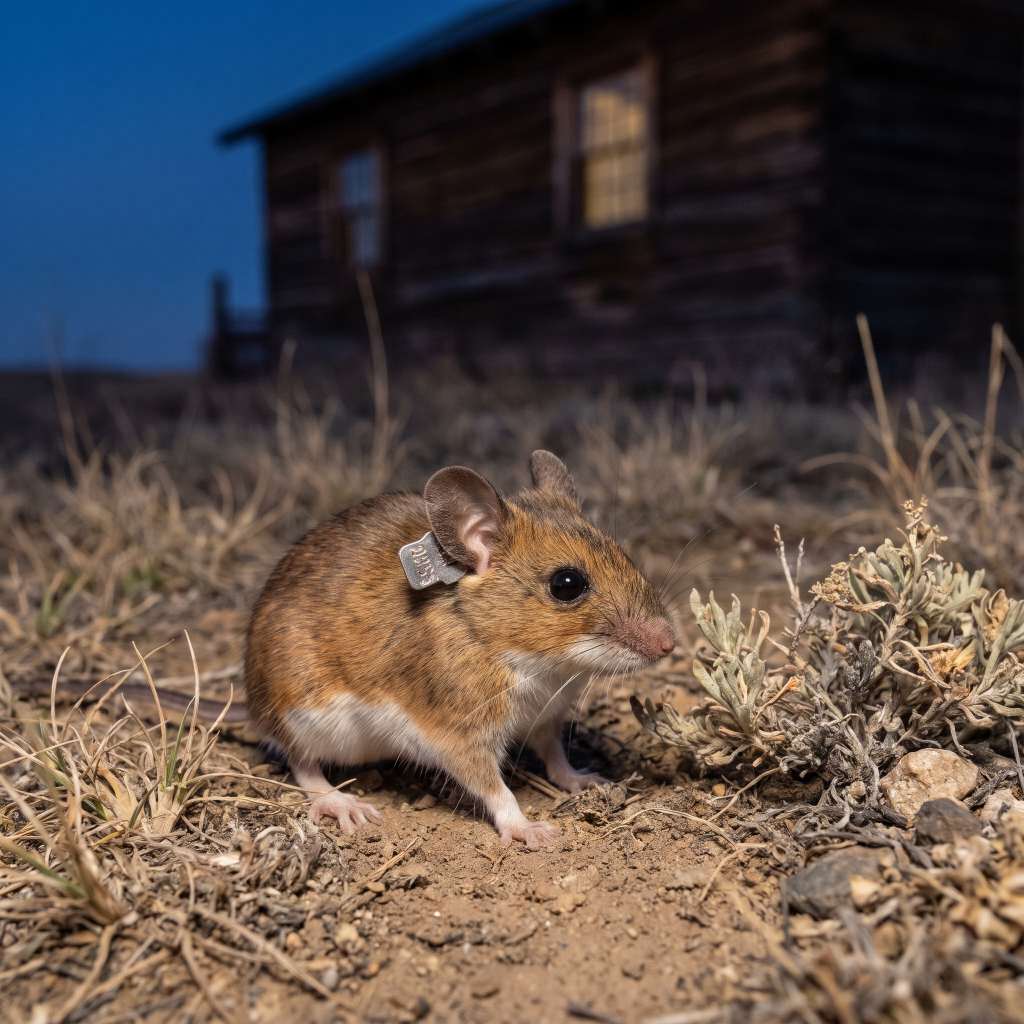
Biologists dropped an ear-tagged deer mouse nearly three-quarters of a mile into the southeastern Colorado prairie, and it walked right back into the same ranch bunkhouse before the next trapping session. Over the course of the experiment, researchers hauled that single mouse out four separate times at distances ranging from a third of a mile to nearly three-quarters of a mile, and it found its way back every single time.
For anyone who has ever caught a mouse in a live trap and driven it down the road to spare its life, a study led by Colorado State University virologist Charles H. Calisher shows what actually happens after the cage door opens. Between 1996 and 1998, Calisher and his colleagues set up a field test inside an old, mouse-infested ranch bunkhouse in southeastern Colorado.
The team was not studying rodent navigation out of sheer curiosity. They were tracking the primary reservoir of Sin Nombre hantavirus, a pathogen carried by the North American deer mouse and shed in its urine, droppings, and saliva. When dried waste gets stirred into the air inside enclosed spaces like cabins, sheds, or bunkhouses, inhaling the dust can trigger Hantavirus Pulmonary Syndrome, a severe and often fatal human respiratory disease first identified in the Four Corners region in 1993.
During fieldwork, homeowners frequently asked researchers whether live-trapping and relocating mice outside was a safe way to clear a building. Calisher’s team decided to test whether evicted deer mice actually stay gone.
Inside the bunkhouse, the researchers live-trapped 19 deer mice, fitted each one with a numbered metal ear tag, and began releasing them into the surrounding brush at steadily increasing distances from the building. Fourteen of the mice, mostly juveniles and subadults, never turned up in the bunkhouse traps again, likely picked off by owls, snakes, or coyotes in unfamiliar terrain, or forced to settle elsewhere.
Five adults, however, locked onto the bunkhouse like a compass needle.
Every one of those five homing mice made it back inside the building within 24 hours of release. Two of them covered roughly a third of a mile and half a mile in about six hours, crossing open country in a single night to slip back through the same walls before dawn.
Then there was the champion of the study. Across successive trapping sessions, researchers carried one remarkably persistent deer mouse out to about a third of a mile, then nearly two-thirds of a mile, then half a mile, and finally almost three-quarters of a mile. Each time, it navigated through predator-filled prairie and climbed right back into the bunkhouse traps. Within about six weeks, the researchers ran that same mouse through the last three releases all over again. It came back from every single drop.
Even that marathon runner did not set the all-time distance record for the species. Calisher’s report pointed back to a classic homing study by biologists Olaus J. Murie and Adolph Murie, who documented wild deer mice returning to their home ranges from release points between 700 yards and 1.25 miles away, a massive trek for a rodent weighing less than an ounce.
Published in the Centers for Disease Control and Prevention journal Emerging Infectious Diseases, Calisher’s findings delivered a blunt message for cabin and rural home owners. Catch-and-release trapping either dumps a naive mouse into unfamiliar territory where it quickly dies, or sends an experienced adult walking right back toward your pantry with any viruses it carries.
Because evicted deer mice routinely beat their drivers home, the authors concluded that their data strongly support snap trapping mice inside homes rather than releasing them alive outdoors.
Image is for illustration purposes only.
Source: Calisher, C. H., Sweeney, W. P., Root, J. J., & Beaty, B. J. (1999), "Navigational instinct: a reason not to live trap deer mice in residences," Emerging Infectious Diseases 5(1): 175-176, Centers for Disease Control and Prevention / Murie, O. J., & Murie, A. (1931), "Travels of Peromyscus," Journal of Mammalogy 12(3): 200-209.