
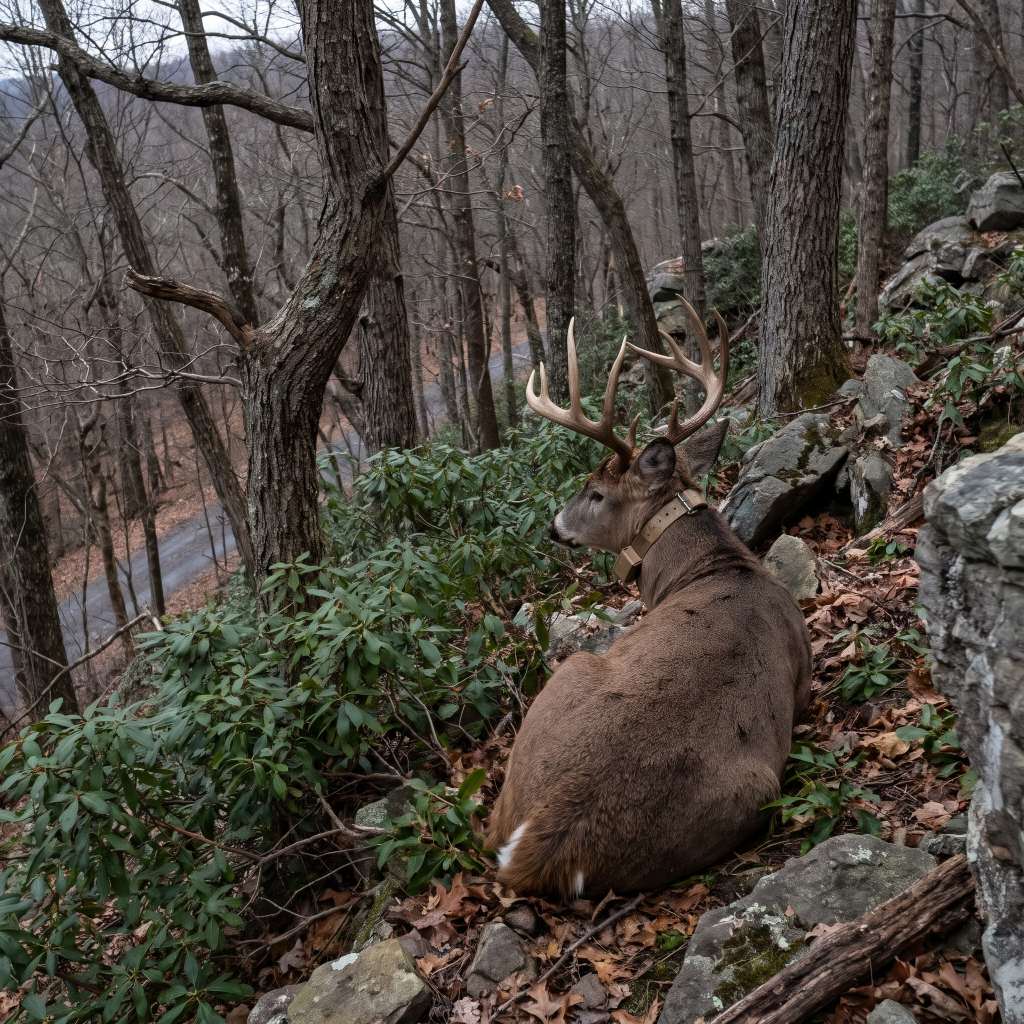
Researchers fitted a buck with a GPS collar programmed to track how a mature whitetail navigates one of the most heavily hunted public forests in North America.
On February 25, 2015, field crews with the Penn State Deer-Forest Study pulled that deer out of a Clover trap inside central Pennsylvania’s Bald Eagle State Forest. Designated as Buck 8393, the animal was already at least two and a half years old, meaning he had survived two full Pennsylvania hunting seasons before ever stepping into a research trap.
Before releasing him back into the mountain timber, the team tagged his ears and buckled on the satellite collar. For most of the year, the unit recorded his location every seven hours. When Pennsylvania’s autumn archery season opened, the tracking schedule tightened to every three hours. Once the late-November rifle season began and thousands of hunters in blaze orange headed into the state forest, the collar logged a satellite fix every 20 minutes.
For nearly three years, that collar beamed thousands of data points back to the university. Not once during those three years did a single field researcher ever lay eyes on Buck 8393 in the woods.
When the Penn State team, led by Duane Diefenbach and Bret Wallingford alongside project writer Jeannine Fleegle, mapped the buck's movements for their report titled "We Spied on Him for 3 Years," the GPS tracks showed why he was nearly impossible to spot. Outside of hunting season, Buck 8393 covered a standard home range across the ridges and hollows. As soon as rifle season opened, he shut his daytime movement down almost completely.
Instead of fleeing miles away when hunters entered the woods, the buck retreated to a brutal piece of vertical terrain inside his core range, spending his days tucked onto a steep mountain ridge with roughly a 40 percent slope. Most hunters walking the state forest naturally followed the gentler benches, saddles, and logging trails, passing right above or below the steep rock and laurel face where the buck lay motionless.
Even more counterintuitive was how he used the forest roads. The 20-minute GPS fixes showed that on multiple occasions during rifle season, Buck 8393 bedded down right alongside a gravel forest road. While hunters drove their trucks past him all morning looking for deep woods to hike into, and parked hundreds of yards away to walk into the timber, the buck stayed curled in the thick roadside cover watching the vehicles roll by.
Those two habits carried Buck 8393 through the 2015 and 2016 hunting seasons without a scratch, pushing him to at least four and a half years old, a rare milestone for a public-land buck in Pennsylvania.
His streak finally ran out on December 2, 2017. While moving along the southern edge of his home range during the first Saturday of rifle season, Buck 8393 crossed paths with a hunter who ended the three-year game of hide-and-seek and called in the ear tag number to the research team.
Image is for illustration purposes only.
Source: Penn State Deer-Forest Study (2018), "We Spied on Him for 3 Years" / Pennsylvania Cooperative Fish and Wildlife Research Unit / Pennsylvania Game Commission.