
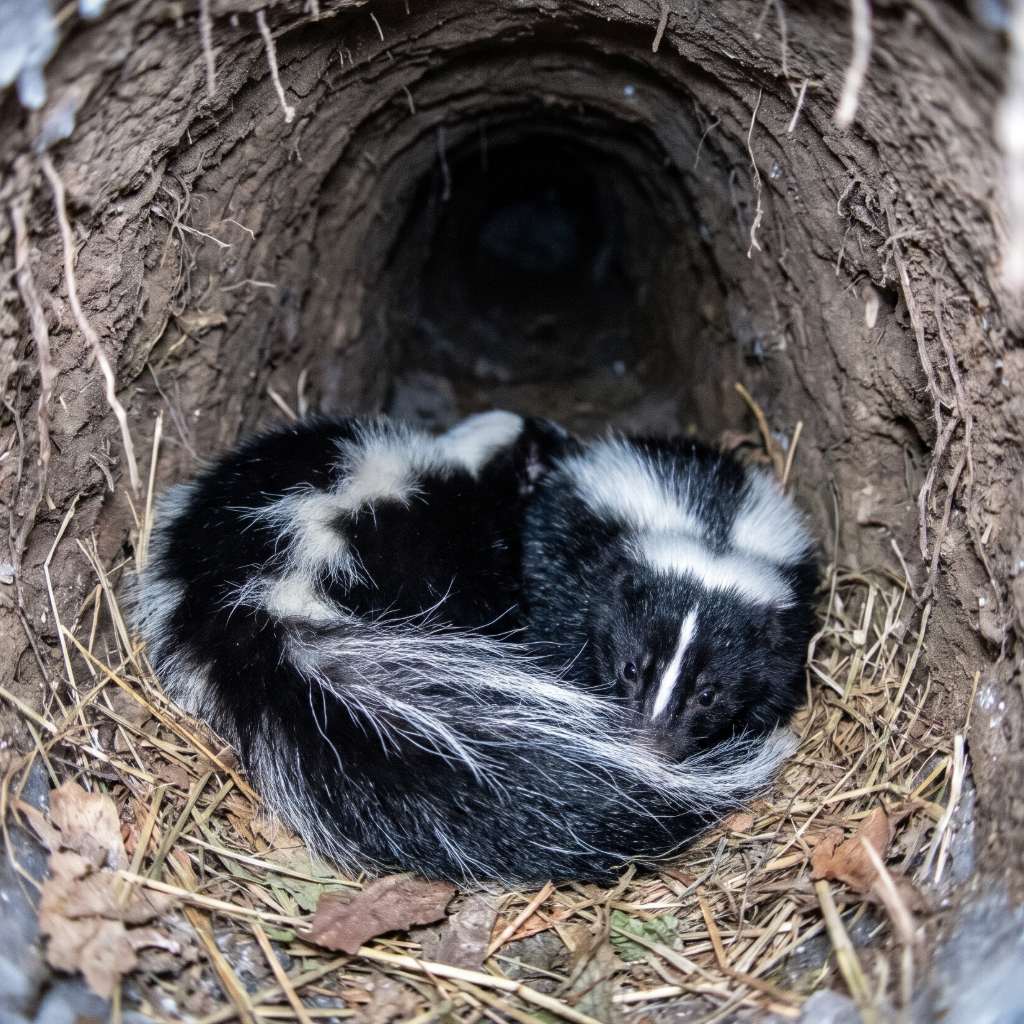
Striped skunks that spent winter alone let their body temperatures plunge. The ones that shared a den stayed warmer and still came out with more fat.
In a 2006 study published in Physiological and Biochemical Zoology, mammalian physiologists Yeen Ten Hwang, François Larivière, and Serge Messier tested how North America’s most recognizable backyard carnivore survives a northern winter without being a true hibernator.
Unlike groundhogs or ground squirrels that curl up in deep burrows and drop their core temperatures to near freezing for months at a time, striped skunks rely on brief bouts of daily torpor, lowering their metabolic rate and internal heat for a few hours before warming back up.
To measure how social behavior changes that winter equation, the researchers placed striped skunks in outdoor enclosures in Saskatchewan for 120 days, exposing them to natural winter temperatures and short winter daylight while cutting off their food supply to replicate the lean months underground.
One group of skunks was housed in solitary nest boxes, while the other group was housed together in communal dens so they could huddle through the cold. Internal temperature loggers tracked every rise and dip in their body heat from late autumn until spring.
The solitary skunks had to fight the cold by repeatedly shutting their bodies down. Over the four-month winter trial, skunks sleeping alone entered torpor an average of about 50 times, compared with just six times for the skunks sleeping in a group. During the deepest cold snaps, one solitary skunk allowed its core body temperature to plunge all the way down to 79 degrees Fahrenheit, roughly 20 degrees below normal.
On paper, dropping into torpor 50 times should have saved the lone skunks massive amounts of energy. In reality, waking back up from torpor requires a furnace blast of metabolic heat that burns through stored blubber at a brutal pace.
Because the grouped skunks pressed their fur-covered bodies together inside a single nest chamber, their combined body heat insulated the entire pile and shrunk the amount of surface area exposed to the freezing air.
The huddling animals rarely needed to drop into deep torpor at all. They stayed close to their normal body temperature throughout the 120-day fast, yet burned through their winter reserves far more slowly than the lone animals shivering and reheating next door.
When the researchers weighed and scanned the animals at the end of the four-month winter experiment, the solitary skunks had been stripped down to an average of just 9.3 percent body fat. The skunks that huddled together emerged from winter averaging 25.5 percent body fat, carrying nearly three times the energy reserves into the spring breeding season.
Image is for illustration purposes only.
Source: Hwang, Larivière & Messier (2007), Physiological and Biochemical Zoology 80(1): 138-145 / Theimer et al. (2016), Journal of Mammalogy / University of Chicago Press.