
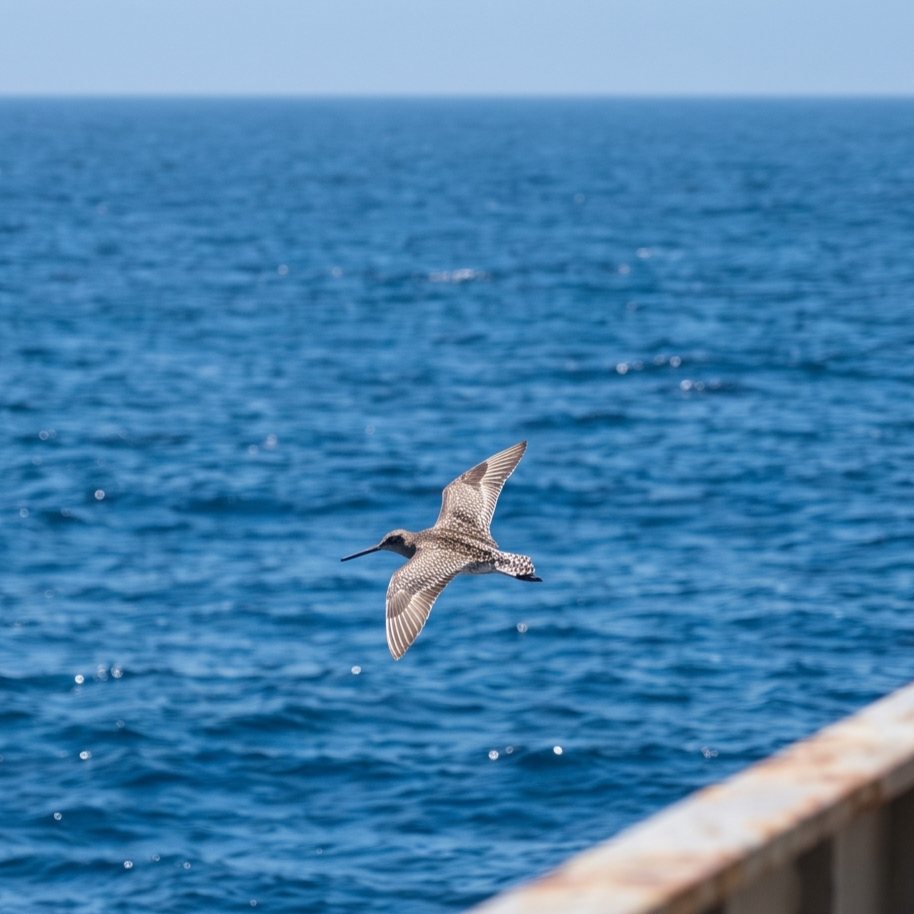
On July 15, 2022, wildlife biologists Jesse Conklin and Dan Ruthrauff caught a bar-tailed godwit chick on the coastal tundra near Nome, Alaska. Hatched in late June, the young shorebird was only about three weeks old and still could not fly.
Working with the U.S. Geological Survey and the Global Flyway Network, the researchers fitted that chick and two others from the same tundra brood area with satellite transmitters weighing less than two-tenths of an ounce, worn like miniature backpacks and powered by a solar panel the size of a postage stamp. Within days, two of the tags slipped off in the grass. The third stayed secure. In the official research logs, the young bird was known strictly by its six-digit transmitter code, 234684.
We have covered the legendary female bar-tailed godwit E7 before, the adult bird whose 2007 satellite track proved that the species crosses the entire Pacific Ocean between Alaska and New Zealand in a single flight. What makes the first southbound crossing of a juvenile godwit even harder to comprehend is how the generations split up in the fall. Adult godwits depart Alaska up to six weeks before the young of the year. When a four-month-old juvenile finally lifts off the mudflats for its first winter migration, it has no experienced adults to follow toward a continent it has never seen.
Through late summer, 234684 moved south to the vast mudflats of the Yukon-Kuskokwim Delta to gorge on worms and clams. Before departing, migrating godwits pack on so much subcutaneous fat that they roughly double their weight, while their digestive organs actually shrink to cut dead weight for the crossing. Once over open ocean, the shorebirds cannot land on the waves to rest. As Eric Woehler of BirdLife Tasmania noted, a godwit lacks webbed feet and waterproof plumage, meaning that if it touches down on open water, it cannot take off again and will drown.
On October 13, 2022, at roughly four months old, 234684 launched out over the Bering Sea.
The young bird initially angled southwest toward Japan before riding tailwinds southeast across the Aleutian chain and passing west of Hawaii. On October 19, the satellite pings showed the juvenile crossing directly over Kiribati, and two days later over Vanuatu. Both Pacific island chains offered shallow shorelines where an exhausted shorebird could have dropped down to rest and feed, yet 234684 kept climbing through the trade winds day and night.
Tracking the incoming coordinates, Ruthrauff and his colleagues watched on pins and needles as the bird passed 385 miles east of Sydney, flying south into the open Tasman Sea between Australia and New Zealand. On October 23, instead of banking east toward the classic godwit wintering grounds in New Zealand, the juvenile cut a sharp right turn straight west.
On October 24, the transmitter pinged from the quiet mudflats of Ansons Bay on the northeastern tip of Tasmania. The four-month-old bird had stayed aloft for 11 days and one hour without food, water, or rest, burning through at least half of its body weight in the air.
Guinness World Records certified the crossing at roughly 8,425 miles, breaking the previous nonstop record held since 2020 by an adult male godwit known as 4BBRW. When Conklin, Ruthrauff, and their colleagues published their full peer-reviewed analysis of the Alaska chick tracks in the journal Wader Study in April 2026, their own conservative path calculation measured the nonstop flight at approximately 8,320 miles. Even at the lower figure, the longest nonstop flight ever recorded for a landbird belonged to a juvenile making its very first trip south.
Image is for illustration purposes only.
Source: Conklin, Ruthrauff et al. (2026), Wader Study / U.S. Geological Survey / University of Alaska Fairbanks Geophysical Institute / BirdLife Tasmania / Guinness World Records.