
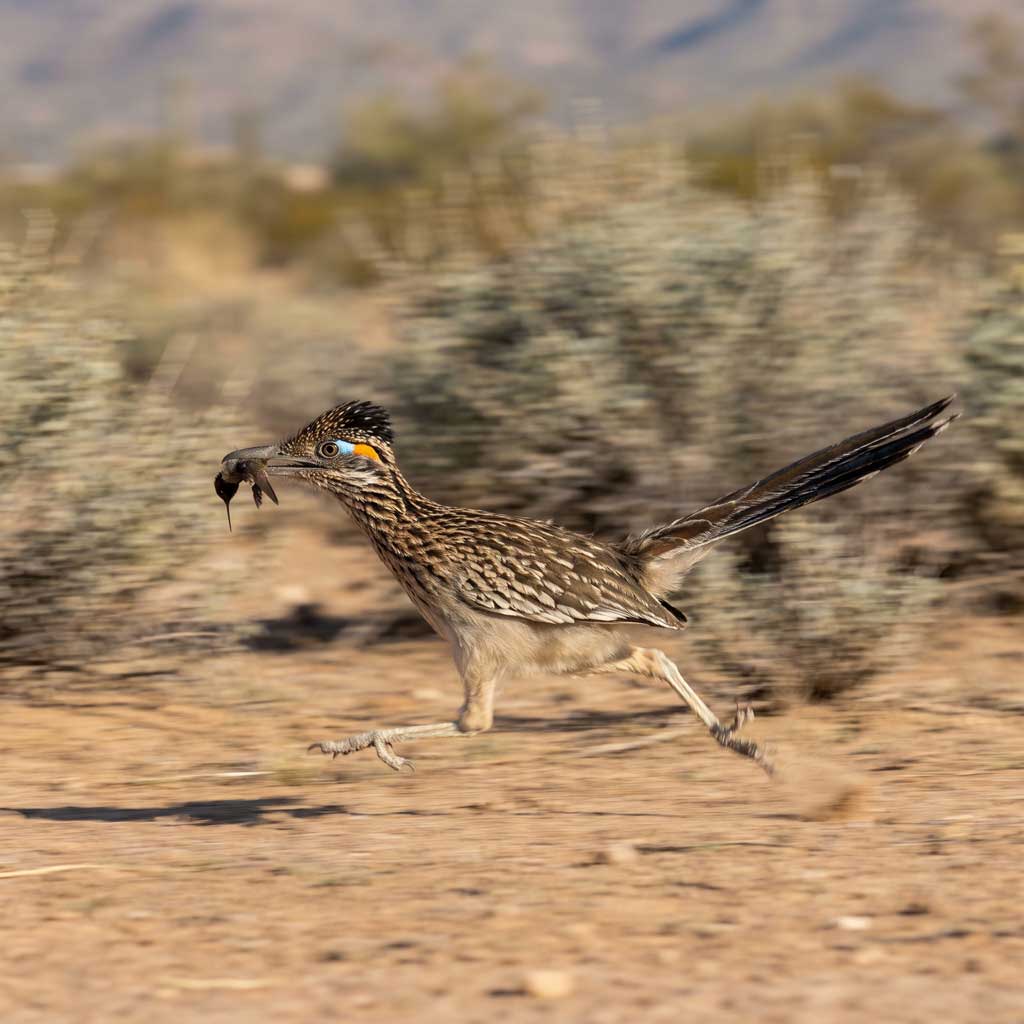
On April 28, 1974, ornithologist Sally Hoyt Spofford and her husband, Walter, were watching a crowd of hummingbirds buzz around the sugar-water feeders hanging from the eaves of their porch in Portal, Arizona. Looking up, they noticed one of the yard’s resident greater roadrunners crouched flat on the porch roof, nine feet off the ground, staring down at the feeders.
They had seen the big ground cuckoo lurk on the dirt underneath the feeders before, occasionally springing straight into the air in a failed attempt to snag a hovering bird. Up on the shingles, the roadrunner shifted its feet a few times and made a couple of false starts.
Then it launched off the edge of the roof, snapped a black-chinned hummingbird right out of the air in mid-flight, hit the ground with the bird clamped in its bill, and trotted off into the brush. Forty minutes later, a roadrunner sprinted back across the yard carrying a second, sparrow-sized bird in its beak.
People tend to picture roadrunners strictly as reptile hunters, sprinting down lizards and whipping rattlesnakes against desert rocks. At backyard feeding stations and desert waterholes across the Southwest, they are patient, calculating bird killers.
Spofford, who published her observations in The Condor in 1976, watched the local roadrunners work her Portal feeders all summer. On June 20, 1974, she and her husband caught a roadrunner down by their brush pile, methodically pounding a freshly caught black-chinned hummingbird against the dirt beneath a low-hanging feeder. When they walked toward it, the roadrunner ran off and dropped the hummingbird, which died in less than a minute.
A week after that, they found all the tail feathers of a female blue-throated hummingbird scattered under the feeder. That hummingbird had managed to rip free when the roadrunner’s bill clamped shut on its tail, and spent the next several days buzzing around the yard completely tailless.
Those attacks were not the work of a single oddball bird. The Birds of North America species account notes that roadrunners regularly stake out hummingbird feeders, hiding in the shade beneath a hanging bottle until a hummingbird drops low enough to be plucked out of the air with an upward leap.
The hummingbirds know the danger is down there. In a 1991 study published in Evolutionary Ecology, biologist Steven Lima tested the feeding habits of Anna’s hummingbirds in Arizona. Even when richer, more concentrated nectar was placed close to the ground, the hummingbirds routinely passed it up in favor of higher perches. Lima pointed directly to ground-ambushing predators, specifically the greater roadrunner, as the reason hummingbirds refuse to linger near the dirt.
Any small bird drawn to food or water in roadrunner country faces the same ambush. In 1970, ornithologist Dale Zimmerman documented roadrunners at a New Mexico feeding station stalking house sparrows and killing and eating an adult junco.
A year later, on October 24, 1971, Laurence Binford of the California Academy of Sciences and two companions were birding at Mesquite Spring in Death Valley when they spotted a rare migrant orchard oriole drinking at a tiny pool. As they watched, a roadrunner slipped silently through the low cover toward the water. The hunter froze with its neck stretched out flat, then exploded ten feet forward into the brush and stepped back out with the oriole screeching in its bill. Binford sprinted thirty yards after the roadrunner until it finally dropped its prize.
The stunned oriole lay panting on its back in the dirt before recovering in a mesquite tree, saved only because three biologists happened to interrupt a desert ambush that plays out at springs and feeders across the West every day.
Image is for illustration purposes only.
Source: Spofford (1976), The Condor 78(1): 142 / Lima (1991), Evolutionary Ecology 5(3): 220-230 / Binford (1971), California Birds 2: 139 / Zimmerman (1970), The Condor 72(4): 475-476.