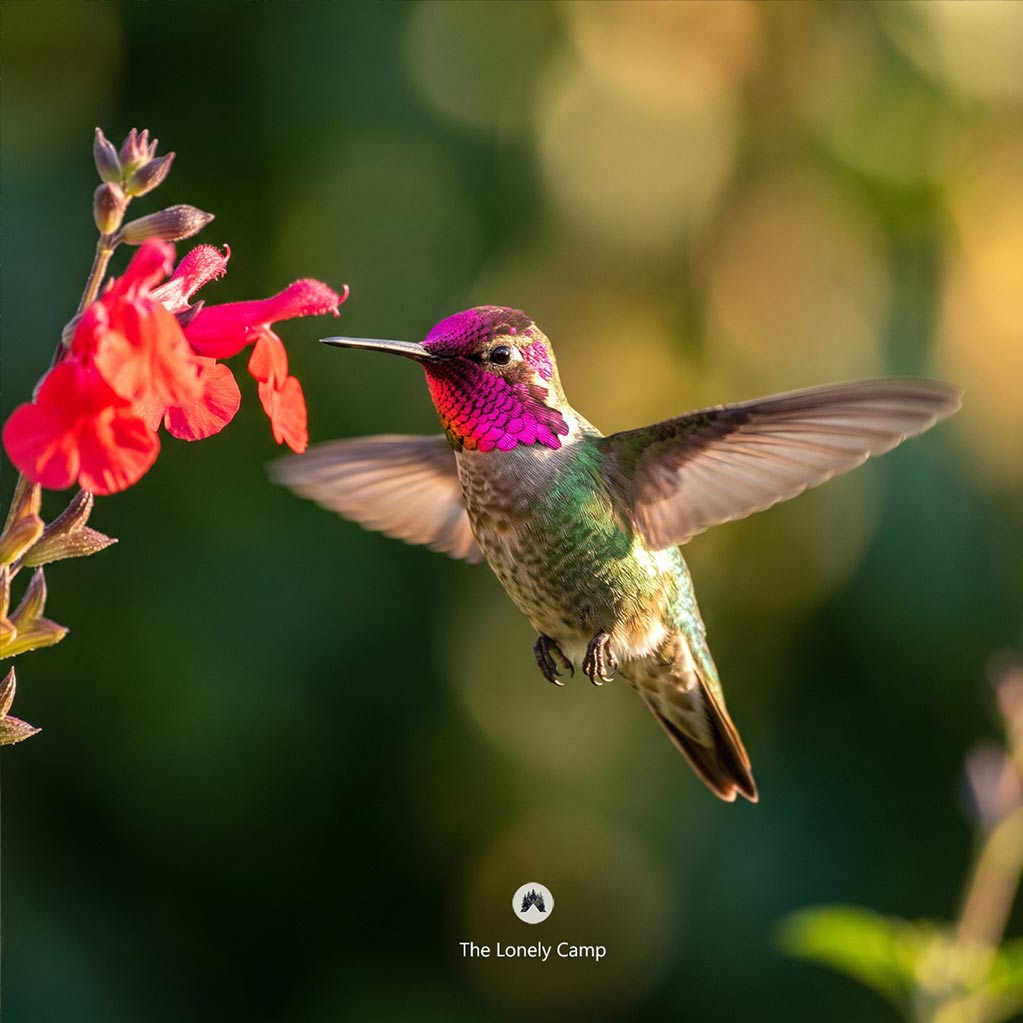
Hummingbirds see colors humans have no names for. Human eyes build every color we know using three types of cones in the retina, tuned to red, green, and blue light. When red and blue cones fire at the same time without green in the middle, our brains invent a combination color that does not exist as a single wavelength in the rainbow: purple.
Birds have those same three cones, plus a fourth one sensitive to ultraviolet light. In theory, that extra cone lets them see an entire set of combination colors that humans cannot see or even picture, such as ultraviolet mixed with green or ultraviolet mixed with red. For decades, though, nobody had shown that a wild bird actually tells those combinations apart in the real world.
To test it in the field, evolutionary biologist Mary Caswell Stoddard and her colleagues set up pairs of feeders in an alpine meadow at the Rocky Mountain Biological Laboratory in Gothic, Colorado, where wild broad-tailed hummingbirds spend the summer breeding.
Before sunrise each morning, the researchers filled one feeder with sugar water and the other with plain tap water. Right beside each feeder, a specialized LED tube glowed with a specific blend of light. The researchers regularly swapped the positions of the tubes so the birds had to rely on the color of the light rather than simply memorizing where the sugar water sat.
Over three summers and more than 6,000 feeder visits across 19 experiments, the wild hummingbirds learned to pick the sugar feeder using colors humans cannot see. Within hours of each setup, the birds reliably distinguished ultraviolet plus green from plain green, ultraviolet plus red from plain red, and ultraviolet plus yellow from plain yellow, as well as different shades of purple. To the human scientists watching from the grass, the pairs of glowing lights looked completely identical.
Publishing their findings in the Proceedings of the National Academy of Sciences in 2020, the team also analyzed 3,315 feather and plant colors. They concluded that roughly a third of those natural surfaces reflect light in ways that likely look like these combination colors to birds.
The study does not show what those colors actually look like inside a hummingbird's head, and no camera screen can display them for us. What it proves is that the birds easily tell those wavelengths apart in the wild, meaning the mountain flowers and iridescent feathers we think we know look entirely different to the birds visiting them.
Image is for illustration purposes only.
Source: Stoddard et al. (2020), Proceedings of the National Academy of Sciences / University of Maryland Department of Biology.
Wild Broad-Tailed Hummingbirds Distinguish Colors Humans Cannot See