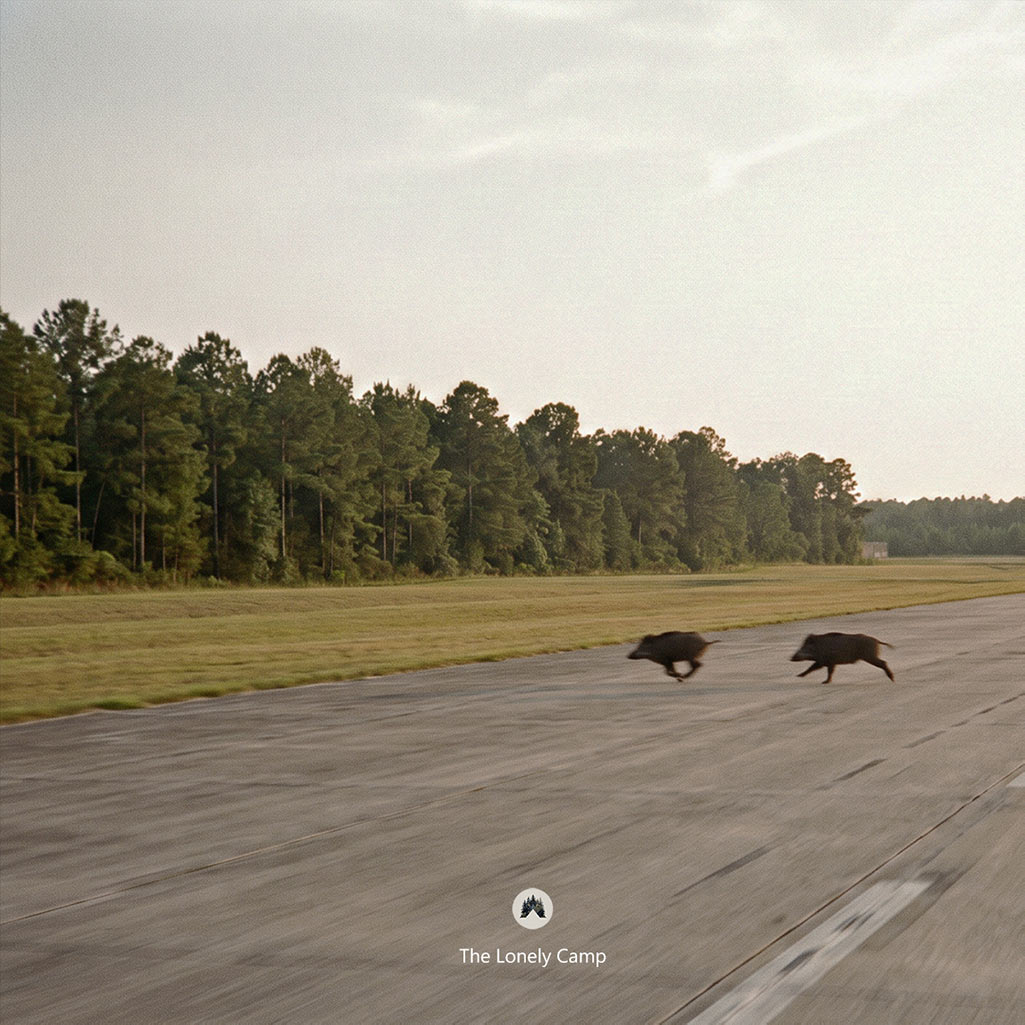
In June 1988, two wild hogs walked onto the runway at Jacksonville International Airport just as an F-16 fighter came in to land. The jet hit them at landing speed and lost its gear.
The pilot was Lt. Col. Sam Carter of the Florida Air National Guard’s 159th Fighter-Interceptor Squadron, which flew F-16s out of the Air National Guard base on the north side of the airport. On June 7, 1988, he was coming home from a training flight in F-16A serial number 81-0713. As the jet touched down, two pigs ran across the runway directly in front of it.
A landing F-16 is still moving at well over 100 miles an hour when its wheels meet the pavement. At that speed there is no swerving and no stopping short. The jet struck the hogs, and the impact sheared off the left main landing gear. With one side of its undercarriage gone, the fighter could no longer hold the runway. It veered off the pavement, and Carter ejected. He came down bruised. Both pigs were killed.
Some accounts still describe the $16 million jet as destroyed. According to the airframe records kept for the F-16 fleet, it was not. The damage came to $487,000. Crews replaced about 900 parts, including all of the landing gear, the speed brakes, both horizontal stabilizers, the nose, the canopy and most of the instruments in the cockpit. On May 14, 1989, eleven months after the crash, the jet flew again. Carter was at the controls. It went on to be converted into the air defense version of the F-16 and was photographed still flying with the same Jacksonville squadron in 1993.
Wild pigs had been in Florida far longer than airplanes. They are descended mainly from domestic hogs brought by Spanish explorers in the 1500s and from later free-ranging farm stock, and today they live in every county in the state, in one of the largest feral hog populations in the country. They root through pastures and pine flatwoods, travel at dusk and dawn, and they will cross open ground to get from one patch of cover to the next. An airport surrounded by woods and wetlands, with wide mowed fields on either side of the runways, sits squarely in their kind of country.
That has not changed. Jacksonville International still sits in a rural part of Duval County, and the airport employs a certified wildlife biologist, Alison Doran, whose job is to keep animals away from aircraft. “Jacksonville is in a very rural area, so we have more wildlife compared to places like Newark or Reagan National,” she said. Birds are the most frequent problem, mainly egrets, hawks, vultures and swallows, but large mammals are the ones that can do the kind of damage the hogs did in 1988.
Much of the work is habitat. Crews keep the grass along the runways between 6 and 12 inches tall, because taller grass draws small mammals, and small mammals draw predators. Parts of the airfield that used to be wetlands have been reshaped to stop attracting birds. When that is not enough, the team uses air cannons and pyrotechnic launchers to drive animals off the airfield before aircraft come through.
The F-16 that hit the pigs outlived the 159th’s use of it. Of the two fighters the squadron crashed at Jacksonville in 1988, it was the only one that flew again. The other, lost in March of that year after running out of fuel on approach, was a total write-off.
Image is for illustration purposes only.
Source: F-16net airframe database (81-0713) / Aviation Safety Network / News4JAX (2025) / Florida Fish and Wildlife Conservation Commission
Wild Hogs Hit an F-16 at Jacksonville International Airport