
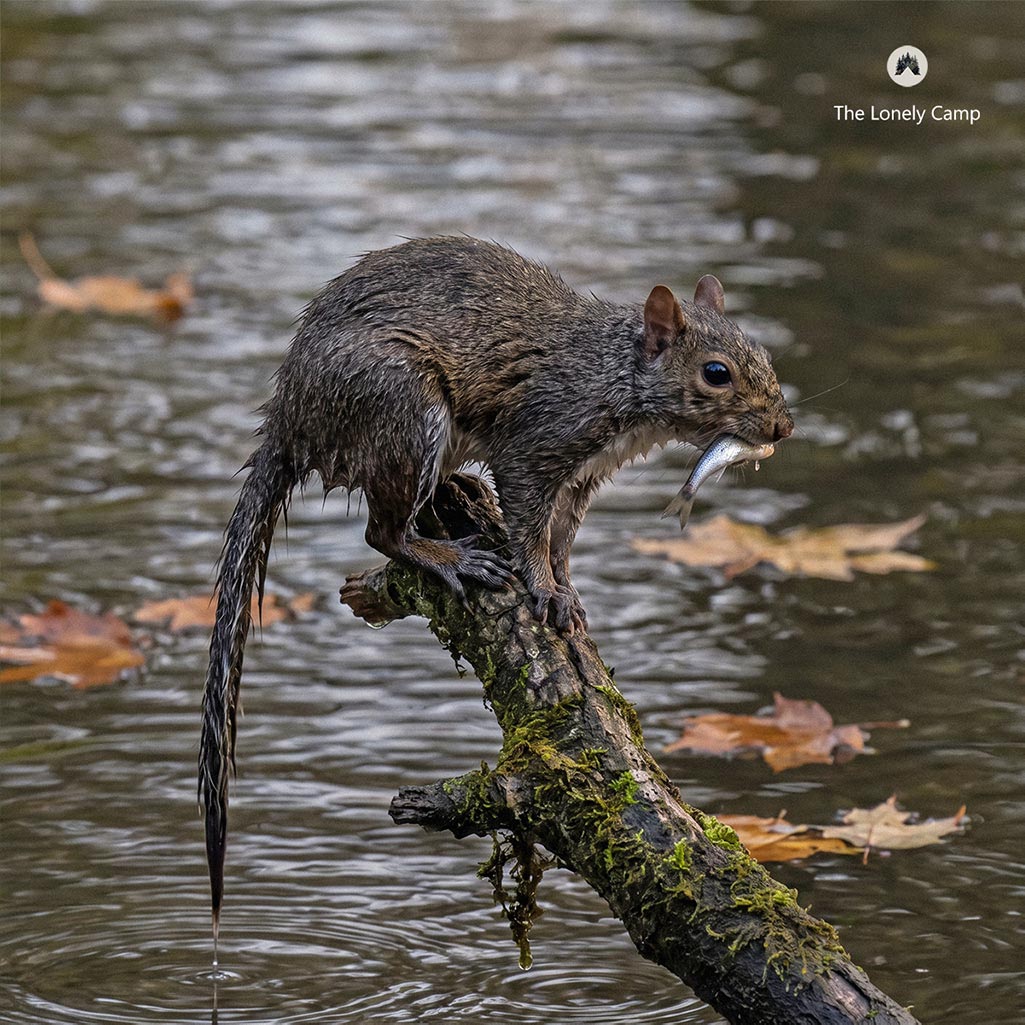
Around 6 p.m. on September 27, 2018, three biology graduate students from the University of Guelph were paddling down the Speed River in Ontario when they spotted an eastern gray squirrel sitting on a dead log that leaned out over the water.
The students were out on a canoe trip put together by their department's mental health and wellness committee, and the river was running low. As their canoe drifted toward the snag, the squirrel dove headfirst into the river and went completely underwater.
At first glance, it looked like a startled animal bailing out to get away from an approaching boat. A few seconds later, the squirrel proved them wrong. It broke the surface, swam straight back to the exact same log with a live fish clamped in its mouth, and climbed out of the water.
The fish was small, about an inch and a half to two inches long. The squirrel sat on the deadfall and started eating the fish right in front of the canoe before carrying the rest of its catch into the thick brush along the bank.
In 2020, the three students published what they saw in the Canadian Field-Naturalist. While plenty of backyard photos and rumors float around the internet, their paper was the first time anyone had formally documented a wild squirrel diving into water to hunt and catch a live fish in the scientific record.
Anyone who spends enough time in the woods knows that squirrels are not pure vegetarians. Stomach analyses and field notes going back to the 1920s show that squirrels will eat meat when they can get it, including insects, bird eggs, nestlings, and small rodents, both scavenged and killed outright. Even so, meat makes up less than 5 percent of an eastern gray squirrel's diet, and almost all of it is caught on dry ground or up in the branches.
The water is what made the Guelph sighting so unusual. While American red squirrels are strong, regular swimmers, with one documented crossing more than a mile of open water, gray squirrels generally stay out of rivers and lakes. Historically, the main times naturalists ever saw gray squirrels in the water were during massive autumn population movements, like the famous "squirrel emigrations" recorded in Wisconsin in 1947 and across New England in the early 1960s, when thousands of hungry squirrels marched across the landscape at once and washed up drowned along riverbanks.
Why this particular squirrel went fishing is anybody's guess. Biologists usually figure squirrels turn to meat for extra protein and calcium during the breeding season, or kill smaller animals while defending a territory, or hunt when nuts and seeds run short in the fall.
Late September in Ontario sits outside both of the gray squirrel's yearly breeding peaks, and the animal was not defending a nest. A fall food crunch made the most sense on paper, though the students noted the woods along the Speed River still had plenty of nuts and seeds on the ground.
It is possible that heavy competition from other squirrels pushed this individual to try hunting the shallow water, or that a few squirrels along that stretch of river had simply figured out an easy way to grab a meal when the water dropped low.
Image is for illustration purposes only.
Source: Sutton, Fuirst & Bill (2020), Canadian Field-Naturalist 134(1): 42–44.