A false rumor nearly brought mongooses to California in 1892, and eight years later Congress banned them by name to keep them off the mainland, for good reason.
In February 1872, a Jamaican sugar planter named W. Bancroft Espeut brought nine mongooses from India to clear the rats out of his cane. There were four males and five females. Within a few years they had spread across the whole island. Rat numbers fell, and within a decade planters were crediting the animals with saving them around £45,000.
Then the mongooses moved on to everything else. A government commission appointed in 1890 gathered the evidence. The animals were killing young pigs, lambs, kittens, puppies and poultry. They dug up the eggs of ground-nesting birds and sea turtles and ate snakes, lizards, frogs and land crabs. The Jamaica petrel nearly disappeared. So did the island's introduced bobwhite quail, a North American bird. With fewer lizards and ground birds around to eat them, ticks became a serious pest.
By then the planters had already shipped mongooses to other cane islands. They went to Cuba, Barbados, Grenada and St. Croix, and reached Puerto Rico around 1877. Hawaii's sugar growers brought in a shipment from Jamaica in 1883. Nine years later the Kingdom of Hawaii banned importing, breeding or keeping a mongoose. The government offered bounties on them, and according to the federal Biological Survey nobody bothered to claim them, because the animals were already seen as "a necessary evil."
That same year the mongoose nearly reached California. In 1892 a report spread that the US Department of Agriculture was about to release mongooses to control gophers. The report was false, but people believed it, and some began arranging to get animals from Honolulu. Biological Survey naturalist T.S. Palmer later wrote that the shipments were stopped "by the most strenuous efforts." He credited the quarantine officer at the port of San Francisco with keeping the state free of them.
In 1898 Palmer wrote a report for the Department of Agriculture arguing that the mongoose had to be kept out of the United States. He named the two places it would most likely come from, Hawaii and Puerto Rico. Two years later Congress passed the Lacey Act. Its import ban named four animals, and the mongoose was listed first. Two of the others were birds, the English sparrow and the starling. Both were dropped in 1960 because they had already spread across the country. The mongoose is still written into the law by species name.
The ban was tested in November 1962. A sailor off a ship that had called in India gave a mongoose to the zoo in Duluth, Minnesota, and federal officials ordered it killed. The city fought back, and Interior Secretary Stewart Udall signed a reprieve. Mr. Magoo lived at the zoo until January 1968. He could never have started an infestation, because he was a single male. The city had even offered to have him neutered.
In 1966 the ban was widened to 19 species, meerkats included. Ten years later came the closest call on record. In 1976 the US Fish and Wildlife Service got reports of a mongoose at the Port of Miami on Dodge Island. Trapping turned up one young female. People working nearby said two more had been killed by cars a month earlier. That makes at least three animals loose on the mainland, with a female among them. No more were found, and the incursion is recorded as eradicated.
Mongooses are still established on four Hawaiian islands and throughout the US Caribbean territories. In Puerto Rico they account for most of the island's reported rabies cases. A 2017 federal court ruling allowed most injurious species to be moved between mainland states. Importing a mongoose is still a federal crime, and so is bringing one to the mainland from Hawaii, Puerto Rico or the Virgin Islands.
In its native range, which runs from the Middle East across Pakistan and India, the small Indian mongoose is an ordinary animal doing an ordinary job. It hunts rats, insects, frogs, crabs, lizards and snakes, and takes eggs and fruit when it comes across them. The ground birds and reptiles in that part of the world have lived alongside mongooses and other small ground predators for a very long time, and they nest, hide and breed in ways that account for them. It is part of the ecosystem there.
The animal that cleared the ground birds out of Jamaica and Hawaii was behaving there exactly as it behaves in an Indian field. On islands where nothing had ever hunted along the ground, that same behavior took out species that had no defense against it.
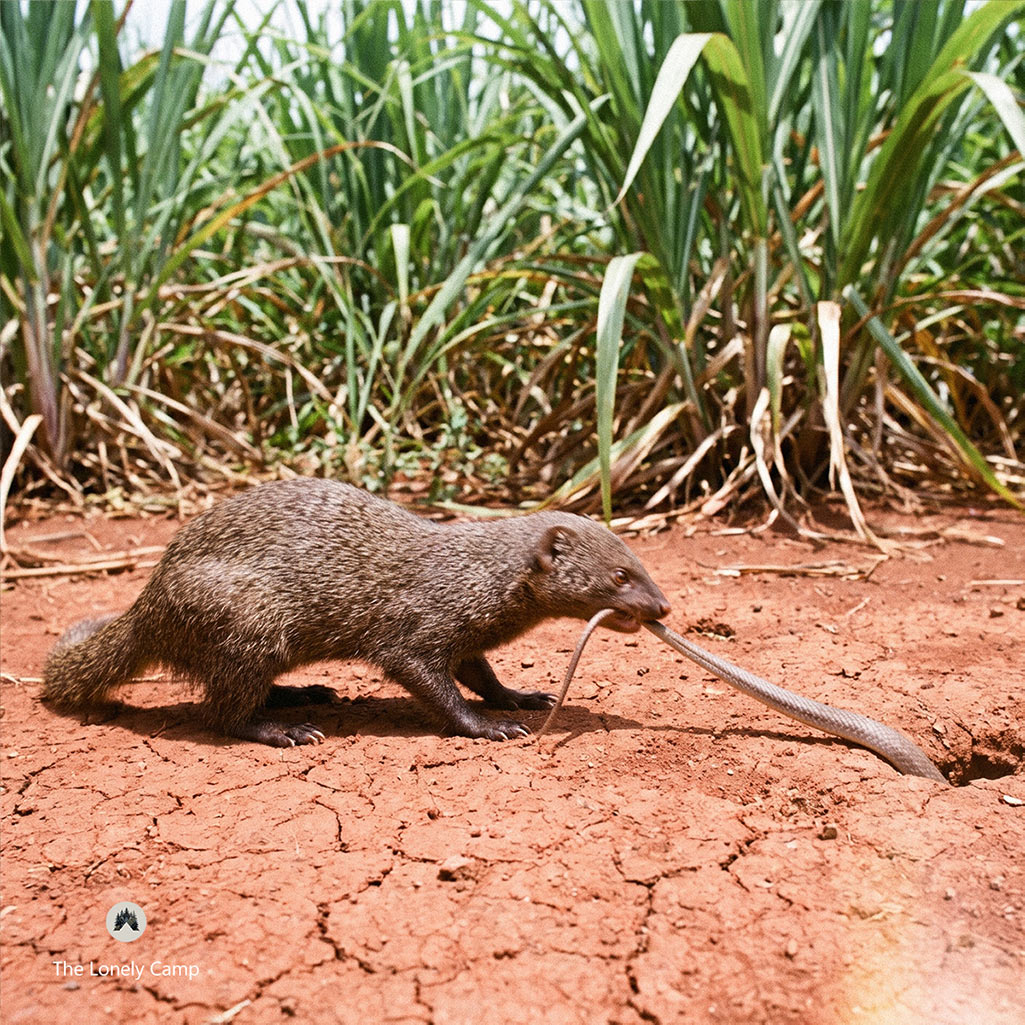
Image is for illustration purposes only
Source: T.S. Palmer, USDA Yearbook (1898) / Congressional Research Service / U.S. Fish and Wildlife Service / Barun et al., IUCN Island Invasives (2011) / Nellis et al., Wildlife Society Bulletin (1978) / Duluth News-Tribune / USDA National Wildlife Research Center
How Mongooses Became Banned From the U.S. Mainland