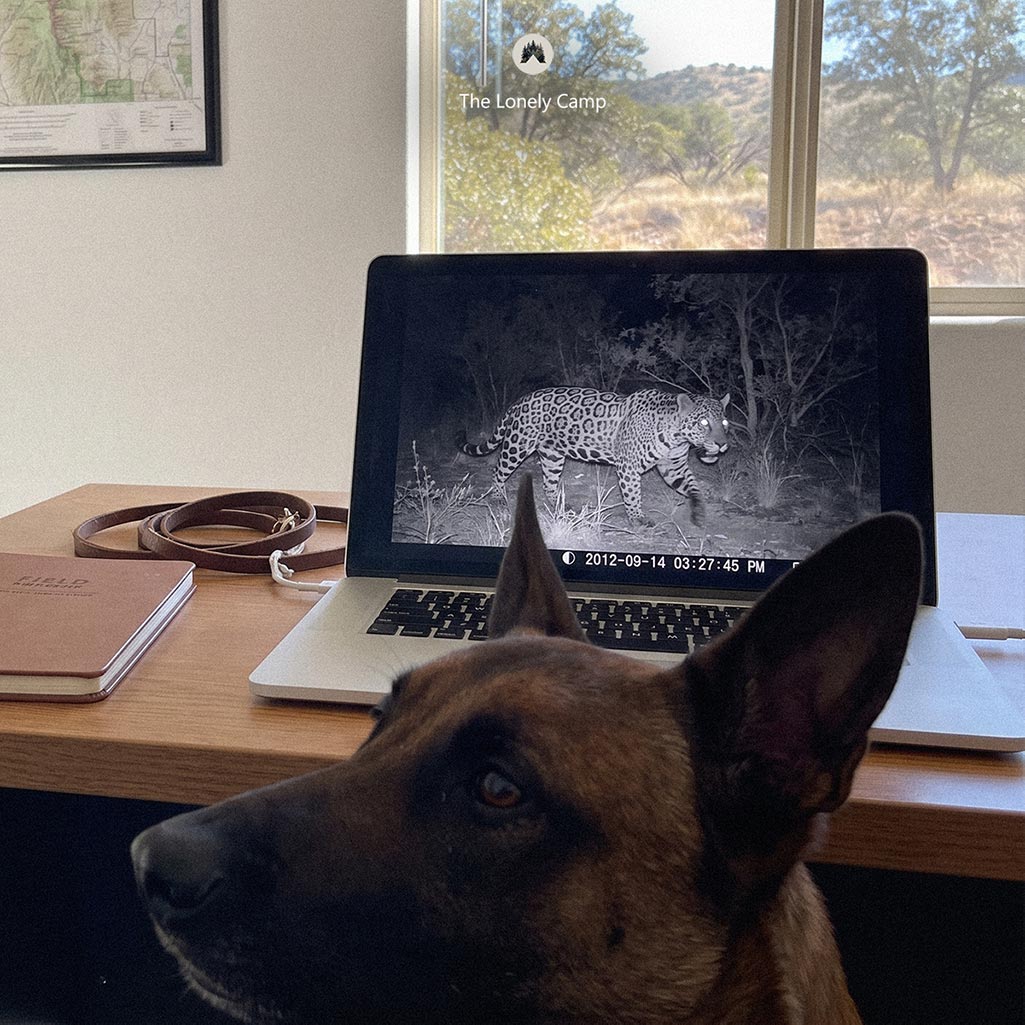
In 2012, a Belgian Malinois washed out of U.S. Border Patrol training because she froze around big trucks. She went on to locate the first genetically verified jaguar scat ever collected in the United States.
Her name was Mayke. Born in Germany, the 65-pound, chocolate-colored Malinois had been purchased and trained at considerable expense to inspect vehicles and search for contraband along the U.S.–Mexico border. Somewhere between her imported training and her Texas evaluation, however, she lost her nerve.
Loud noises and heavy highway traffic rattled her, and when walked around large transport trucks and semitrailers, she would simply shut down. "The problem was, she was afraid of big trucks," said Chris Bugbee, a carnivore biologist based in Arizona. "She would just freeze right up." Border authorities passed on her, and she was labeled unfit for service.
But Bugbee saw a second chance for the high-drive dog. In 2012, he took her in to work for Conservation CATalyst, a Tucson-based non-profit dedicated to studying and protecting wild cats in the Southwest. Bugbee did not need a dog to clear vehicles at highway checkpoints. He needed a dedicated partner to search for jaguar and ocelot droppings on foot in the rugged mountains of southern Arizona, where there were no roads, no sirens, and no trucks.
It was a daunting needle-in-a-haystack assignment. At the time, there was exactly one known wild jaguar roaming the entire United States, an adult male later named El Jefe. He patrolled a vast, 300-square-mile home range through the canyons, oak woodlands, and high grasslands of the Santa Rita Mountains south of Tucson, leaving almost no trace behind in the rugged backcountry.
Wildlife biologists rely on animal scat because it carries invaluable genetic information. From a single dried dropping, lab researchers can extract DNA to confirm the animal's species, verify its individual identity, determine its sex, and study its natural diet. But in a landscape already packed with native mountain lions, bobcats, and coyotes, finding the needle-sized traces of one elusive jaguar is almost impossible for human eyes. In contrast, a dog trained to pick out the unique scent can cover miles of uneven terrain and screen thousands of outdoor odors.
To teach her that exact scent before she ever stepped into the mountains, Bugbee got jaguar scat from a zoo and sealed it inside a short piece of PVC pipe drilled with small holes so she could smell the sample without touching it. Once she knew what she was looking for, she ignored everything else in the canyons. Out on the trail, Mayke stepped right over fresh mountain lion droppings without a second glance and chased black bears out of the way, saving her bark strictly for the jaguar. Over her time in the Santa Ritas, she tracked down 13 scat samples.
The partnership yielded historic results. In the remote Santa Ritas, Mayke successfully sniffed out some of the first genetically verified jaguar scats ever collected on U.S. soil. She also tracked down several of El Jefe's favorite resting and bedding spots, places the big cat frequented between hunts, which Bugbee estimated numbered at least 100 scattered across the rocky range.
In nearly four years of hiking the canyons together, neither Bugbee nor Mayke ever saw El Jefe face to face, though the jaguar was watching them.
Whenever the pair hiked back in to pull memory cards from a trail camera they had checked days earlier, the timestamps on the photos routinely showed El Jefe walking past the exact same lens just minutes after the biologist and his dog had left.
The cat had been shadowing them through the brush, a habit that made Bugbee break out in a cold sweat the first few times he saw the footage before he grew to appreciate the company. By the fall of 2015, the cat stopped showing up on the cameras altogether, and Mayke went months without barking once. After years of sharing the ridges with the dog, El Jefe had slipped out of the Santa Ritas and headed south toward Mexico.
He was last photographed in the Santa Rita Mountains in the fall of 2015. For six years nobody knew what had happened to him, and many assumed he was dead. Then in November 2021, trail cameras set up by a Mexican conservation group photographed a male jaguar in the mountains of central Sonora, about 120 miles south of the Santa Ritas. A researcher with the Northern Jaguar Project compared its spot pattern to the Arizona photos and confirmed it was him. He was at least 12 years old and in good condition, one of the oldest jaguars ever documented in Sonora.
There has been no confirmed sighting of him since.
Mayke was about 7 years old in 2016, the last year her work was reported publicly. No record of her retirement or her later years has ever been published.
Image is for illustration purposes only.
Source: Associated Press via Fox News (2016) / Phoenix New Times (2016) / Center for Biological Diversity / Conservation CATalyst / Smithsonian Magazine (2016).
Mayke the Malinois Found Jaguar Scat in Arizona