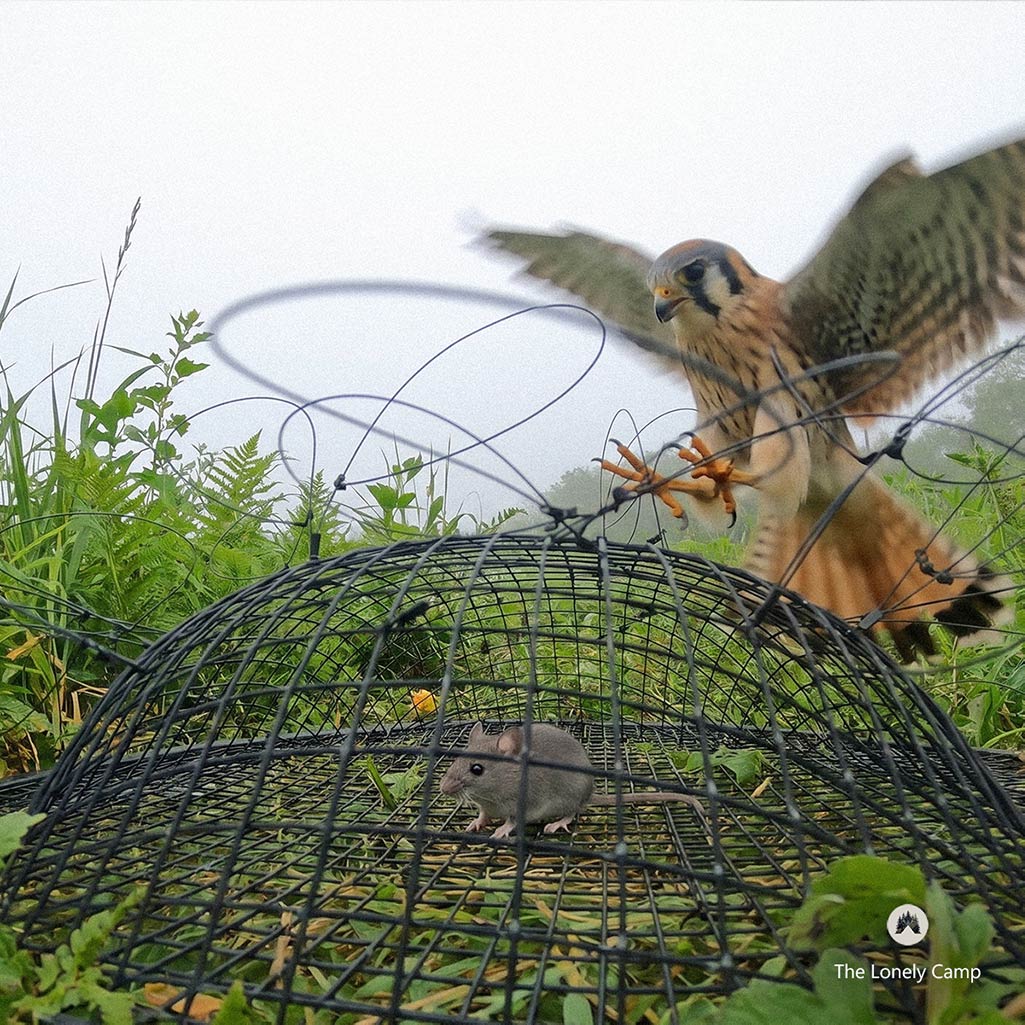
When a wildlife biologist needs to catch a live hawk or falcon from a roadside power line to put a band on its leg or a tracking transmitter on its back, the tool that comes out of the truck is a small wire dome covered in dozens of standing nylon slip-nooses. Inside the cage sits a live mouse, safe behind the mesh. When the raptor drops down from its perch and dances over the wire trying to reach the rodent, a toe slips through one of the upright loops, the noose pulls snug as the bird tries to fly off, and the weight of the cage holds it harmlessly on the ground until the researcher walks up.
The Raptor Research Foundation describes the device as one of the most successful traps ever used to catch birds of prey, noting that most North American raptor species have been captured on one.
Centuries before North American ornithology existed, falconers in East India wove the exact same trap out of split cane, rigging the frame with braided horsehair nooses and baiting the interior with small lure birds to catch wild hawks for hunting. British writer Hugh MacPherson documented the device in 1897 under the name the Shikra Trap, after the small Indian hawk it was built to catch. In a 1942 National Geographic article on Indian falconry, American naturalist Frank Craighead introduced its local name to Western readers: the bal-chatri, which translates roughly to "boy's umbrella."
In 1959, Daniel Berger and Helmut Mueller of the Cedar Grove Ornithological Station in Wisconsin modernized the ancient design for the journal Bird-Banding. Instead of split bamboo and horsehair, they built small cones and cylinders out of hardware cloth, spray-painted the wire dull black or gray to take the shine off, and tied dozens of clear monofilament fishing-line nooses across the roof.
They also modified the umbrella for the American highway. Because roadside raptors are used to ignoring passing traffic but will fly away the second a car stops and a human steps out, Berger and Mueller rigged their traps with a strip of lead around the bottom rim so the cage worked like a weighted toy that always landed right side up.
To set it, the biologists drove down country roads scanning the telephone wires. When they spotted a hunting bird, they slowed the car to about 10 miles per hour and tossed the baited cage straight out the window onto the opposite shoulder, letting the car block the bird's view of the drop. Then they drove 200 to 300 feet down the road, parked, and watched through binoculars.
For the American kestrel, North America's smallest falcon and the robin-sized hunter drivers pass on rural wires every day without noticing, the roadside drop was nearly irresistible.
Out of more than 400 hawks and owls across seven species that Berger and Mueller caught over two and a half years without a single bird dying, 376 were American kestrels. On January 7, 1955, driving the roads near Laredo, Texas, the pair dropped their trap for 25 kestrels in a single day and caught 22 of them. On September 4, 1956, at Owl Canyon, Colorado, they caught 12 out of 15 kestrels in just 70 minutes.
The bal-chatri does have limits. Large open-country falcons that strike flying birds in midair, such as peregrine falcons and gyrfalcons, almost never drop onto a ground cage. For the roadside hunters that watch the grass from fence posts and utility poles, however, the ancient Indian umbrella works so reliably that wildlife supply companies still sell the hardware-cloth cages to researchers today, unchanged since 1959.
Image is for illustration purposes only.
Source: Berger & Mueller (1959), Bird-Banding / Bloom et al. (2007), Raptor Research Foundation Techniques Manual / MacPherson (1897), History of Fowling / Craighead & Craighead (1942), National Geographic.
The Bal-Chatri Trap Caught 376 American Kestrels